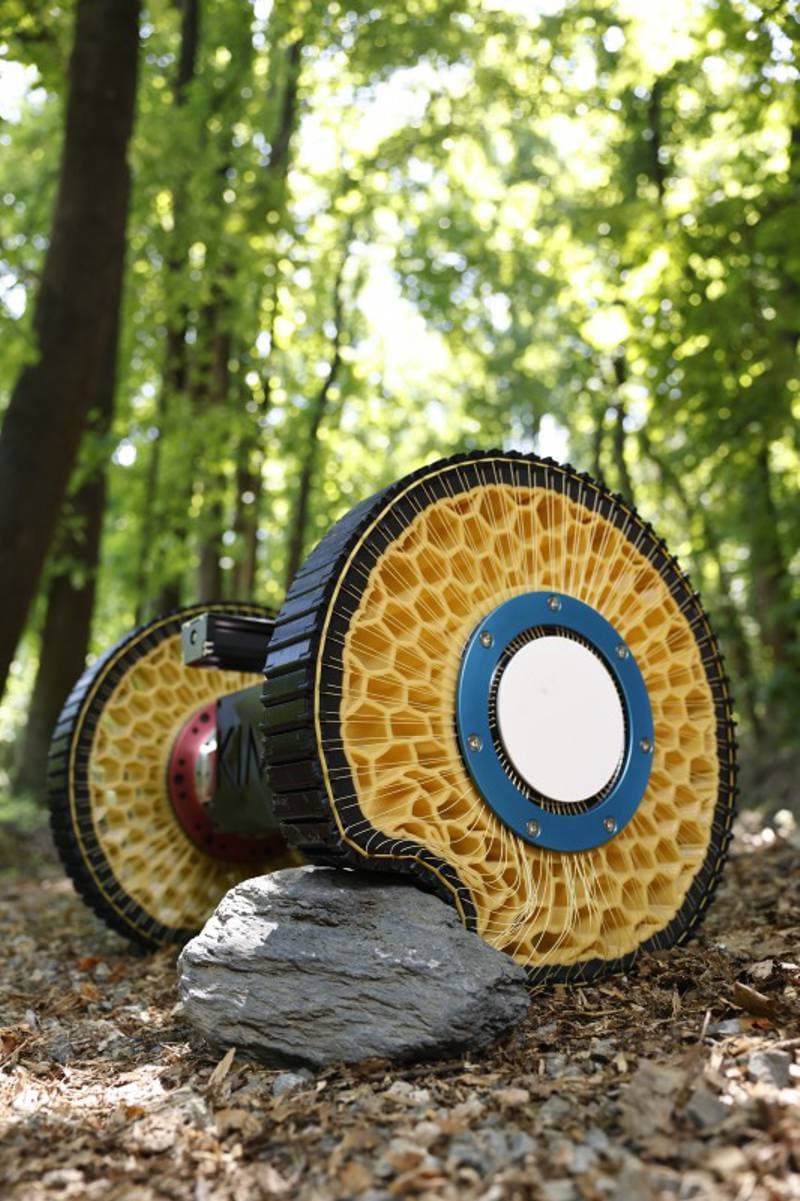
Researchers at the Korea Institute of Machinery and Materials (KIMM) have developed a novel wheel system that uses artificial intelligence to automatically adjust its stiffness in real-time based on the terrain it encounters. This represents a significant step forward in creating more adaptable and efficient mobile robots and vehicles.
Key Takeaways
- Researchers at KIMM created wheels that autonomously adjust their stiffness based on terrain.
- On smooth ground, they stay rigid for efficiency; on rough terrain, they soften and deform to conform to obstacles.
What the System Does

The core innovation is a wheel that can change its physical properties on the fly. When rolling on smooth, paved surfaces, the wheel remains rigid and perfectly circular. This traditional shape provides maximum efficiency and speed, minimizing rolling resistance and energy consumption.
However, when sensors detect an obstacle or rough terrain—like gravel, grass, or steps—the wheel's structure softens. It deforms to conform to the irregular surface, wrapping around obstacles rather than bouncing over them. This adaptive compliance improves traction, reduces vibration, and can prevent the vehicle from becoming stuck.
The AI and Mechanical Intelligence
While the source tweet does not detail the specific AI architecture, the system logically requires a closed-loop control system. It likely involves:
- Perception: Sensors (likely vision-based, LiDAR, and/or inertial measurement units) continuously scan the terrain ahead and monitor wheel interaction.
- Decision Engine: An AI model, potentially a lightweight neural network or a reinforcement learning policy, processes the sensor data. It classifies the terrain type and predicts the optimal wheel stiffness for the upcoming patch of ground.
- Actuation: A command is sent to the wheel's mechanism to alter its stiffness. This could be achieved through several advanced material technologies:
- Variable-Stiffness Structures: Using materials like shape-memory alloys or polymers that change rigidity with temperature or electrical current.
- Jamming Structures: Granular or layer jamming, where a membrane filled with particles or layers is vacuum-sealed to become rigid, then released to become soft.
- Pneumatic/Hydraulic Systems: Adjusting the pressure within a compliant tire or spoke structure.
The key is the real-time, autonomous transition between states, moving beyond pre-programmed settings to a responsive, intelligent system.
Potential Applications and Impact
This technology has immediate implications for several fields:
- All-Terrain Robotics: Search-and-rescue robots, planetary rovers, and agricultural robots that must traverse unpredictable environments would see dramatic improvements in stability and energy efficiency.
- Personal Mobility & Automotive: Wheelchairs or future vehicles could provide a consistently smooth ride by automatically softening wheels over potholes or curbs, then re-stiffening on highways.
- Logistics and Warehousing: Autonomous mobile robots (AMRs) in factories and warehouses often operate in mixed environments (smooth concrete to transition mats). Adaptive wheels could optimize performance across all zones without manual intervention.
The primary benefit is the unification of two traditionally opposed wheel characteristics: efficiency (hard wheels) and obstacle traversal (soft, compliant wheels). This system aims to provide both, contextually.
Limitations and Challenges

The initial research, while promising, faces hurdles before commercialization:
- Durability: Repeated deformation cycles could cause material fatigue and failure. The long-term reliability of the stiffness-changing mechanism is untested.
- Response Speed: The system must react and physically reconfigure faster than the vehicle's traversal speed to be effective.
- Power Consumption: The energy cost of continuously sensing, computing, and actuating stiffness changes must be outweighed by the gains in traversal efficiency.
- Cost and Complexity: Integrating sensors, AI processors, and advanced actuators into each wheel significantly increases complexity and cost over passive systems.
gentic.news Analysis
This work from KIMM fits squarely into the growing trend of Embodied AI and physical intelligence, where machine learning moves beyond pure software to optimize the interaction of hardware with the real world. It's less about a large language model and more about a compact, real-time control system—a form of edge AI for mechanical adaptation.
This development connects to several related threads we've covered. It's a hardware-focused counterpart to the locomotion policies developed by teams like Boston Dynamics (which we analyzed in "How Reinforcement Learning Taught Atlas to Parkour") and Google DeepMind's work on robotic locomotion. While those projects primarily use AI to optimize a robot's gait and movements, KIMM's project uses AI to optimize the tool itself—the wheel. It's a different point of intervention in the mobility stack.
Furthermore, it aligns with material science innovations in 4D printing and programmable matter, where objects are designed to change shape or property in response to stimuli. The KIMM wheel can be seen as a targeted, application-specific instance of this broader concept. The major differentiator here is the use of AI for the decision-making trigger, moving beyond simple environmental reactivity (like heat or moisture) to intelligent, predictive adaptation.
For practitioners in robotics, the takeaway is to watch this intersection of adaptive materials and lightweight, real-time AI. The winning solutions for robust real-world robotics won't come from software or hardware alone, but from deeply co-designed systems where each informs the other. KIMM's wheel is a compelling prototype in that direction.
Frequently Asked Questions
How do the wheels "know" what terrain is coming?
The system almost certainly uses a combination of forward-facing sensors, like cameras or LiDAR, to scan the terrain ahead of the vehicle. An onboard AI model processes this data in real-time to classify the surface (e.g., smooth pavement, gravel, stairs) and predict the required wheel properties before contact is made.
What material allows the wheel to change stiffness?
The research announcement doesn't specify the exact technology, but several viable options exist. These include granular jamming (where a vacuum locks particles together), layer jamming, pneumatic bladders with variable pressure, or smart materials like shape-memory alloys that change rigidity with an electrical current.
Is this technology available for cars or bicycles yet?
No, this is currently a research prototype from a national institute. Significant engineering challenges around durability, cost, response speed, and power consumption need to be solved before it could be integrated into consumer vehicles. It may first appear in specialized robotics or military applications.
What is KIMM?
The Korea Institute of Machinery and Materials (KIMM) is a prominent government-funded research institute in South Korea focused on developing core technologies in mechanical engineering, materials science, and manufacturing systems. It is a major driver of industrial R&D in the country.