Paris-based AI research lab Kyutai Labs has announced the release of OVIE, a novel view generation model. The key technical claim is that OVIE was trained entirely on single images, eliminating the dependency on curated, multi-view datasets that have traditionally been a bottleneck for 3D reconstruction and novel view synthesis (NVS) tasks.
Key Takeaways

- French AI lab Kyutai Labs released OVIE, a novel view generation model trained only on single images, bypassing the need for costly multi-view datasets.
- This could democratize 3D content creation from 2D photos.
What Happened
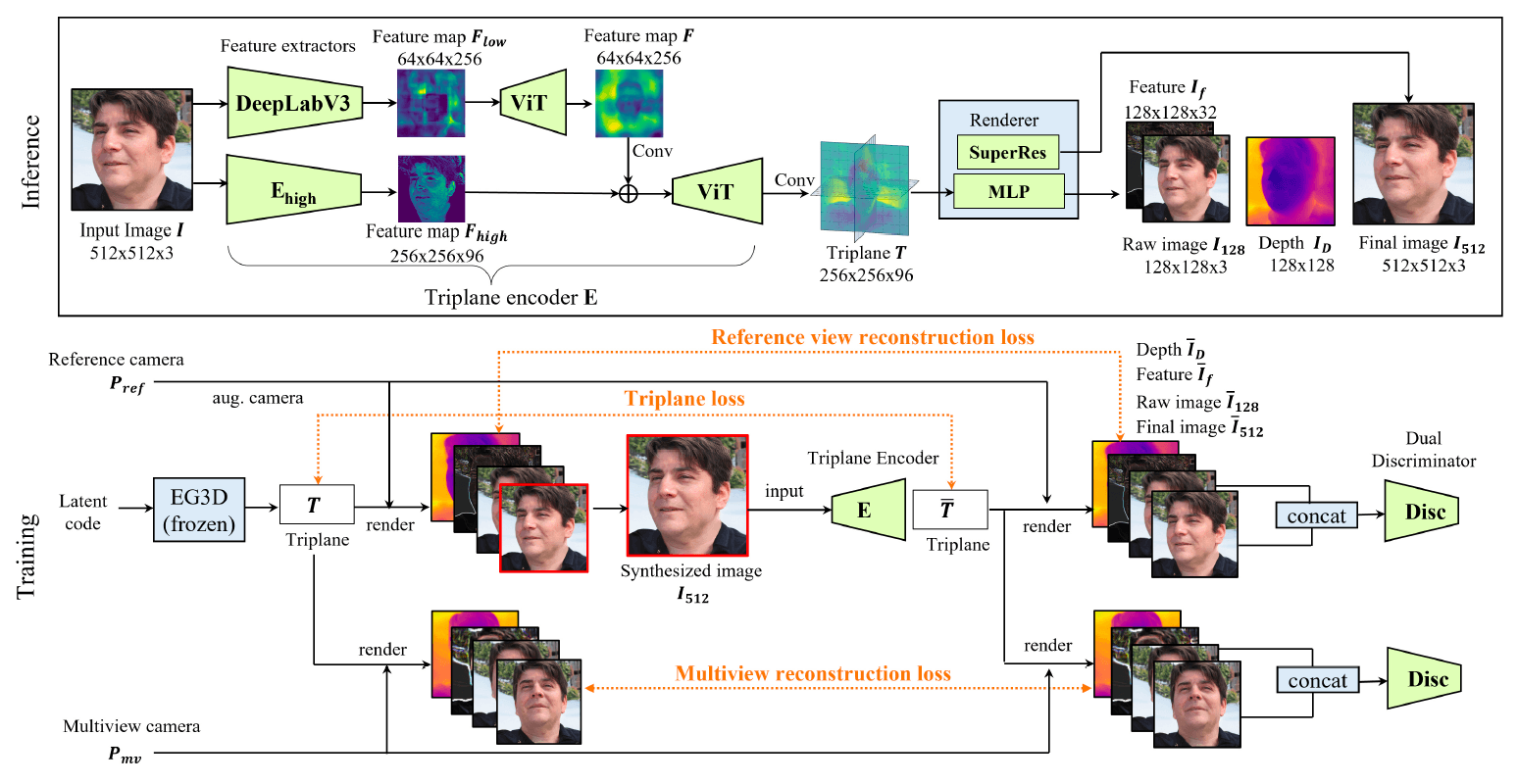
Kyutai Labs, a non-profit AI research organization founded in late 2023, announced the release of OVIE via social media. The model is designed to generate consistent, novel views of a scene or object from a single input image. The core innovation highlighted is its training methodology, which reportedly uses only single-image datasets, a significant departure from standard practice.
Technical Context
Novel View Synthesis (NVS) is the task of generating new, photorealistic viewpoints of a scene from a limited set of input images. State-of-the-art models like NVIDIA's Instant NGP, Google's Mip-NeRF 360, and more recent diffusion-based approaches like Zero-1-to-3 typically require multi-view images for training or fine-tuning. These datasets are expensive and labor-intensive to create, often involving controlled camera rigs or synthetic 3D engines.
OVIE's approach—if validated—represents a move toward data-efficient 3D understanding. By learning view-consistent representations from single images scattered across the internet, the model could theoretically generalize to a wider variety of objects and scenes seen in the wild, not just those captured in multi-view studios.
What We Know (And Don't Know)

The announcement is brief. Key technical details are not provided in the initial post, including:
- Model Architecture: Is it diffusion-based, NeRF-based, or a hybrid?
- Training Data: What specific single-image dataset was used (e.g., LAION, a custom crawl)?
- Benchmarks: Quantitative results on standard NVS datasets like DTU, NeRF Synthetic, or CO3D.
- Inference Speed & Cost: Is it suitable for real-time applications?
- License & Availability: Is the model weights, code, or a demo being released?
Until Kyutai publishes a paper or technical report, OVIE's performance claims remain unverified. The promise lies in the potential paradigm shift in training data, not yet in proven benchmark supremacy.
Why It Matters
If OVIE delivers on its premise, it could lower the barrier to high-quality 3D content creation. Applications span from generating 3D assets for games and VR from product photos, creating immersive previews for e-commerce, to aiding in robotics and simulation. Removing the multi-view data requirement makes the technology more accessible to developers and companies without specialized 3D capture setups.
gentic.news Analysis
Kyutai Labs' release of OVIE fits a clear pattern of the lab prioritizing open, foundational AI research since its high-profile launch with a €300 million budget in November 2023. As a European non-profit counterweight to large corporate labs, Kyutai's strategy appears focused on publishing ambitious models—like their previous large language model Moshi with real-time voice capabilities—that challenge data or scaling assumptions.
This move directly intersects with a major trend in 3D AI: the quest for data efficiency. Just as large language models moved from curated task data to web-scale text, 3D vision models are pushing to learn from the vast corpus of 2D images online. OVIE aligns with other recent research pushing this boundary, such as MVDream and SyncDreamer, which also aim for better 3D consistency from 2D priors. However, those often still rely on multi-view data during training. OVIE's claim of entirely single-image training is a more aggressive step.
The competitive landscape here is intense. Google's Lumiere (for video) and OpenAI's Sora have raised expectations for generative models that understand 3D space and physics implicitly. A robust single-image-to-3D model would be a complementary and highly valuable capability. Kyutai is not alone; Stability AI has also been active in 3D generation with TripoSR. OVIE represents the European open-source research community's bid for relevance in this critical subfield.
The critical question for practitioners is whether OVIE's quality matches its methodological elegance. Single-image 3D is an ill-posed problem—there are infinite possible 3D geometries consistent with one 2D view. The model must learn incredibly strong priors from its training data. We'll be watching for the technical details to see how OVIE navigates this challenge and whether its outputs are sufficiently consistent for professional use-cases.
Frequently Asked Questions
What is novel view synthesis?
Novel view synthesis (NVS) is a computer vision task where a model generates new, photorealistic images of a scene from different camera viewpoints, given one or a few input images. It's a core technology for creating 3D experiences from 2D photos.
Why is training on single images significant?
Historically, high-quality NVS models required training on datasets where each object or scene is photographed from dozens or hundreds of known angles. Creating these datasets is expensive and limits the variety of scenes a model can learn from. Training on single images, scraped from the internet, is far more scalable and could allow models to understand a much wider world.
How does OVIE compare to other 3D AI models?
While details are scarce, OVIE's defining proposed difference is its training data. Models like Zero-1-to-3 are fine-tuned on multi-view data. Instant NGP/NeRF models require multiple views of a specific scene to reconstruct it. OVIE claims to generate novel views of new scenes using only a single image, based on priors learned from a vast collection of unrelated single images.
When will OVIE be available to use?
The initial announcement did not specify a release date for code, weights, or a demo. Typically, Kyutai Labs has released details and access shortly after announcements (as with Moshi). Developers should monitor Kyutai's official channels (GitHub, Hugging Face) for updates.