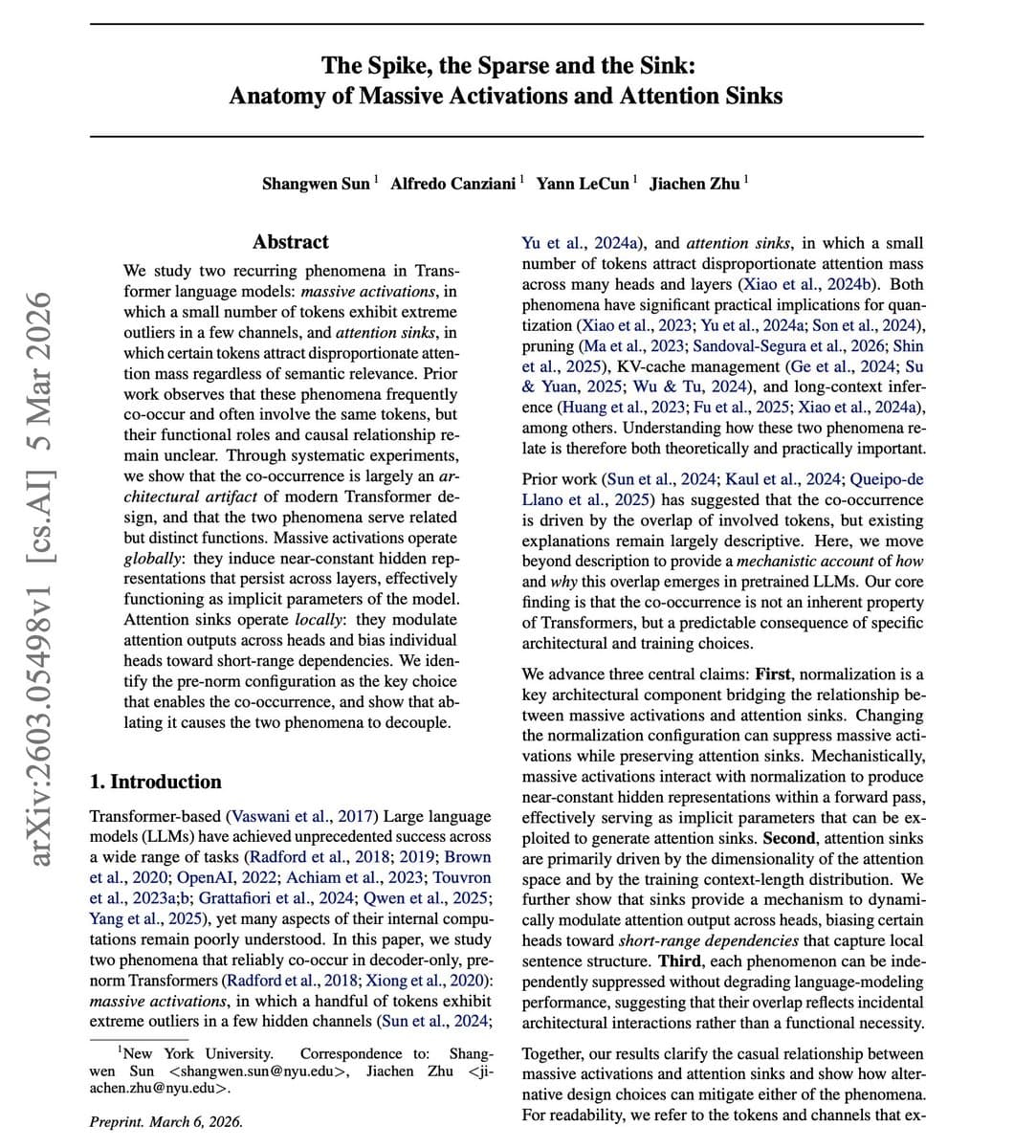
A new research paper from Yann LeCun and collaborators at New York University has identified two systematic phenomena in Transformer language models that significantly impact their efficiency and performance. The study reveals that "massive activations" and "attention sinks"—previously observed but poorly understood behaviors—are actually architectural artifacts rather than fundamental properties of language modeling.
The Twin Phenomena: Massive Activations and Attention Sinks
The research team discovered that Transformer models consistently exhibit two related but distinct patterns. Massive activations occur when a small number of tokens (typically less than 1% of the sequence) display extreme outlier values in their activation vectors—values that can be orders of magnitude larger than typical activations. These outliers aren't random noise but systematic features that appear consistently across different models and training runs.
Simultaneously, attention sinks emerge when certain tokens attract disproportionate attention from the model regardless of their semantic relevance to the task at hand. These tokens become focal points for the attention mechanism, drawing computational resources away from more meaningful parts of the input sequence.
Architectural Roots: The Pre-Norm Design Culprit
Perhaps the most significant finding is that these phenomena are not inherent to language modeling but rather artifacts of specific architectural choices. The researchers traced both massive activations and attention sinks to the pre-norm design commonly used in modern Transformer implementations.
In pre-normalization architectures, layer normalization is applied before rather than after the attention and feed-forward operations. This design choice, while improving training stability, creates conditions where certain tokens can accumulate extreme activation values through successive layers. The research demonstrates that these artifacts emerge consistently across different models when using pre-norm designs, suggesting they're baked into the architecture rather than learned from data.
Functional Roles: Implicit Parameters and Local Modulation
Despite being artifacts, these phenomena serve functional roles within the models. The massive activations effectively function as implicit model parameters, storing information that influences the model's behavior across different contexts. These extreme values aren't merely noise—they encode meaningful information that the model uses during inference.
Attention sinks, meanwhile, act as local output modulators, influencing how the model processes nearby tokens regardless of their semantic content. This creates a form of positional bias where certain token positions receive disproportionate computational attention, potentially distorting the model's focus away from semantically important content.
Practical Implications for AI Engineering
The practical consequences of these findings are substantial for anyone working on AI deployment and optimization. As noted in the original coverage, these phenomena "directly impact quantization, pruning, and KV-cache management"—three critical areas for efficient AI inference.
Quantization efforts are particularly affected because massive activations create extreme value ranges that standard quantization techniques struggle to handle efficiently. The presence of these outliers forces quantization schemes to allocate disproportionate precision to rare extreme values or suffer significant accuracy loss when clipping them.
Pruning strategies must account for attention sinks, as removing connections involving these sink tokens could unexpectedly degrade performance. The research suggests that current pruning approaches might be eliminating connections that, while appearing unimportant statistically, actually serve crucial architectural functions.
KV-cache management for long-context inference is complicated by these phenomena, as attention sinks create unpredictable memory access patterns that undermine standard optimization approaches. Efficient management of the key-value cache requires understanding these systematic attention patterns.
Toward Better Transformer Architectures
The research points toward potential architectural improvements that could mitigate these artifacts. By understanding their root causes in pre-norm designs, researchers can develop alternative normalization schemes or architectural modifications that maintain training stability while avoiding these efficiency-degrading artifacts.
This work represents a shift from treating these phenomena as unavoidable quirks of large language models to understanding them as correctable architectural flaws. The paper suggests that future Transformer variants could be designed to explicitly avoid creating these artifacts, potentially leading to more efficient models that don't require complex workarounds for quantization and pruning.
Broader Context in AI Efficiency Research
This research arrives at a critical moment in AI development, as the field grapples with the escalating computational costs of ever-larger models. Efficiency has moved from a secondary concern to a primary research focus, with billions of dollars invested in making AI models faster, smaller, and less resource-intensive.
The NYU team's work connects to broader efforts to understand and optimize Transformer architectures, which have dominated AI since their introduction in 2017. By revealing systematic architectural artifacts rather than learned behaviors, this research provides a more solid foundation for optimization efforts that have often proceeded through trial and error.
Future Research Directions
The paper opens several promising research avenues. First, it suggests that architectural analysis should precede optimization efforts—understanding why models behave certain ways can lead to more principled optimization approaches. Second, it raises questions about what other architectural artifacts might exist in modern AI models, waiting to be discovered and addressed.
Finally, the research implies that some current optimization techniques might be addressing symptoms rather than causes. By fixing the architectural roots of these efficiency problems, researchers might achieve better results than by developing increasingly complex workarounds for their manifestations.
Source: Research from Yann LeCun and collaborators at NYU, as highlighted by Omar Sarhan (@omarsar0).