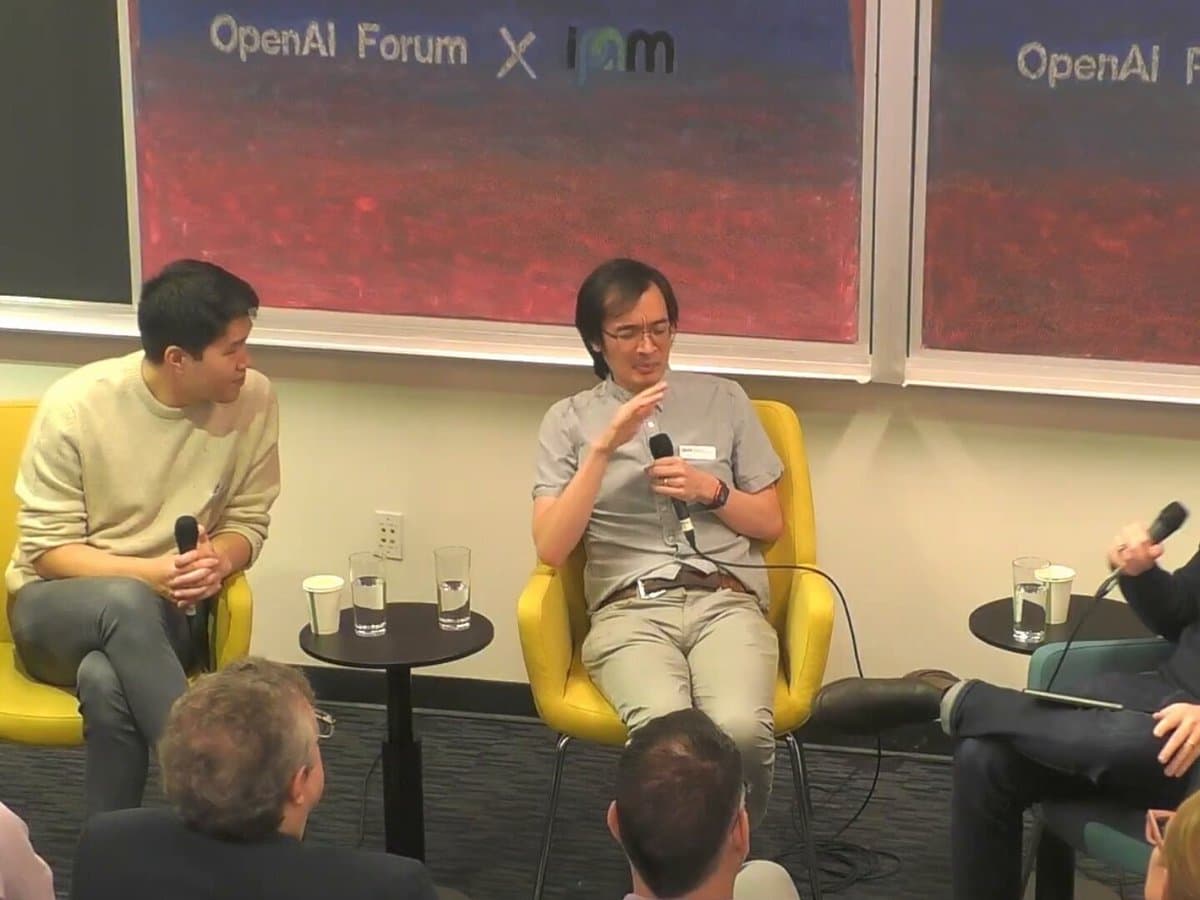
In a significant development at the intersection of artificial intelligence and pure mathematics, Terence Tao, a Fields Medalist and one of the world's most renowned mathematicians, has stated that AI systems are already capable of producing unique mathematical proofs. However, he highlights a critical bottleneck: the process of evaluating and verifying these AI-generated proofs is currently very slow. This revelation, shared via social media and linked commentary, signals a pivotal shift in how mathematical research might be conducted.
The Statement from a Mathematical Luminary
Terence Tao, a professor at UCLA and recipient of the prestigious Fields Medal in 2006, is widely regarded for his profound contributions across multiple areas of mathematics, including harmonic analysis, partial differential equations, and number theory. His perspective on technological progress in mathematics carries considerable weight. His observation points to a new phase in computational mathematics, where AI is no longer just a tool for calculation or brute-force search but an agent capable of novel logical construction.
According to the shared statement, Tao's key insight is: "In order to take full advantage of AI, we need to create challenges that are easily verifiable." This suggests that the current limitation isn't necessarily the AI's ability to generate proofs, but the mathematical community's ability to assess them efficiently. The proof, once generated, must be translated into a form that human mathematicians or reliable automated verifiers can confirm as correct without prohibitive time and effort.
The Context: AI's Growing Role in Mathematics
This development did not occur in a vacuum. Over the past few years, AI has made several high-profile incursions into pure mathematics. In 2021, DeepMind's AI system AlphaGeometry demonstrated the ability to solve complex geometry problems at the level of International Mathematical Olympiad gold medalists. Furthermore, machine learning tools have been used to propose conjectures and identify potential patterns in areas like knot theory and representation theory.
What makes Tao's comment particularly noteworthy is the emphasis on "unique proofs." This implies AI is not merely rediscovering known proofs through alternative search paths but is potentially creating novel logical arguments that human mathematicians might not have previously considered. This moves AI from an assistant role into a potential collaborator in the creative process of theorem-proving.
The Verification Bottleneck: A New Kind of Mathematical Problem
The central challenge Tao identifies—slow verification—is a profound one. Mathematics is built on a foundation of rigorous, peer-reviewed proof. A proof that cannot be efficiently verified is of limited use to the community, regardless of its ingenuity.
This bottleneck exists for several reasons:
- Complexity: AI-generated proofs, especially those leveraging novel strategies, might be exceptionally long, intricate, or rely on subtle steps that are difficult for human intuition to parse quickly.
- Formalization Gap: Many AI systems may output proofs in a format that is not directly compatible with existing formal verification software (like Lean or Coq). Translating and formalizing these proofs is a non-trivial task.
- Trust: The mathematical community operates on trust built through transparent logic. An opaque AI-generated proof, even if formally verified by another program, may face sociological hurdles to acceptance unless the verification process itself is universally trusted.
Tao's proposed solution is to design "challenges that are easily verifiable." This could mean mathematicians start formulating problems or conjectures with verification explicitly in mind—perhaps structuring them so that a proof's correctness can be checked by a streamlined, automated process. It calls for a new discipline that sits between pure mathematics, computer science, and AI research: the design of verifiable mathematical problem spaces.
Implications for the Future of Mathematical Research
If AI can reliably generate unique, verifiable proofs, the implications for mathematical discovery are staggering.
- Accelerated Discovery: Fields plagued by notoriously difficult proofs, such as some problems in number theory or combinatorics, might see rapid progress if AI can explore vast proof spaces beyond human endurance.
- New Avenues for Exploration: Mathematicians could offload the exploration of routine but complex logical branches to AI, freeing human intellect to focus on high-level strategy, conjecture formulation, and interpreting results.
- Democratization and Accessibility: Tools that generate and verify proofs could lower barriers to entry, allowing more researchers to engage with deep problems by providing AI-assisted scaffolding.
- A Shift in Skill Sets: The role of the mathematician may evolve. Skills in "AI collaboration," formal verification, and problem-framing for machines could become as important as deep intuition in a specific sub-field.
However, this future also raises questions. Does a proof discovered by AI carry the same intellectual meaning? How does credit get assigned? Tao's commentary implicitly urges the community to start grappling with these meta-problems now, by designing the verifiable frameworks that will govern this new partnership.
The Path Forward: Collaboration, Not Replacement
Terence Tao's observation is ultimately a call for proactive adaptation. He is not warning of AI replacing mathematicians but pointing out that to harness its potential, the field must evolve its practices. The goal is to create a synergistic workflow where human creativity in problem-setting and interpretation is amplified by AI's ability to navigate immense combinatorial and logical landscapes.
The next frontier may well be the development of shared standards and languages—a kind of "verifiable mathematical API"—that allow AI systems and human mathematicians to communicate proofs efficiently. The work of projects like the Lean Theorem Prover community, where Tao himself is an active participant in formalizing modern mathematics, is a direct step toward this verifiable future.
In conclusion, Terence Tao has highlighted a quiet but revolutionary transition: AI has crossed the threshold from a computational tool to a generative partner in mathematical proof. The task ahead is no longer just to build smarter AI, but to build a smarter mathematical ecosystem that can understand, verify, and benefit from what AI creates. The race is not only for discovery but for comprehension.