What Happened
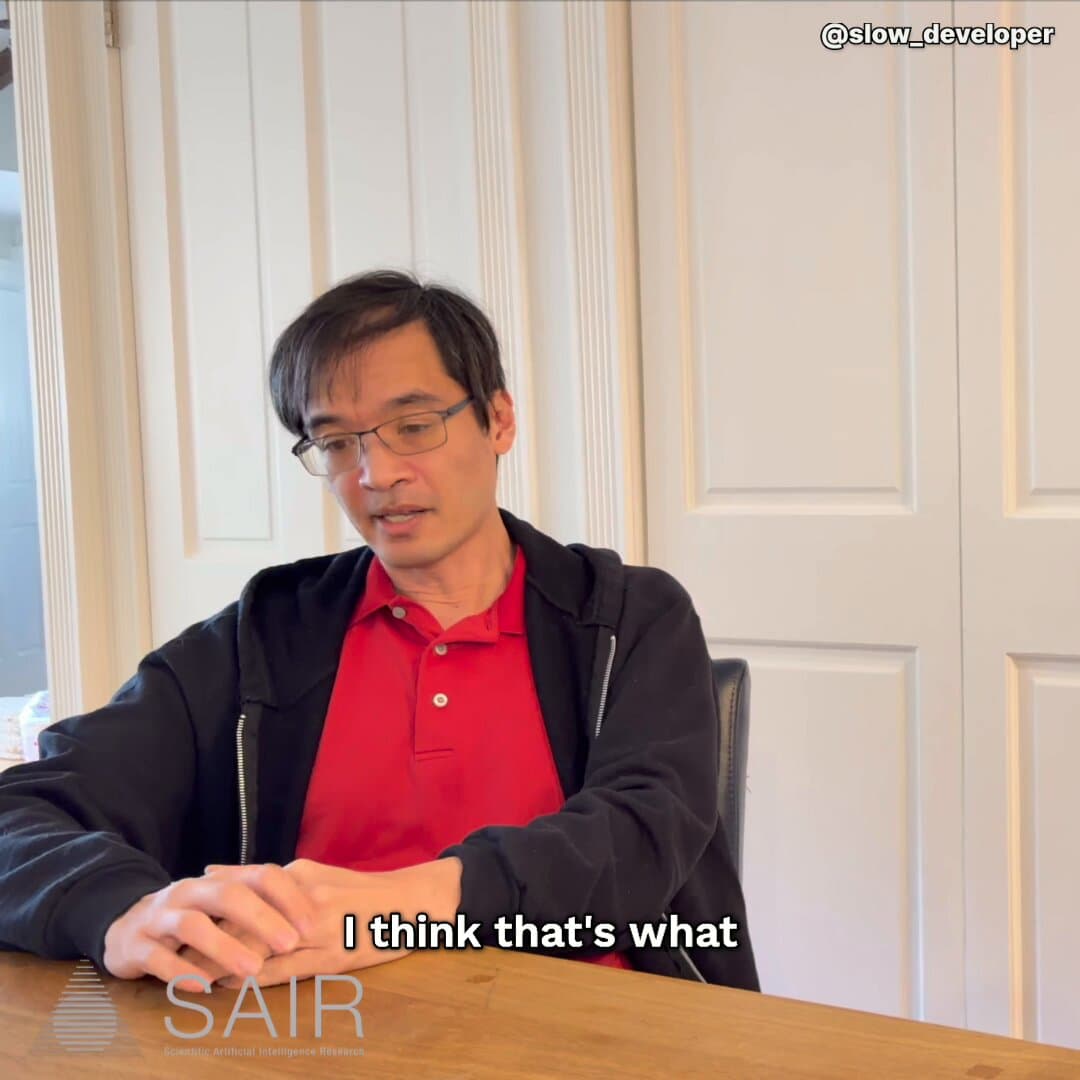
Fields Medalist and mathematician Terence Tao commented on the evolving role of artificial intelligence in mathematical research during a discussion highlighted on social media. His observation draws a clear distinction between current AI capabilities and human mathematical intuition.
Tao stated that AI systems can currently "synthesize a million papers and brute-test ideas"—a reference to the ability of large language models and symbolic AI to process vast corpora of existing mathematical literature and computationally test conjectures or explore solution spaces through sheer scale. In contrast, he noted that human mathematicians "can check just 5 examples and see the pattern," highlighting the human capacity for abstract pattern recognition, intuition, and conceptual leaps from limited data.
The Context
Terence Tao is a professor of mathematics at UCLA and one of the most influential mathematicians of his generation, having made significant contributions to harmonic analysis, partial differential equations, and number theory. His perspective carries weight in discussions about AI's role in formal reasoning domains.
The comment appears in the context of increasing experimentation with AI-assisted mathematical discovery. Systems like DeepMind's AlphaGeometry, Google's FunSearch, and OpenAI's GPT-4 have demonstrated capabilities in solving Olympiad-level problems and generating novel mathematical constructions. However, these systems typically operate through search-heavy, sample-intensive methods rather than human-like conceptual reasoning.
The Trajectory Tao Foresees
Tao suggests this efficiency gap "will narrow" as AI systems progress toward three capabilities:
- World Models: Systems that develop internal representations of mathematical structures and their relationships, moving beyond pattern matching in text to modeling mathematical "worlds."
- Causal Reasoning: The ability to infer cause-and-effect relationships within mathematical systems, not just correlations in data.
- Active Learning: Systems that can strategically choose what to learn or test next, rather than processing all available information indiscriminately.
This progression would represent a shift from current brute-force approaches toward more efficient, human-like mathematical reasoning.