Key Takeaways
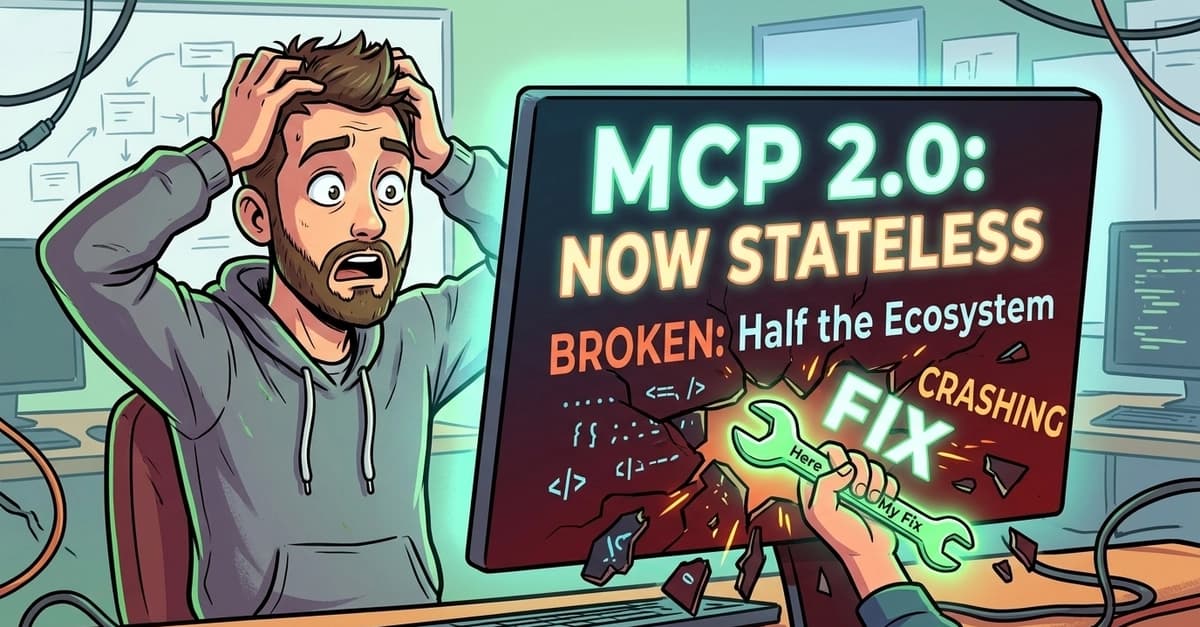
- MCP 2.0's stateless overhaul breaks local servers via removed
mcp.server.fastmcp. - Pin
mcp<2.0.0and audit session-tied state before migrating.
What Changed — MCP's Stateless Overhaul
The Model Context Protocol's 2026-07-28 specification update removed stateful transports, persistent sessions, and the initialization handshake. Every request now carries a self-describing _meta context payload over clean HTTP.
For enterprise teams running thousands of stateless agents on Cloudflare Workers or AWS Lambda, this is a gift. For local tool developers running custom Python servers, it's a breaking change that will crash your environment silently.
The Hidden Dependency Trap
Bumping mcp to >=2.0.0 and running pip install will crash your environment.
The break is surgical: MCP Python SDK 2.0.0 removed mcp.server.fastmcp entirely and renamed FastMCP to MCPServer under mcp.server.mcpserver. If your code still does from mcp.server.fastmcp import FastMCP, the process dies at import. Your client sees a transport error, not a traceback, because the subprocess exits before speaking the protocol.
The trap: fastmcp 3.x protects itself with mcp<2.0,>=1.24.0. But any other dependency declaring mcp>=1.0.0 with no upper bound resolves straight through the breaking major. A warm pip cache keeps working. Your next fresh clone or container build breaks.
What It Means For You
Before you touch anything, run pip show mcp to find which package actually owns your mcp resolution. If it's a transitive dependency, editing your requirements.txt changes nothing — you need to pin at the source or use a constraint file.

The SDK's migration guide is blunt: "If your package depends on mcp, keep a <2 upper bound until you've migrated."
Try It Now — Pin Your Environment
Here's the exact pins the author of zerikai_memory used in v1.0.0-beta.15:
# --- CORE (MCP & SERVER LOCKS) ---
fastmcp>=3.2.4,<4.0.0
mcp>=1.27.0,<2.0.0
uvicorn>=0.30.0,<1.0.0
starlette>=0.35.0,<1.0.0
Commit this, test in CI, verify it resolves cleanly before any other change.
Why Your Existing Clients Still Work
MCP includes Protocol Era Negotiation. When Cursor, Windsurf, or Claude Desktop connects to a server running mcp 1.27.0, the client probes for v2 features (server/discover RPC, stateless _meta primitives). If absent, it drops into backward-compatible session-based handshake mode. No runtime errors.
This is a safety valve, not a permanent solution. The negotiation layer won't be maintained indefinitely. Build your upgrade roadmap now.
Isolating State Before You Migrate
The stateless model moves execution boundaries. Session lifecycle hooks are gone. Every request arrives cold. Your persistence layer must be keyed using application-level identifiers inside the request payload — completely independent of transport lifecycle.
Before migrating:
- Audit session dependencies — search for
Mcp-Session-Id, session lifecycle hooks, or stateful handshake callbacks. - Map persistence boundaries — document every read/write against local state; confirm each is keyed by application logic, not transport handles.
- Pin your environment — add upper bounds to
mcp,fastmcp,uvicorn,starlettebefore anything else.
Anti-Patterns to Avoid
- Unpinned dependencies —
mcp>=1.27.0without an upper bound crashes on the next automated update. - Migrating framework and persistence simultaneously — doubles your blast radius; sequence them separately.
- Trusting beta compatibility claims —
fastmcp 4.0.0b1requiresmcp>=2.0.0,<3.0.0. It's a beta. Treat it as one. - Ignoring the confirmation flow redesign — v2 replaces bidirectional sampling with multi-round-trip
InputRequiredResultloops. Unsolicited client pushes need redesigning.
Source: dev.to