Key Takeaways
- Anthropic released MCP in November 2024; OpenAI and Google DeepMind adopted it by March 2025.
- The protocol standardizes AI agent-data connectivity, reducing integration complexity.
What Happened
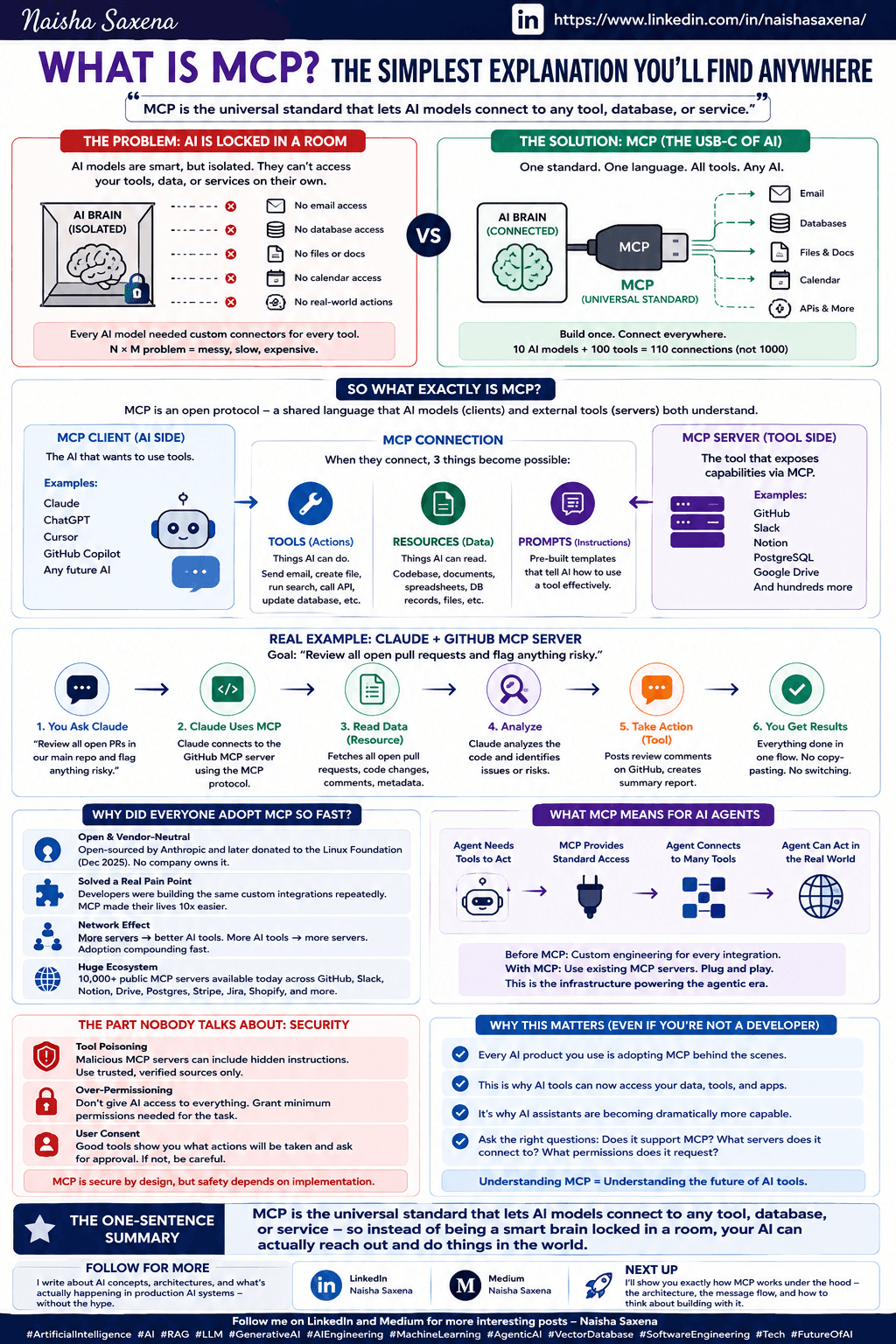
In November 2024, Anthropic released the Model Context Protocol (MCP), an open standard and open-source framework designed to standardize how AI agents connect to external data sources, tools, and APIs. By March 2025, OpenAI had adopted MCP for its agentic workflows, and Google DeepMind followed suit shortly after. In less than a year, MCP has become the de facto standard for agent-data connectivity across the industry.
Technical Details
MCP defines a common interface between AI agents and the data sources they need to access. Instead of requiring custom integrations for each database, API, or tool, agents can use MCP to interact with any compliant server. The protocol handles authentication, data formatting, and error handling, allowing developers to focus on agent logic rather than plumbing.
MCP servers expose resources (data), tools (actions), and prompts (templates). Agents discover available servers dynamically and negotiate capabilities. This design mirrors the client-server architecture of HTTP, but optimized for AI agent workflows.
Retail & Luxury Implications
For luxury and retail enterprises, MCP offers a pragmatic path to unifying fragmented data landscapes. A single MCP server can expose CRM data, inventory systems, customer purchase history, and real-time supply chain feeds to any MCP-compatible agent. This eliminates the need for bespoke integrations for each AI application.
Consider a luxury brand using an AI agent for personalized clienteling. With MCP, the agent can access customer profiles from Salesforce, product catalogs from the e-commerce platform, and past purchase data from the ERP—all through a single protocol. The brand can swap agent providers (Anthropic, OpenAI, Google) without rewriting integrations.
However, the technology is still maturing. A developer reported 93 production outages from MCP server versioning issues in June 2026, per our knowledge graph. Enterprises should expect operational challenges as the ecosystem stabilizes.
Business Impact
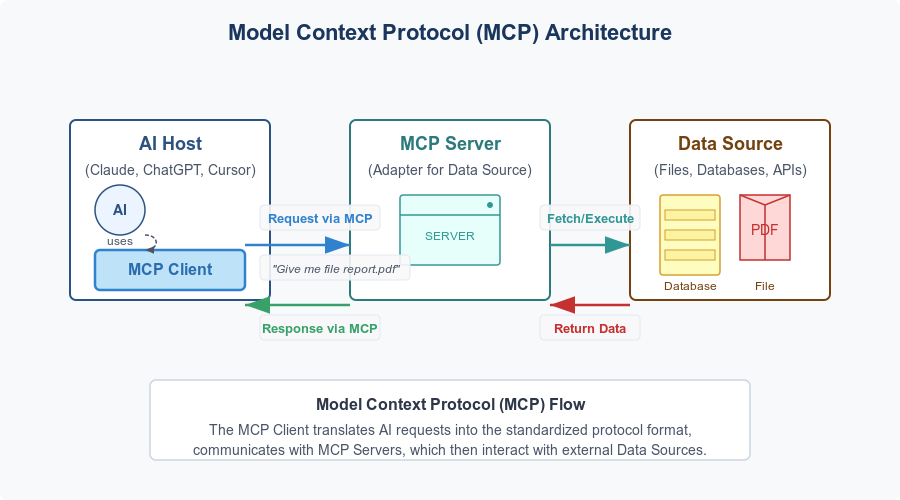
MCP's standardization reduces the cost and time to deploy AI agents. For a typical luxury retailer, integrating an agent with 5-10 data sources currently requires 2-4 months of custom development. With MCP, that timeline could shrink to 2-4 weeks, assuming MCP-compatible servers exist for those systems.
The protocol also reduces vendor lock-in. Brands can choose the best agent for each use case—Anthropic for safety-critical tasks, OpenAI for creative generation, Google for multimodal—without re-integrating data sources.
Implementation Approach
Adopting MCP requires:
- MCP Server Deployment: Expose existing data sources (CRM, ERP, CMS) via MCP servers. This can be done using Anthropic's open-source reference implementation or third-party tools.
- Agent Configuration: Configure agents (Claude, GPT, Gemini) to discover and use MCP servers. Most major agents now support MCP natively.
- Governance Layer: Add authentication, rate limiting, and audit logging to MCP servers. MCP supports OAuth 2.0 and API keys.
- Monitoring: Track server health and version compatibility. The June 2026 outages highlight the need for robust monitoring.
Governance & Risk Assessment
MCP is open-source and protocol-level, reducing vendor lock-in. However, enterprises must manage:
- Versioning: MCP servers and agents must be version-compatible. Plan for coordinated upgrades.
- Security: MCP servers expose sensitive data. Implement strong authentication and network segmentation.
- Reliability: The ecosystem is young. Expect outages and breaking changes.
- Maturity: MCP is production-ready but not battle-tested at scale. Pilot with non-critical workflows first.
gentic.news Analysis
MCP is a rare example of industry-wide standardization happening quickly—and voluntarily. Anthropic released it as an open standard, and competitors adopted it because the alternative (fragmented protocols) was worse for everyone. This mirrors the web's adoption of HTTP: a simple standard that unlocked exponential growth.
For retail and luxury, the practical impact is real but incremental. MCP won't transform AI overnight, but it removes a major friction point. The brands that invest in MCP-compatible data infrastructure now will have a head start when agentic AI becomes mainstream in 2027-2028.
The knowledge graph shows MCP already has 13,000+ servers in the ecosystem (per our June 2026 coverage). That's a strong signal that the protocol has critical mass. The key risk is versioning instability—the 93-outage incident is a warning that enterprises need robust change management.
Bottom line: MCP is a pragmatic standard that reduces integration friction. It doesn't solve every problem, but it solves an important one. Retailers should adopt it for new agent deployments and plan to migrate existing integrations over the next 12-18 months.
Source: pub.towardsai.net
[Updated 29 Jun via devto_mcp]
Laravel shipped a built-in MCP client on June 9, 2026, allowing its AI agents to connect out to any MCP server (GitHub, Notion, Nightwatch) without custom integration code [per dev.to]. The feature consists of two packages: laravel/mcp (v0.8.1) handles client-server handshake and tool calls, while laravel/ai (v0.8.1) lets agents consume those tools via the existing tools() array. This reverses the usual pattern—agents reach out instead of tools reaching in—and requires PHP 8.3+.
[Updated 29 Jun via gn_mcp_protocol]
Stibo Systems launched an MCP server on June 18, 2026, enabling AI agents to query enterprise master data (product, customer, supplier) directly from its STEP platform without custom coding [per PR Newswire]. The server supports real-time retrieval of entity hierarchies, attributes, and relationships, and is designed for retail and manufacturing use cases where consistent master data is critical. This marks the first major enterprise master data management (MDM) vendor to ship a native MCP interface, signaling that the protocol is moving beyond developer tools into core enterprise infrastructure.
[Updated 30 Jun via gn_mcp_protocol]
Stibo Systems' MCP server now supports multi-domain master data—products, customers, suppliers, locations—in a single interface, per the June 18 PR Newswire release. This enables luxury retailers to query unified golden records across domains via natural language, with built-in role-based access control and audit trails for compliance. The server integrates with any MCP-compatible agent (Claude, GPT, Gemini) without additional middleware, reducing deployment time from months to weeks for enterprises managing complex hierarchies [per PR Newswire].