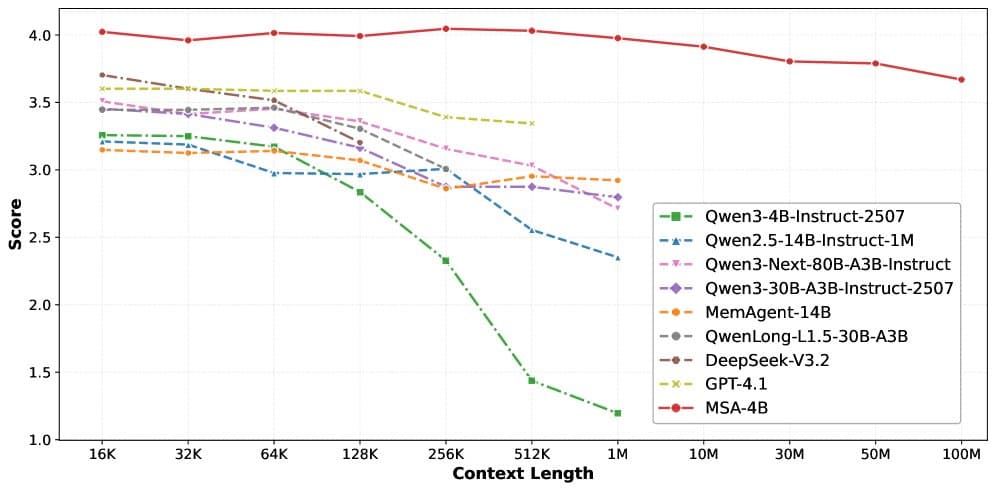
A new research development, highlighted by the X account @HuggingPapers, claims a significant breakthrough in transformer context length. The method, called Memory Sparse Attention (MSA), is reported to achieve an "unprecedented 100M token context" while operating with near-linear computational complexity.
The core achievement is scaling the effective context window far beyond the standard 128K or 1M tokens seen in recent frontier models like GPT-4o or Claude 3.5 Sonnet. According to the source, the architecture maintains 94% accuracy at 1M tokens and is said to outperform both Retrieval-Augmented Generation (RAG) systems and existing frontier models on long-context tasks.
What the Architecture Achieves
The primary claim is that MSA breaks the 100-million-token barrier. In transformer models, the standard self-attention mechanism scales quadratically (O(n²)) with sequence length, making processing such long contexts computationally infeasible. MSA is described as achieving this scale with near-linear complexity, a critical requirement for practical deployment.
The reported 94% accuracy at 1M tokens suggests the method maintains high performance even as context scales by orders of magnitude, addressing a common problem where model accuracy degrades significantly in the middle of very long contexts.
How It Works: Technical Mechanism
The source mentions two key technical components:
- End-to-End Sparse Attention: Instead of computing attention between every token pair, MSA uses a sparse pattern, likely attending only to a subset of tokens deemed relevant. This is what enables the near-linear scaling.
- Document-Wise RoPE: Rotary Position Embedding (RoPE) is a common technique for encoding token position. A "document-wise" application suggests the position encoding is structured or reset at document boundaries within the massive context, which could help maintain positional coherence over extreme lengths.
The combination allows the model to process the entire 100M-token sequence as a single context, unlike RAG systems which retrieve and process smaller, relevant chunks separately.
Claimed Advantages Over Existing Methods
The source states MSA "outperforms RAG systems and frontier models." This implies direct comparisons on long-context tasks where:
- vs. RAG: MSA's end-to-end processing of the full context may capture cross-document relationships and nuances that a retrieval step might miss.
- vs. Frontier Models (e.g., Claude, GPT-4): These models typically have context windows in the hundreds of thousands to low millions of tokens. MSA's 100M context is two orders of magnitude larger, potentially enabling entirely new applications involving massive corpora.
What We Don't Know Yet
The source is a brief social media post, not a full paper. Critical details are missing:
- Specific Benchmarks: What tasks was the 94% accuracy measured on? What metrics were used to claim it outperforms RAG and frontier models?
- Model Size & Training: Is this a new model architecture, or a method applied to an existing model? What was the training compute and dataset?
- Inference Cost: While complexity is near-linear, the absolute computational and memory cost for a 100M-token forward pass is not specified.
- Authorship & Publication: The research team and a link to a preprint or paper are not provided.
gentic.news Analysis
If validated, MSA represents a direct attack on one of the most fundamental limitations of the transformer architecture. The quadratic attention bottleneck has been the primary constraint on context length, leading the industry to adopt hybrid solutions like RAG. A method that achieves near-linear scaling to 100M tokens could significantly alter the architectural roadmap.
The mention of outperforming RAG is particularly provocative. RAG has become the de facto standard for enterprise applications requiring knowledge from large document sets, precisely because of the context window limitation. If an end-to-end model can handle 100M tokens effectively, it challenges the need for a separate retrieval step and its associated complexity—latency, chunking strategies, and potential loss of context. This aligns with a broader trend we've noted of models increasingly absorbing tasks that were previously handled by multi-component systems, a theme in our coverage of Agentic AI frameworks.
However, extreme caution is warranted. The field has seen many claims of "linear attention" or "infinite context" that, upon closer inspection, involved significant trade-offs in accuracy or were highly task-specific. The claim of 94% accuracy at 1M tokens needs rigorous verification on standardized long-context benchmarks like L-Eval or the Needle-in-a-Haystack test. Furthermore, the practical utility of a 100M-token context is untested. Most human-readable tasks don't require that scale, and managing positional understanding across such distances remains a profound challenge.
This development sits squarely within the intense competition for long-context supremacy. It follows Google's release of Gemini 1.5 Pro with a 1M token context in February 2024 and Anthropic's Claude 3 pushing to 200K tokens. If MSA's results hold, it could leapfrog these efforts by a factor of 100, potentially resetting the competitive landscape. The next critical step is for the full research to be published, allowing for independent evaluation of its benchmarks and complexity claims.
Frequently Asked Questions
What is Memory Sparse Attention (MSA)?
MSA is a proposed transformer attention architecture that uses end-to-end sparse attention and document-wise Rotary Position Embeddings (RoPE) to achieve context lengths of up to 100 million tokens with near-linear computational complexity, a significant leap from current models.
How does MSA compare to Retrieval-Augmented Generation (RAG)?
The source claims MSA outperforms RAG systems. Unlike RAG, which retrieves relevant document chunks for a query, MSA processes the entire massive context (up to 100M tokens) end-to-end. This could potentially capture more complex cross-document relationships but may come with higher computational costs for inference.
Has the MSA research paper been published?
As of this reporting, the details were shared via a social media post from @HuggingPapers. A full research paper with complete methodology, benchmarks, and authorship has not yet been linked or published, so the claims await independent verification.
What does "94% accuracy at 1M tokens" mean?
This is a key performance claim from the source, but the specific benchmark or task used to measure this accuracy is not specified. It suggests the model maintains high performance on a given task even when its context window is filled with 1 million tokens, addressing the common issue of performance degradation in long contexts.