What Happened
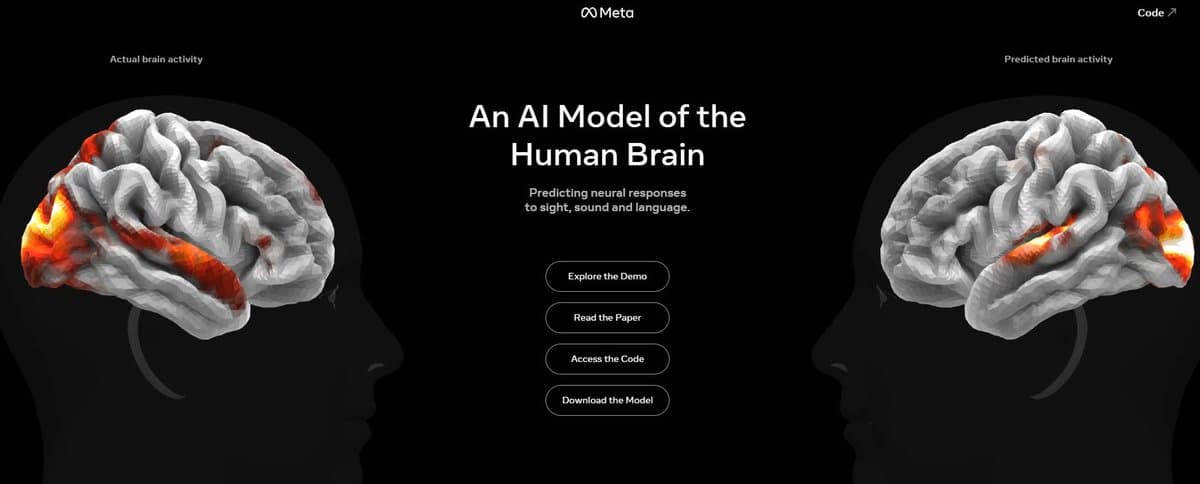
Meta AI has released TRIBE v2, a foundation model designed to predict how the human brain responds to sensory and linguistic stimuli. According to the announcement, the model was trained on a substantial neuroimaging dataset comprising over 500 hours of functional magnetic resonance imaging (fMRI) data collected from more than 700 individuals.
The core claim is that TRIBE v2 can generalize to predict the brain activity of a new, unseen individual without requiring any model retraining or fine-tuning on that person's data. Furthermore, the announcement states that the model's predictions are "more accurate than a real brain scan," suggesting its outputs may have higher fidelity or signal-to-noise ratio than a single empirical measurement.
Context
This development sits at the intersection of artificial intelligence and cognitive neuroscience, a field often referred to as "AI neuroscience" or "computational cognitive neuroscience." The goal is to build computational models that can simulate or predict neural activity, which can serve as both a tool for scientific discovery and a potential component for brain-computer interfaces.
Training a model on pooled fMRI data from hundreds of subjects is a significant technical undertaking. fMRI measures blood-oxygen-level-dependent (BOLD) signals, which are indirect, noisy proxies for neural activity. Creating a model that can generalize across individuals requires solving challenges related to anatomical differences between brains, variability in functional organization, and the inherent noise in the data.
The claim that a model's prediction can surpass the accuracy of a real scan is provocative. It likely refers to the model's ability to generate a denoised or "idealized" estimate of the brain's response by learning the common patterns across a massive dataset, effectively averaging out the noise present in any single scan.
Technical Implications & Open Questions
The announcement, made via social media, lacks the detailed methodology, benchmarks, and ablation studies typically found in a peer-reviewed publication. Key technical details are absent:
- Architecture: The model architecture is unspecified. Is it a transformer adapted for spatiotemporal brain data? A convolutional network? A hybrid model?
- Training Regime: Beyond the scale of the dataset (500+ hours, 700+ subjects), the precise training objectives, loss functions, and preprocessing pipelines are unknown.
- Accuracy Metric: The claim of outperforming a real scan needs a defined metric. Is it measured by correlation with held-out scans? By performance on a downstream task like stimulus identification from brain activity? The nature of "accuracy" in this context is crucial.
- Modality Specificity: The model handles "sight, sound, and language." It is unclear if it is a single unified model or a collection of specialized sub-models, and how it integrates these different input modalities.
For AI engineers and ML researchers, the interesting challenges here involve building foundation models for high-dimensional, noisy, time-series data that must align across diverse biological substrates (different human brains). Success in this domain could inform techniques for other cross-subject or cross-system generalization problems.
gentic.news Analysis
Meta's release of TRIBE v2 represents a continued and significant investment by Big Tech into foundational AI research for neuroscience. This follows a clear pattern of activity from Meta's AI research division, which has previously released influential work at this intersection, such as the Image Reconstruction from fMRI models we covered last year. That research demonstrated the ability to decode and reconstruct perceived images from brain activity, a complementary direction to TRIBE v2's forward-prediction task.
This development also aligns with a broader, competitive trend. Google DeepMind has its long-standing neuroscience team, and startups like Neuralink (though focused on invasive methods) are pushing the boundaries of brain-machine interfaces. Meta's approach, leveraging non-invasive fMRI and large-scale AI, stakes out a distinct position focused on understanding general brain function rather than direct clinical intervention.
The claim of surpassing real scan accuracy, if rigorously validated, would be a major milestone. It suggests the model has learned a sufficiently robust generative model of brain activity that it can correct for measurement noise. This has immediate implications for basic neuroscience research, where trial averaging is standard practice to overcome low signal-to-noise ratios. A reliable predictive model could reduce the number of experimental trials or subjects needed for studies.
However, the lack of an accompanying preprint or paper means the community cannot yet evaluate the claims. The history of AI-neuroscience includes instances of impressive demos that later face scrutiny regarding their generalizability and real-world utility. The next critical step will be independent replication and benchmarking by third-party research groups. If TRIBE v2's capabilities hold up, it could rapidly become a standard tool in computational cognitive neuroscience labs and accelerate the pace of discovery in human brain mapping.
Frequently Asked Questions
What is TRIBE v2?
TRIBE v2 is a foundation model from Meta AI that predicts how a person's brain will respond to visual, auditory, and linguistic stimuli. It was trained on a large dataset of fMRI scans from over 700 people.
How is TRIBE v2's prediction "more accurate than a real brain scan"?
This claim likely means the model's output has a higher signal-to-noise ratio than a single empirical fMRI scan. By learning common patterns across hundreds of individuals, the model can generate a denoised, idealized prediction of brain activity, effectively averaging out the random noise inherent in any one physical measurement.
What could TRIBE v2 be used for?
Potential applications include basic neuroscience research (e.g., testing hypotheses about brain function with simulated responses), improving the design of brain-computer interfaces, and potentially aiding in the diagnosis of neurological disorders by comparing a patient's scan to a model's "healthy" baseline prediction. It is primarily a research tool, not a clinical product.
Has the TRIBE v2 research been published?
As of this announcement via social media, there is no accompanying peer-reviewed paper or detailed technical report from Meta. The claims are therefore preliminary and await full scientific evaluation and replication by the broader research community.