Microsoft and NVIDIA have announced a partnership to develop and deploy artificial intelligence tools aimed at accelerating the development and operation of nuclear energy facilities. The collaboration, framed as a response to the urgent need for "always-on, carbon-free power," seeks to apply AI across the entire nuclear lifecycle—from permitting and design to construction and operations.
The initiative is a direct response to what the companies describe as a "delivery bottleneck" in the nuclear industry. Despite nuclear energy's potential as a carbon-free backbone for digital expansion and reindustrialization, complex regulatory processes, lengthy design phases, and operational challenges have historically slowed deployment.
What the Partnership Aims to Build
The collaboration focuses on three primary application areas for AI:
Generative AI for Regulatory Automation: The partnership will develop tools to automate the creation and management of the massive volumes of documentation required for nuclear permitting and compliance. This targets one of the most time-consuming and costly aspects of nuclear project development.
Digital Twins for Plant Simulation: NVIDIA's expertise in simulation and high-performance computing will be leveraged to create detailed digital twins of nuclear plants. These virtual models will allow for extensive design testing, safety analysis, and operational optimization before physical construction begins.
Real-Time Data Integration Systems: The companies plan to build AI-driven platforms that unify data streams from engineering, permitting, and operations. The goal is to create a single source of truth that can improve decision-making, predictive maintenance, and overall plant efficiency.
Technical Approach and Known Capabilities
While the announcement does not detail specific model architectures or software products, the technical approach logically draws from each company's established public cloud and AI portfolios.
- Microsoft's Role: Likely involves providing the Azure cloud infrastructure, integration with its Azure OpenAI Service for generative document processing, and its industrial metaverse/digital twin platform, Azure Digital Twins.
- NVIDIA's Role: Centers on its Omniverse platform for building and connecting 3D digital twins, its CUDA and AI software stacks for simulation, and potentially its DGX systems or access via NGC for training specialized models.
The core premise is that AI can compress timelines by parallelizing and automating tasks that are currently sequential and manual, particularly in the regulatory and design phases.
The Stated Motivation: Energy as the Ultimate Bottleneck
The partnership is explicitly motivated by a macro-level concern: that energy supply, not computing power, will become the primary constraint on technological and industrial growth. The announcement states, "Even before computing, energy will be the biggest bottleneck, and everyone is aware of that by now."
This framing positions nuclear energy—as a dense, reliable, carbon-free source—as non-negotiable infrastructure for the AI-driven future both companies are betting on. The application of AI to build that infrastructure faster creates a self-reinforcing cycle: use AI to accelerate the deployment of the power needed to run more AI.
gentic.news Analysis
This partnership is a significant, concrete step in the growing convergence of the AI and energy sectors, a trend we highlighted in our analysis of Terra Praxis's repowering coal plants initiative. It moves beyond theoretical discussions of AI for science and into the gritty, paperwork-intensive realm of industrial regulation and project delivery—where time and cost overruns are the norm.
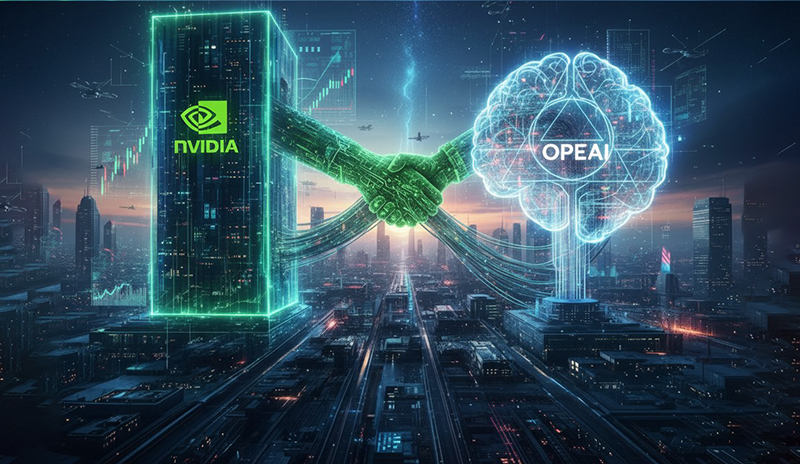
The collaboration is a strategic alignment of complementary giants. Microsoft, through its $10 billion investment in OpenAI and its cloud dominance, brings enterprise-scale AI services and cloud orchestration. NVIDIA, whose H100 and Blackwell GPUs are the engines of the AI boom, brings unparalleled simulation and high-performance computing capabilities. This isn't a startup experiment; it's two foundational players applying their core industrial stacks to a critical problem.
The focus on permitting and regulatory automation is particularly astute. While digital twins for design are increasingly common in aerospace and automotive, the nuclear industry's unique regulatory burden represents a high-value, under-automated target. Success here could provide a blueprint for other heavily regulated industries like pharmaceuticals or aviation.
However, the announcement lacks critical specifics: benchmark metrics for time/cost reduction, details on model training data (especially for safety-critical regulatory text), or a named pilot project. The real test will be whether these tools can navigate the specific, stringent requirements of bodies like the U.S. Nuclear Regulatory Commission, not just general document automation. As we've seen with AI in medicine and law, domain-specific validation is everything.
Frequently Asked Questions
What are Microsoft and NVIDIA actually building for nuclear energy?
They are building a suite of AI-driven tools focused on three areas: 1) Generative AI to automate the creation and management of regulatory paperwork and permits, 2) Digital twin simulation platforms to model and test nuclear plant designs virtually before construction, and 3) Real-time data systems to unify information from engineering, operations, and compliance for better decision-making.
Why is the nuclear energy industry considered to be in a "delivery bottleneck"?
The nuclear industry faces exceptionally long project timelines (often over a decade) and high costs, driven largely by complex, multi-year regulatory review processes, bespoke plant designs, and stringent safety requirements. This slow pace is at odds with the urgent demand for large-scale, carbon-free power to support digital infrastructure and industrial growth, creating a bottleneck between energy demand and deployment.
How can AI help speed up nuclear plant development?
AI can help by automating time-intensive manual tasks, such as drafting and reviewing thousands of pages of compliance documents. Simulation via digital twins allows engineers to test countless design and safety scenarios in software far faster than with physical models. AI-powered data platforms can also streamline coordination between different teams (design, regulation, construction) and optimize plant operations for efficiency and predictive maintenance.
Is there a specific project or pilot where these tools will be used first?
The initial announcement does not name a specific utility partner, power company, or greenfield project as the first pilot. The development appears to be in the early stages, focused on building the general toolset. The effectiveness of the partnership will be measured by its ability to attract and deploy these tools with an actual nuclear developer or operator in the future.