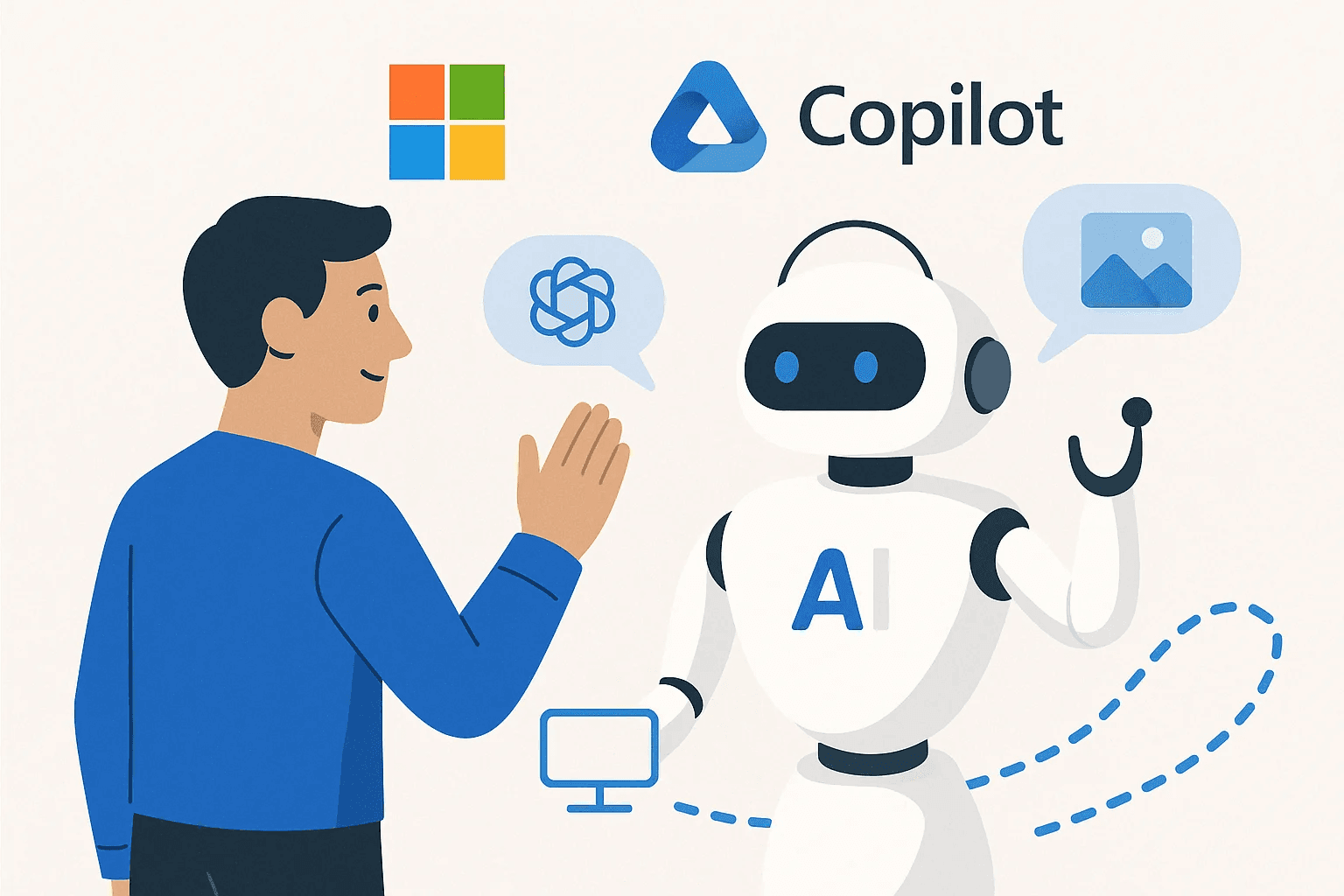
Microsoft has announced a significant expansion of its Copilot platform, introducing AI agents capable of autonomously performing complex, multi-step business tasks. These agents, positioned as "virtual employees," move beyond the reactive assistance of current Copilots to proactively handle workflows like monitoring email inboxes and automating business processes.
What's New: From Assistant to Autonomous Agent
The core announcement is the evolution of Microsoft Copilot from a tool that assists with user-initiated tasks to an agent that can operate independently. Businesses and developers can now create these agents using Copilot Studio through natural language instructions, defining their goals and parameters without extensive coding.
Key capabilities include:
- Autonomous Task Execution: Agents can perform defined workflows without constant human prompting.
- Complex, Multi-Step Workflows: Moving beyond single-command responses to handle sequences of actions across applications.
- Proactive Monitoring: Example use cases include watching specific email inboxes for certain types of messages and triggering appropriate responses or workflows.
Microsoft frames this as the next evolution of productivity software, where AI transitions from being an integrated assistant within applications (like Word or Excel) to an independent actor that manages routine operational tasks.
Technical Details & Platform
The creation and management hub for these agents is Copilot Studio, Microsoft's low-code development environment for customizing and extending Copilot. This suggests the agents will integrate with the existing Microsoft 365 ecosystem—Outlook, Teams, SharePoint, Power Platform—and likely connect to external systems via APIs.
While the announcement blog post does not specify underlying model details, pricing, or availability timelines, the focus is on the shift in capability: defining an agent's role and letting it run persistently to achieve a goal, rather than invoking a Copilot session for each discrete task.
How It Compares: The Agent Landscape
This move places Microsoft in direct competition with other platforms developing "AI agent" frameworks. Unlike OpenAI's GPTs or Anthropic's Claude Projects, which are often constrained to a chat interface or require user initiation, Microsoft is emphasizing autonomy and persistence.
Microsoft Copilot Agents Defined workflow / Persistent goal High (Virtual Employee) Deep (Microsoft 365, Power Platform) OpenAI GPTs / Assistants API Chat / User-initiated session Low-Medium (Assistant) Broad via API Anthropic Claude Projects Chat / Document analysis Low (Tool) Limited Cognition Labs' Devin Autonomous coding environment Very High (Specialist Agent) Narrow (Software Development)Microsoft's key differentiator is its entrenched position in enterprise software. An agent that can natively manipulate a SharePoint document library, a Teams channel, and an Outlook calendar has a significant integration advantage over API-based competitors.
What to Watch: Limitations and Open Questions
The announcement is light on technical specifics, raising several practical questions for developers and enterprises:
- Orchestration & Reliability: How are long-running, multi-step workflows managed, especially when steps fail? What is the error-handling and human-in-the-loop escalation model?
- Security & Governance: Autonomous agents with access to email and business data require robust permission models, audit trails, and guardrails. Microsoft's enterprise focus suggests these will be priorities.
- Pricing Model: Will this be a premium add-on to existing Copilot for Microsoft 365 licenses, or a separate service? The cost of persistent, autonomous agents could be significantly higher than per-user, per-month assistant licensing.
- Benchmarks & Capability Limits: The blog uses generalized examples ("monitoring email," "automating workflows"). The real test will be in documented case studies showing concrete time savings or error reduction in complex business processes.
gentic.news Analysis
Microsoft's announcement is a direct strategic counter to the burgeoning market for autonomous AI agents, a trend we've tracked closely. This follows Google's launch of its Gemini-powered "AI Agents" for Google Workspace in late 2025, which also promised automated workflow handling. The race is now on to see which productivity suite can most effectively delegate routine office work to AI.
This move also aligns with a broader industry pivot we noted in our Q4 2025 trend report: From Copilots to Agents. Startups like Cognition Labs (Devin) and MultiOn have driven narrative momentum around fully autonomous AI, pushing incumbent platform vendors to respond. Microsoft's play leverages its overwhelming enterprise distribution channel—Copilot Studio—to bring agentic capabilities to a mainstream business audience faster than any startup could.
However, it also creates potential internal tension. Microsoft is a major investor in OpenAI, whose Assistants API and GPTs represent a more platform-agnostic, chat-centric approach to agent building. Microsoft's deepening investment in its own proprietary agent framework, deeply wedded to its 365 ecosystem, suggests a continued strategy of both partnership and competition with OpenAI. For enterprise CTOs, the key decision will now be whether to build agents on the open-but-fragmented ecosystem of OpenAI's tools or within the closed-but-deeply-integrated Microsoft universe.
Frequently Asked Questions
What is a Copilot AI Agent?
A Copilot AI Agent is an AI system built using Microsoft's Copilot Studio that can autonomously execute multi-step business workflows, such as monitoring an inbox, processing forms, or updating databases. Unlike a standard Copilot that responds to user queries, an agent is given a goal and operates independently to achieve it, functioning more like a virtual employee.
How do you build a Microsoft Copilot Agent?
According to the announcement, agents are built using Copilot Studio, Microsoft's low-code development tool. The process involves using natural language instructions to define the agent's goal, the data sources it can access (like specific SharePoint sites or inboxes), and the actions it can take within the Microsoft 365 ecosystem and connected applications.
What's the difference between a Copilot and a Copilot Agent?
A standard Copilot (like the one in Microsoft Word) is an assistive tool that helps you complete a task you are actively working on. A Copilot Agent is an autonomous worker assigned a persistent goal—like "ensure all contract requests in this inbox are logged in the CRM within one hour." The agent works proactively without needing to be manually triggered for each instance.
When will Microsoft Copilot Agents be available and how much will they cost?
The initial announcement did not specify a general availability date or pricing model. These details are expected to be revealed at Microsoft's Build conference or through subsequent enterprise communications. Pricing will be a critical factor, as persistent, autonomous agents consuming continuous compute resources will likely be priced differently than per-user Copilot licenses.