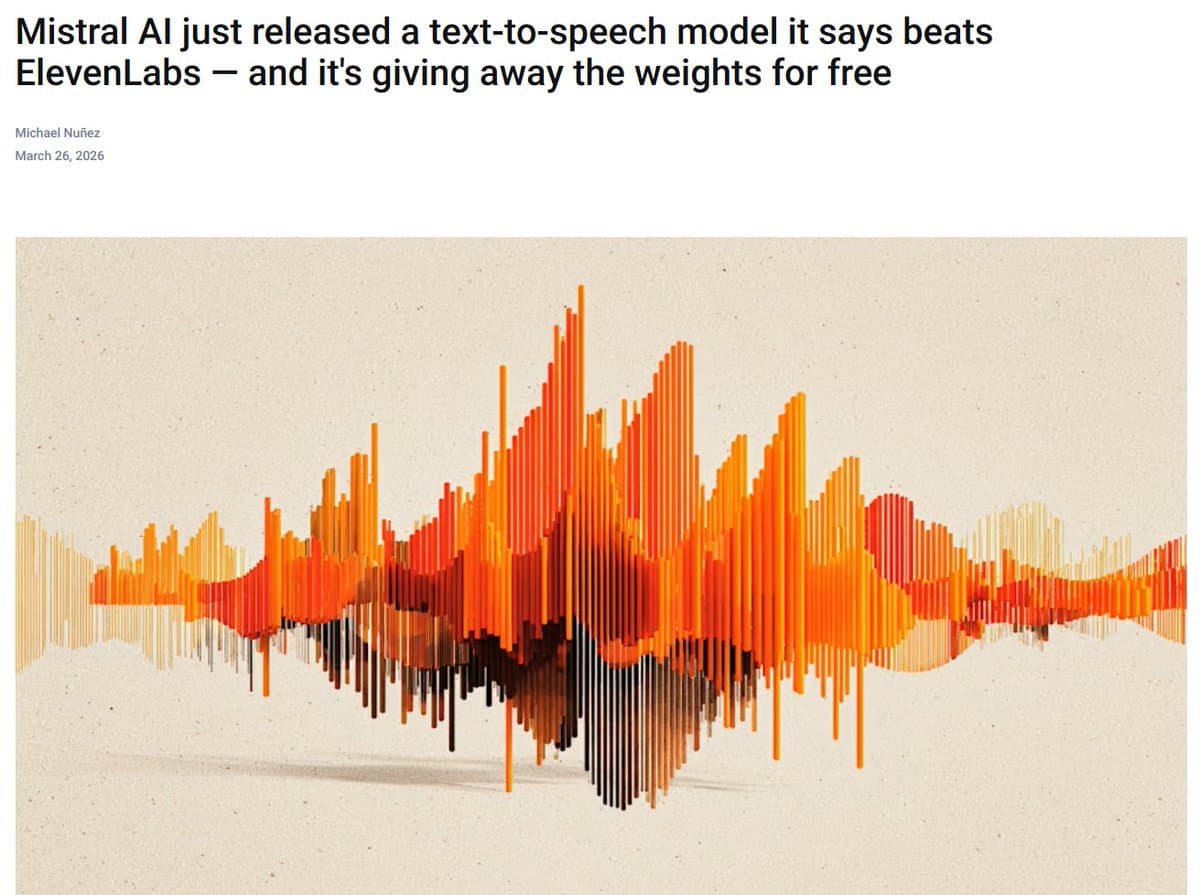
Mistral AI has entered the text-to-speech (TTS) arena with the release of Voxtral TTS, a 3-billion-parameter model released under an open-weights license. The company claims it outperformed a leading commercial competitor, ElevenLabs Flash v2.5, in human preference evaluations. This release marks a significant move by the Paris-based AI lab beyond its core competency in large language models (LLMs) and into the competitive generative audio space.
What's New: Open-Weights TTS with Competitive Claims
Voxtral TTS is a fully open-weights model, meaning its parameters are publicly available for download, modification, and commercial use, subject to its license (likely Apache 2.0, consistent with Mistral's previous releases). The key claim from Mistral AI is that in human preference tests, listeners preferred Voxtral's output over that of ElevenLabs Flash v2.5 approximately 63% of the time for standard voices and nearly 70% of the time for voice customization tasks.
Beyond benchmark performance, the model is engineered for efficiency and accessibility:
- Hardware Efficiency: It requires about 3 GB of RAM to run, making local inference feasible on consumer hardware.
- Low Latency: It achieves a 90-millisecond time-to-first-audio, critical for real-time interactive applications.
- Multilingual Support: It natively supports nine languages.
- Advanced Voice Cloning: The model can clone a voice from just five seconds of reference audio. A notable feature is cross-lingual adaptation, where a voice cloned from English audio can speak French while retaining the original speaker's accent and timbre.
Technical Details and Availability
The model's architecture details were not disclosed in the initial announcement. However, given Mistral's history with efficient transformer variants like Mixture of Experts (MoE), it is plausible Voxtral employs similar architectural innovations to achieve its 3B parameter count with stated efficiency.
The model is expected to be available for download via Mistral's official channels, such as their Hugging Face repository. Developers can integrate it locally or via a potential future API. The 3 GB RAM footprint suggests it can be deployed on edge devices, in cloud instances with modest resources, or as part of larger multimodal pipelines.
How It Compares: Open Source vs. Commercial Leader
The direct comparison to ElevenLabs Flash v2.5 is the headline. ElevenLabs is widely regarded as the market leader in high-quality, expressive TTS and voice cloning, primarily offered as a commercial API service. Mistral's claim of a >60% human preference win rate, if independently verified, positions Voxtral as a potent open-source alternative.
License Open Weights Proprietary / Commercial API Model Size ~3B Parameters Undisclosed Key Claim 63-70% preference win rate Industry benchmark for quality & speed Voice Cloning 5-second reference, cross-lingual High-quality cloning, extensive voice library Deployment ~3 GB RAM, local/self-host possible API-only, optimized for latencyThis release follows a pattern of Mistral leveraging open-source releases to challenge established API-based businesses, similar to their strategy with LLMs against OpenAI and Anthropic.
What to Watch: Verification and Ecosystem Development
The primary caveat is the lack of published evaluation methodology or raw data. The community will need to independently verify the human preference scores against ElevenLabs and other models like Meta's AudioCraft or Google's Chirp. Furthermore, the practical performance of the 5-second voice cloning in diverse, noisy acoustic conditions remains to be tested at scale.
The success of Voxtral will depend on the developer ecosystem that forms around it. Ease of integration, tooling, and community-contributed fine-tunes will determine if it becomes the "Mistral 7B" of the TTS world.
gentic.news Analysis
Mistral AI's release of Voxtral TTS is a strategic expansion that leverages its open-source credibility to attack a new market vertical. This move is consistent with the company's broader playbook, as we analyzed in our coverage of Mistral's Mixtral 8x22B release, where they used an open MoE model to compete on the cost-performance frontier against larger, closed models. By applying this same philosophy to TTS, Mistral is attempting to disrupt ElevenLabs' stronghold, much as it has challenged OpenAI in LLMs.
The timing is notable. The generative audio space has been heating up, with companies like ElevenLabs securing significant funding and Google releasing its Chirp models. By offering a high-performance, open-weights alternative, Mistral provides a pressure release for developers and companies wary of vendor lock-in or high API costs for scalable TTS. This aligns with a broader trend we've noted: the "commoditization through open-source" of AI capabilities that were recently the exclusive domain of well-funded labs.
However, the TTS market has different dynamics than LLMs. While LLMs have a vast, general-purpose developer base, high-quality TTS is often integrated into specific product experiences (audiobooks, assistants, games) where reliability, emotional range, and unique voice libraries are paramount. Mistral's success will hinge not just on beating a benchmark, but on enabling those specific use cases as effectively as the integrated solutions from ElevenLabs. The cross-lingual voice adaptation feature is a smart differentiator, directly targeting a complex, high-value problem in global media and entertainment.
Frequently Asked Questions
What license is Mistral Voxtral TTS released under?
While the specific license is not stated in the initial announcement, Mistral AI has a strong track record of using permissive open-source licenses like Apache 2.0 for its model weights (e.g., Mistral 7B, Mixtral 8x7B). It is highly likely Voxtral TTS follows this pattern, allowing for commercial use, modification, and distribution, which would be a key differentiator from the proprietary API model of ElevenLabs.
How does the 5-second voice cloning work?
The technical details of the cloning mechanism are not yet public. Typically, such systems use a speaker encoder network to create a compact vector (an "acoustic fingerprint") from the short reference audio. This vector then conditions the TTS model's decoder to synthesize speech in that voice. The claimed cross-lingual adaptation suggests their speaker encoder is highly robust and disentangles speaker identity from linguistic content, allowing the voice characteristics to be applied to a different language's phonetics.
Can I run Mistral Voxtral TTS locally on my computer?
Yes, based on the stated requirement of approximately 3 GB of RAM, local inference is a primary use case. Developers should be able to download the model weights and run it on a standard laptop or desktop, provided they have the necessary machine learning frameworks (like PyTorch or Transformers) installed. This is a major advantage for applications requiring data privacy, offline functionality, or predictable latency without API calls.
How does Voxtral's performance compare to other open-source TTS models?
The announcement only provides a direct comparison to the commercial ElevenLabs Flash v2.5. Without independent benchmarks, it's difficult to compare precisely to other open models like Coqui TTS, Tortoise-TTS, or Meta's Voicebox and AudioCraft. However, the claimed human preference win rate against a top-tier commercial product suggests Voxtral could be a new state-of-the-art for open-weights TTS, especially in the critical areas of voice similarity and naturalness.