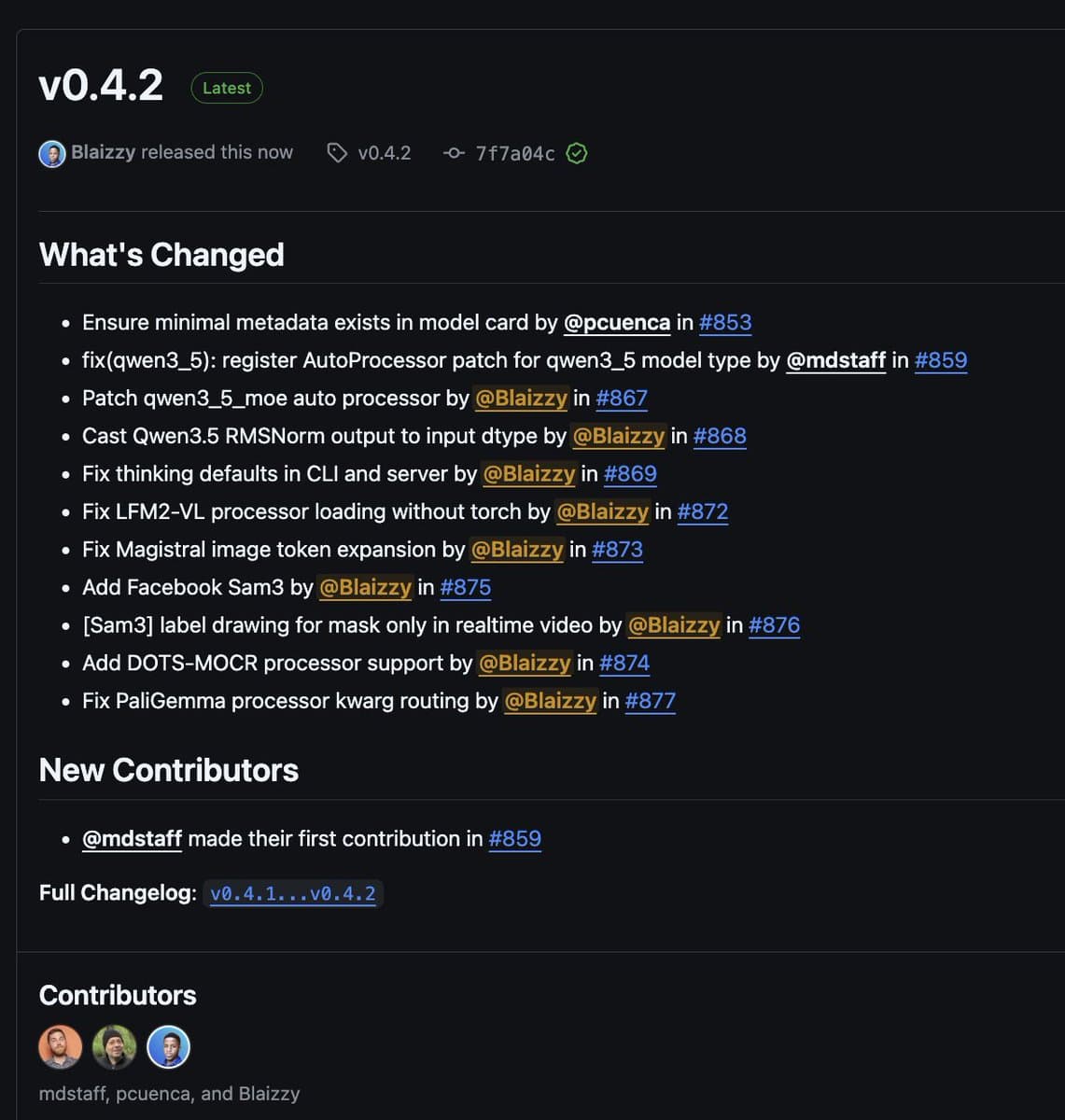
The mlx-vlm project, which enables efficient vision-language model inference on Apple Silicon using Apple's MLX framework, has released version 0.4.2. This update adds support for two new computer vision models—Meta's Segment Anything 3 (SAM3) and the DOTS-MOCR document OCR model—while fixing critical issues affecting several popular vision-language models including Qwen3.5, LFM2-VL, Magistral, and PaliGemma.
What's New in v0.4.2
The release focuses on expanding model support and addressing technical issues that previously hindered deployment of certain vision-language models on Apple hardware.
New Model Support:
- SAM3 (Segment Anything 3): Meta's latest zero-shot segmentation model, now with real-time mask-only label drawing capability. This allows users to generate segmentation masks without classification labels, useful for applications requiring clean mask outputs.
- DOTS-MOCR: A document OCR model developed by rednote-hilab for optical character recognition in document images.
Critical Fixes:
- Qwen3.5 RMSNorm dtype fix: Resolves an issue with the RMSNorm layer data type that prevented proper loading of Qwen3.5 vision-language models.
- LFM2-VL loads without torch: Enables LFM2-VL model loading without requiring PyTorch dependencies, improving deployment simplicity.
- Magistral image token expansion fix: Addresses an issue with image token processing in the Magistral model.
- PaliGemma processor kwarg routing fix: Corrects keyword argument routing in the PaliGemma processor.
- Thinking defaults fixed in CLI + server: Resolves issues with the "thinking" parameter defaults in both command-line and server interfaces.
Technical Implementation
mlx-vlm leverages Apple's MLX framework, which provides GPU-accelerated machine learning primitives optimized for Apple Silicon's unified memory architecture. The library enables running vision-language models directly on Mac hardware without requiring cloud inference or complex setup.
Version 0.4.2 continues mlx-vlm's trend of expanding model compatibility while maintaining the performance advantages of native Apple Silicon execution. The addition of SAM3 support is particularly notable given Meta's recent release of the Segment Anything 3 model, which offers improved segmentation accuracy and new interactive capabilities compared to previous versions.
Installation and Usage
Users can update to the latest version via:
uv pip install -U mlx-vlm
Or using pip:
pip install --upgrade mlx-vlm
The project is available on GitHub at https://github.com/riccardomusmeci/mlx-vlm, where users can report issues, contribute fixes, or request new model support.
gentic.news Analysis
This release represents a significant step in making cutting-edge computer vision models accessible to Apple Silicon developers. The addition of SAM3 support is particularly timely, coming just weeks after Meta's official release of Segment Anything 3. This rapid integration demonstrates mlx-vlm's commitment to staying current with the latest vision model developments.
The technical fixes in this release address real pain points for developers working with vision-language models on Apple hardware. The Qwen3.5 RMSNorm issue, for instance, was a known blocker for many users attempting to deploy Alibaba's Qwen2.5-VL models locally. Similarly, the LFM2-VL fix removes PyTorch dependencies that complicated deployment in production environments.
From a broader ecosystem perspective, mlx-vlm v0.4.2 continues Apple's push to establish its Silicon architecture as a viable platform for AI development. While NVIDIA GPUs still dominate training workflows, Apple is making steady progress in the inference space, particularly for edge deployment scenarios where Mac hardware is already prevalent. The addition of document OCR capabilities via DOTS-MOCR also expands mlx-vlm's utility beyond general vision tasks to specific business applications like document processing.
Looking at the contributor acknowledgments, the shoutout to @pcuenq and @mdstaff (for his first contribution) suggests a growing community around the project. This is consistent with the increased interest in local AI inference solutions as developers seek alternatives to cloud-based APIs for cost, latency, and privacy reasons.
Frequently Asked Questions
What is mlx-vlm and what does it do?
mlx-vlm is an open-source library that enables running vision-language models on Apple Silicon Macs using Apple's MLX framework. It provides optimized implementations of popular vision-language models that can execute efficiently on Mac hardware without requiring cloud services or external GPUs.
How does SAM3 integration in mlx-vlm compare to using it through other frameworks?
The mlx-vlm implementation of SAM3 is specifically optimized for Apple Silicon, leveraging MLX's unified memory architecture for efficient execution. This typically results in better performance on Mac hardware compared to running SAM3 through PyTorch or other cross-platform frameworks that weren't optimized for Apple's specific architecture.
Can I use mlx-vlm for production applications?
Yes, mlx-vlm is suitable for production applications, particularly those targeting Apple hardware deployments. The recent fixes in v0.4.2 address several stability issues that previously affected production use. However, as with any rapidly evolving AI framework, thorough testing of your specific use case is recommended before full production deployment.
What Apple hardware is required to run models through mlx-vlm?
mlx-vlm runs on any Mac with Apple Silicon (M1, M2, M3, or M4 processors). Performance will vary based on the specific chip, with higher-end models (M3 Max, M4 Max) offering significantly faster inference times. The unified memory architecture means models that fit within your Mac's RAM can run efficiently regardless of whether you have a MacBook Air or Mac Studio.