What Happened
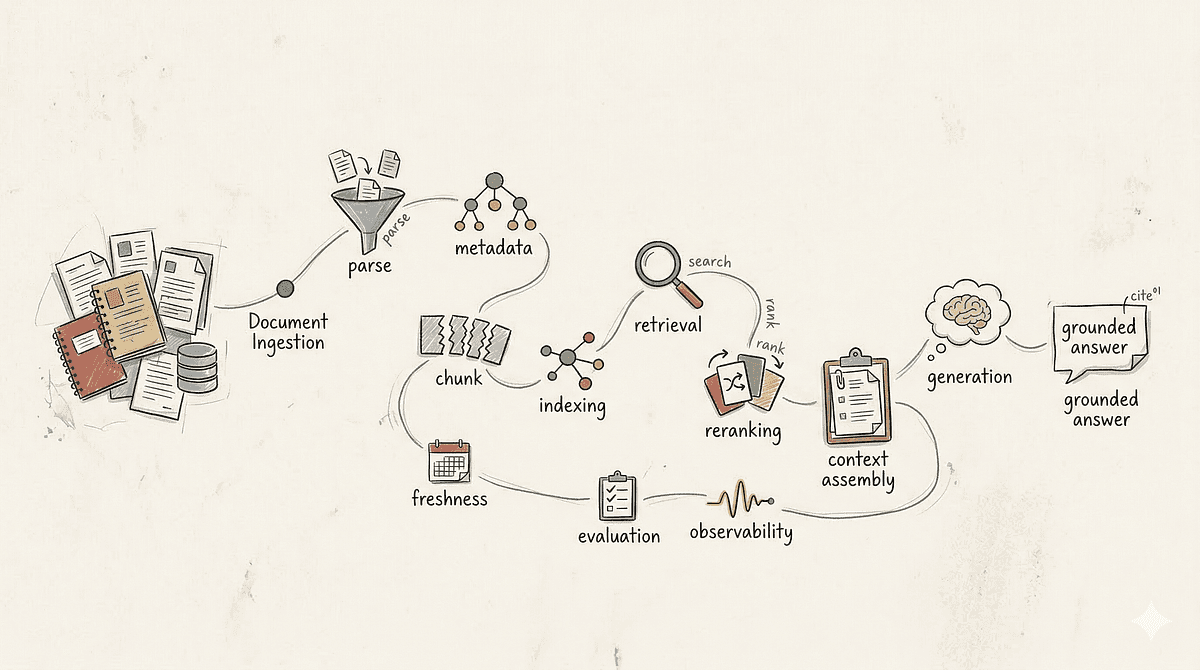
A new technical guide, published on the Medium platform via Towards AI, provides a forward-looking, "production-first" breakdown of the essential components for building modern Retrieval-Augmented Generation (RAG) systems as of 2026. The article, titled "Modern RAG in 2026: The Components That Actually Matter," moves beyond academic theory to focus on the practical stack required for reliable deployment. Its summary highlights a comprehensive list of concerns: ingestion, parsing, metadata, chunking, retrieval, reranking, citations, and freshness.
This publication is part of a clear trend of deep technical content on Medium, which has seen a surge in activity this week, including guides on prompt engineering, RAG bottlenecks, and visual recommendation systems. Notably, this article follows a related piece we covered just yesterday, "Your RAG Deployment Is Doomed — Unless You Fix This Hidden Bottleneck," indicating a concentrated industry focus on moving RAG from prototype to production.
Technical Details: The Modern RAG Stack
While the full article is behind Medium's subscription paywall, the provided summary points to the maturation of RAG architecture. The listed components represent a significant evolution from early, simplistic RAG implementations that often treated retrieval as a monolithic step.
- Ingestion & Parsing: This foundational layer involves extracting and normalizing data from diverse sources (PDFs, internal wikis, product databases, CRM notes). Robust parsing is critical for handling the unstructured and semi-structured documents common in corporate environments.
- Metadata & Chunking: Beyond simple text splitting, modern RAG emphasizes intelligent chunking strategies (semantic, recursive) and the enrichment of chunks with metadata (source, author, date, document type). This metadata becomes crucial for filtering and improving retrieval precision.
- Retrieval: This is the core search mechanism, typically using dense vector embeddings from models like OpenAI's
text-embedding-3or Google'sGemini Embedding 2(an AI model known to utilize RAG techniques). The trend is towards hybrid search, combining semantic (vector) search with keyword-based (sparse) search for better recall. - Reranking: A critical post-retrieval step where a more computationally expensive model (a cross-encoder or a specialized LLM) re-scores the initially retrieved passages to push the most relevant ones to the top, dramatically improving answer quality.
- Citations & Freshness: These are hallmarks of a production system. Citations provide traceability for generated answers, building user trust and enabling fact-checking. Freshness mechanisms, such as cached embeddings with update triggers or real-time retrieval blends, ensure the system's knowledge remains current—a non-negotiable requirement for dynamic business data.
This stack reflects a shift from a "RAG pipeline" to a "RAG platform," with each component requiring its own engineering, monitoring, and maintenance.
Retail & Luxury Implications
The implications for retail and luxury are profound, as RAG is the primary architectural pattern for building trusted, domain-specific AI assistants. A modern RAG stack directly enables several high-value use cases:
- Hyper-Personalized Customer Service: An AI concierge can retrieve information from a customer's past purchases (ERP), preferences (CRM), current cart, and real-time inventory to provide context-aware styling advice or support. The reranking component ensures the model prioritizes the customer's specific history over generic product descriptions.
- Expert Product Knowledge Bases: Grounding an LLM in technical design documents, material sourcing details, craftsmanship guides, and sustainability reports allows store associates or a digital assistant to answer intricate product questions with citations, enhancing brand authority and client education.
- Dynamic Merchandising & Planning Assistants: By ingesting and parsing sales data, trend reports, social sentiment, and supply chain updates, a RAG system can help merchandisers answer complex, multi-variable questions. The freshness component is critical here, as decisions rely on the latest sell-through rates or competitor moves.
- Unified Internal Intelligence: Luxury groups managing multiple houses can use RAG to create a single point of access to fragmented internal knowledge—from retail operation manuals and compliance documents to marketing campaign post-mortems. Intelligent chunking and metadata tagging allow queries to be scoped to a specific brand or department.
The move towards a production-first mindset highlighted in the article is essential for luxury brands. Prototypes that "mostly work" are unacceptable in client-facing or mission-critical operational roles. The emphasis on components like reranking and citations addresses core luxury values of accuracy, trust, and quality.
Implementation Approach
Building this stack requires a cross-functional team:
- Data Engineering: For building robust, scalable ingestion and parsing pipelines from source systems.
- ML Engineering: For selecting, testing, and deploying embedding models, rerankers, and the orchestration logic between components. Open-source frameworks (LlamaIndex, LangChain) provide scaffolding, but significant customization is needed for production.
- Infrastructure/Cloud Engineering: To manage vector databases (e.g., Pinecone, Weaviate, pgvector), compute for inference, and monitoring for latency and accuracy.
- Domain Experts (Retail/Merchandising): To define what "good" looks like, curate gold-standard Q&A pairs for evaluation, and label data for fine-tuning retrieval or reranking models if necessary.
The complexity is high, but the path is now well-defined. The alternative—attempting to fine-tune a general LLM on all proprietary knowledge—is often more expensive, less adaptable to new information, and harder to control.
Governance & Risk Assessment
- Data Privacy & Security: Ingestion pipelines must respect data governance boundaries. Client personal data should be masked or excluded from general knowledge retrieval. Vector databases and LLM calls must be secured and compliant with regulations (GDPR, CCPA).
- Bias & Hallucination: While RAG reduces hallucination by grounding responses, biased or incomplete source data will lead to biased answers. A robust citation system is the first line of defense, allowing humans to audit the source. Continuous evaluation of retrieval accuracy is required.
- Maturity: The core RAG pattern is mature, but the "modern stack" with all optimized components is still an advanced implementation. Brands should start with a well-scoped pilot (e.g., a product knowledge base for a single category) to mature their capabilities before scaling to client-facing applications.
gentic.news Analysis
This article underscores the rapid industrial maturation of RAG, a technology that has been mentioned in 73 of our prior articles and appeared in 32 just this week. The focus on production components aligns with the broader industry shift from research to ROI. It directly complements our recent coverage of RAG bottlenecks, forming a narrative: first a warning about what can go wrong, now a blueprint for building it right.
The context from our Knowledge Graph is telling. The surge in RAG content coincides with intense activity from major platform players like Meta, which has appeared in 22 articles this week. While Meta's recent teaser about its 'Avocado' AI project and its foundational LLaMA models are part of the general LLM ecosystem that RAG builds upon, the competitive landscape for enterprise AI solutions is heating up. Meta (via LLaMA) competes with OpenAI, Google, and Anthropic in providing the base LLMs, but the value for retailers is built on top through stacks like the one described here.
Furthermore, the publication venue itself is significant. Medium, through channels like Towards AI, has become a primary conduit for disseminating advanced implementation knowledge, hosting 8 articles this week alone. For technical leaders in retail, monitoring these platforms is essential to separate enduring architectural patterns from fleeting hype.
For luxury brands, the message is clear: the foundational technology for trustworthy, data-grounded AI is crystallizing. The competitive advantage will soon lie not in whether to implement RAG, but in how well it is implemented—how seamlessly ingestion pipelines run, how intelligent the chunking is, and how effectively reranking models understand the nuanced language of luxury. The components that matter, as the article states, are those that move the system from a demo to a dependable asset.