What Happened
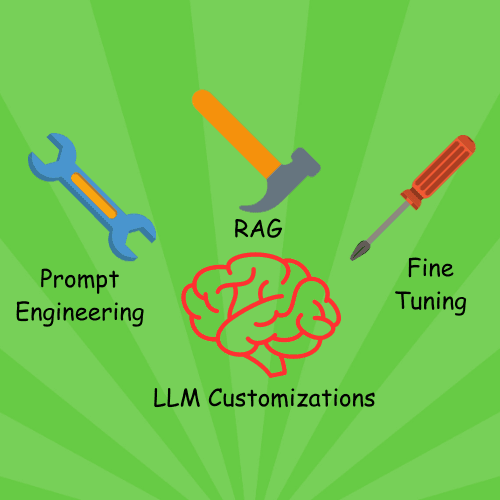
A new article provides a foundational guide to the three dominant strategies for customizing Large Language Models (LLMs): Prompt Engineering, Retrieval-Augmented Generation (RAG), and Fine-Tuning. While the full text is behind a paywall, the summary positions these methods as the core toolkit for building AI-powered products. The piece likely serves as a primer, comparing the technical complexity, cost, data requirements, and control offered by each approach.
Technical Details: The Customization Spectrum
Understanding the trade-offs between these strategies is the first critical decision for any AI implementation.
1. Prompt Engineering
This is the simplest entry point, involving the careful design of input instructions (prompts) to guide a pre-trained, general-purpose LLM toward a desired output. It requires no model retraining or additional infrastructure. Effectiveness depends heavily on the model's inherent capabilities and the user's skill in crafting context, examples (few-shot learning), and constraints. It's fast, cheap, and flexible but offers the least control and can struggle with highly specialized or dynamic knowledge.
2. Retrieval-Augmented Generation (RAG)
RAG enhances a pre-trained LLM by connecting it to an external, updatable knowledge base (like a vector database of company documents). At inference time, the system first retrieves relevant information from this source and then provides it to the LLM as context to generate an answer. This grounds the model in specific, proprietary data without altering its weights. It's excellent for knowledge-intensive tasks where information changes or is private, but it introduces system complexity in retrieval accuracy and context management.
3. Fine-Tuning
This involves further training a pre-trained LLM on a specialized dataset to adjust its internal parameters (weights). This can teach the model a new style (e.g., brand voice), a specialized domain (e.g., haute couture textiles), or a specific task format. It offers deep behavioral control and can improve efficiency on that task. However, it is computationally expensive, requires substantial, high-quality datasets, and risks "catastrophic forgetting" of general knowledge. Newer techniques like Parameter-Efficient Fine-Tuning (PEFT) reduce some of these costs.
Retail & Luxury Implications
For technical leaders in retail and luxury, choosing the right customization strategy is not an academic exercise—it directly impacts project viability, cost, and time-to-value.
Prompt Engineering is your tool for rapid prototyping and low-stakes applications. Use it for:
- Generating initial marketing copy variations.
- Classifying customer service email sentiment.
- Brainstorming product description tags.
- It’s the first step before committing to more complex infrastructure.
Retrieval-Augmented Generation (RAG) is arguably the most strategic fit for the industry's core challenges. It allows you to build expert systems on top of immutable brand knowledge. Prime use cases include:
- Intelligent Clienteling Assistants: Providing store associates with instant access to lookbooks, product catalogs, client purchase history, and style notes.
- Internal Knowledge Hubs: Allowing designers, buyers, and planners to query decades of trend reports, supplier details, and fabric libraries.
- Dynamic Customer Support: Answering complex product care, authenticity, or sourcing questions by retrieving from official manuals and archives.
- The key advantage is that the knowledge base can be updated in real-time (e.g., with a new collection launch) without retraining a model.
Fine-Tuning is for mastering a specific, consistent tone or process. Consider it for:
- Brand Voice Amplification: Training a model to generate copy that perfectly mimics the house's unique heritage and aesthetic language across all channels.
- Hyper-Specialized Classification: Creating a model that excels at identifying subtle defects in leather or grading gemstone quality from images and text descriptions.
- Automated Personalization Engines: Tuning a model to predict client preferences with extreme precision based on historical interaction data.
The choice often involves layering these strategies: using RAG to provide context and fine-tuning to perfect the response style.