Key Takeaways
- Muxer reduces Claude Code costs by multiplexing models per subtask via agent frontmatter and session hooks.
- Keep Fable/Opus for planning; route boilerplate to Haiku.
What Changed — The Update
Muxer is an open-source Claude Code plugin that lets an expensive model orchestrate a session while cheaper models do the actual work. It hit GitHub recently and solves a pain point anyone on a Max plan knows: the orchestrator model (Fable, Opus) bills for every subtask it spawns, even trivial ones like grepping files or writing boilerplate.
Muxer works through three mechanisms:
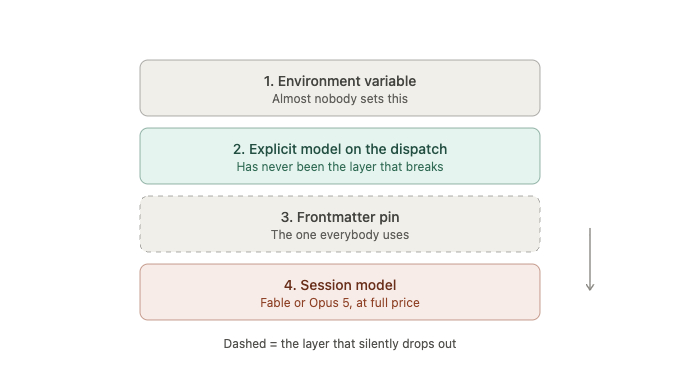
Agent frontmatter — Each agent in
agents/*.mdhas amodel:line. The scout always runs on Haiku; the builder always runs on Opus. This is a hard guarantee, not a suggestion.SessionStart hook — A
scripts/session-policy.shinjects a routing policy: on Fable sessions it says "keep the main loop lean"; on cheaper models it adds an escalation path up to Fable viamuxer:oracle.PreToolUse guard —
scripts/guard-model.shcatches subagents (Explore, Plan) that inherit the session model and pins them to Opus unless overridden. Prevents premium billing on file exploration.
What It Means For You — Concrete Impact
If you're on a Max plan, your biggest cost driver isn't the number of prompts—it's the model running each subtask. Claude Code's built-in subagents inherit the session model by default. On a Fable session, every grep, find, and boilerplate write bills at premium rates.
Muxer's approach mirrors the strategy we covered in "Claude Fable 5 in Claude Code: The Routing Strategy That Saves Your Weekly Limit" (2026-07-02). The difference: Muxer gives you hard guarantees via agent frontmatter rather than relying on prompt engineering.
The project also has rules for quality control:
- Taste-critical work (UI, CSS, game feel) never goes below Opus regardless of cost hints.
- The verifier is never a cheaper model than the builder it's judging.
- Work that fails review twice at one tier gets redone a tier up with a fresh brief.
Try It Now — Commands, Config, and Prompts
1. Clone and Set Up
git clone https://github.com/DangerousYams/muxer.git
cd muxer
# Copy agents and hooks into your Claude Code project
cp -r agents/* ~/.claude/agents/
cp scripts/* ~/.claude/hooks/
2. Configure Agent Frontmatter
Create agents/scout.md:
---
model: haiku
---
You are a scout. Your job is to explore the codebase and gather information. Be fast and concise.
Create agents/builder.md:
---
model: opus
---
You are a builder. You implement features from detailed briefs. Never accept under-scoped briefs.
3. Install Session Hook
In ~/.claude/hooks/session-start.sh:
#!/bin/bash
# If session model is Fable, inject delegation policy
if [ "$CLAUDE_SESSION_MODEL" = "fable" ]; then
  echo "Policy: Delegate all file operations to haiku. Escalate complex decisions to opus."
fi
4. Run and Watch Savings
Start a Claude Code session on Fable. Muxer prints $ saved after each task. You'll see the scout run on Haiku, the builder on Opus, and Fable only for planning and review.
Why It Works

Claude Code picks a model for a subtask at the moment the orchestrator spawns it. Muxer leans on that decision from three directions: agent frontmatter guarantees the model, session hooks set policy, and guards catch unspawned overrides. This triple-layer approach means you don't need to trust prompt engineering—you get hard routing guarantees.
When To Use It
- Max plan users — Your biggest cost is Fable/Opus subtasks. Muxer cuts that.
- Multi-model workflows — You want to route specific work to Gemini or OpenAI Codex via their CLIs.
- Quality-sensitive projects — The review escalation rules ensure cheap models don't produce garbage.
Caveats
Muxer is new (2 points, 0 comments on HN as of writing). The guard script approach is experimental. Test on a small project before rolling out to production. Also, as we noted in "How Navan's MCP Server Cuts Travel Booking from 8 Steps to 1 Command" (2026-07-02), any tool that modifies session behavior can introduce unexpected interactions—monitor your first few sessions closely.
Source: github.com
[Updated 04 Jul via hn_claude_code]
A new competitor, Brick-SR1 by regolo-ai, has emerged on GitHub with a similar model-routing approach but claims to save tokens rather than direct costs. Unlike Muxer's agent frontmatter system, Brick-SR1 uses a YAML configuration file to define routing rules per task type and includes built-in fallback logic if a cheaper model fails quality checks. The project has 9 points on Hacker News but zero comments as of writing, suggesting early-stage adoption. [per regolo-ai/Brick-SR1]