Agentic coding is no longer “cheap experimentation”: Lovable burned $85K in tokens, and the real bill came from debugging, not generation.
13,000+ MCP servers crossed in June
Trending Now
🔥 Hard Guardrails Beat “Let Claude Figure It Out” — Cut Migration Time ~30%Teams are replacing open-ended prompts with decision matrices in `CLAUDE.md` so Claude stops mixing legacy and new patterns mid-migration. If you’re doing a framework or architecture transition, encode the allowed path explicitly instead of hoping the model infers it. 🔥 Model Routing Is Becoming a Cost Control Layer — Keep Opus/Fable for Planning, Haiku for Boilerplate
The community is splitting tasks by complexity: use expensive models only for multi-file reasoning, then route repetitive edits and scaffolding to cheaper tiers. If you don’t route by subtask, you’re paying premium rates for low-value token churn. 📈 MCP Is Moving From “Nice Integration” to Regulated Infrastructure — 13,000+ Servers and Counting
Native MCP servers from Pipedrive, Google Cloud, Apple Safari, and others show the protocol is becoming the default way to expose auditable tools. For enterprise teams, the win is replaceable integrations and cleaner permission boundaries; the risk is gateway sprawl unless you pin versions and constrain tools.
Best Practices
Add a decision matrix to `CLAUDE.md`Before: Claude mixes legacy and new architecture patterns during migrations. After: it follows explicit branch-by-branch rules, which cut one Flutter migration timeline by ~30%. Pin MCP servers and lock `allowed_tools`
Before: fail-open resolvers and unpinned servers can silently expand agent access. After: each server is versioned and least-privilege is enforced, closing the three MCP gateway gaps LiteLLM found. Use discovery-driven MCP instead of hardcoded model lists
Before: static tool schemas bloat prompts and go stale as infrastructure changes. After: dynamic discovery cut token bloat by 40% and keeps Claude aligned with the actual available models.
Tools & MCP
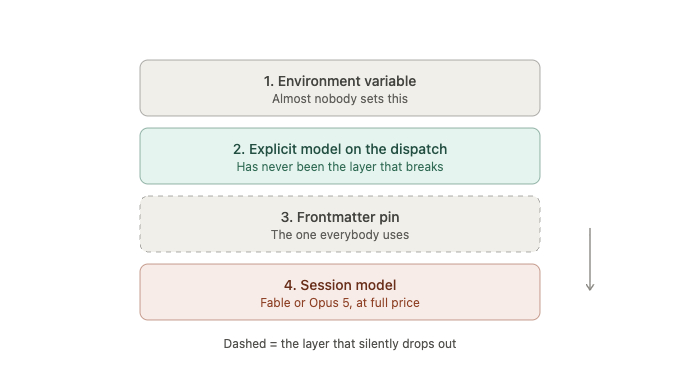
Google Cloud MCP — Queries BigQuery and manages GCS directly from Claude Code — install with `claude mcp add google-cloud` and skip custom glue. Apple Safari 247 MCP Server — Inspects live webpages from Claude Code — fast path to debug rendering and JavaScript issues without leaving the agent loop. Muxer — Routes subtasks to different models via frontmatter and session hooks — keeps Fable/Opus for planning while sending boilerplate to Haiku.Multi-Agent Patterns
Discover → Plan → Execute → Observe with MCP InspectorUse MCP Inspector to replace brittle REST calls with a visible workflow for messaging tasks; the BridgeXAPI demo shows how to keep each step inspectable instead of burying logic inside one giant tool call. Graph-based orchestration with human-in-the-loop checkpoints
Google ADK Go 2.0 adds a graph engine so multi-agent flows can branch, pause, and request approval at defined nodes — useful when you need production reliability instead of a single monolithic agent run. Session-hook model multiplexing
Muxer uses agent frontmatter plus hooks to decide which model handles each subtask, so planning stays on stronger models while repetitive work is offloaded automatically.
Community Requests
- Native MCP gateway policy controls for version pinning, resolver fail-closed behavior, and per-server `allowed_tools` enforcement
- Built-in model routing UI in Claude Code so teams can assign planning/editing/boilerplate tiers without custom hooks
- First-party MCP server benchmarking and audit tooling for latency, token cost, and permission drift