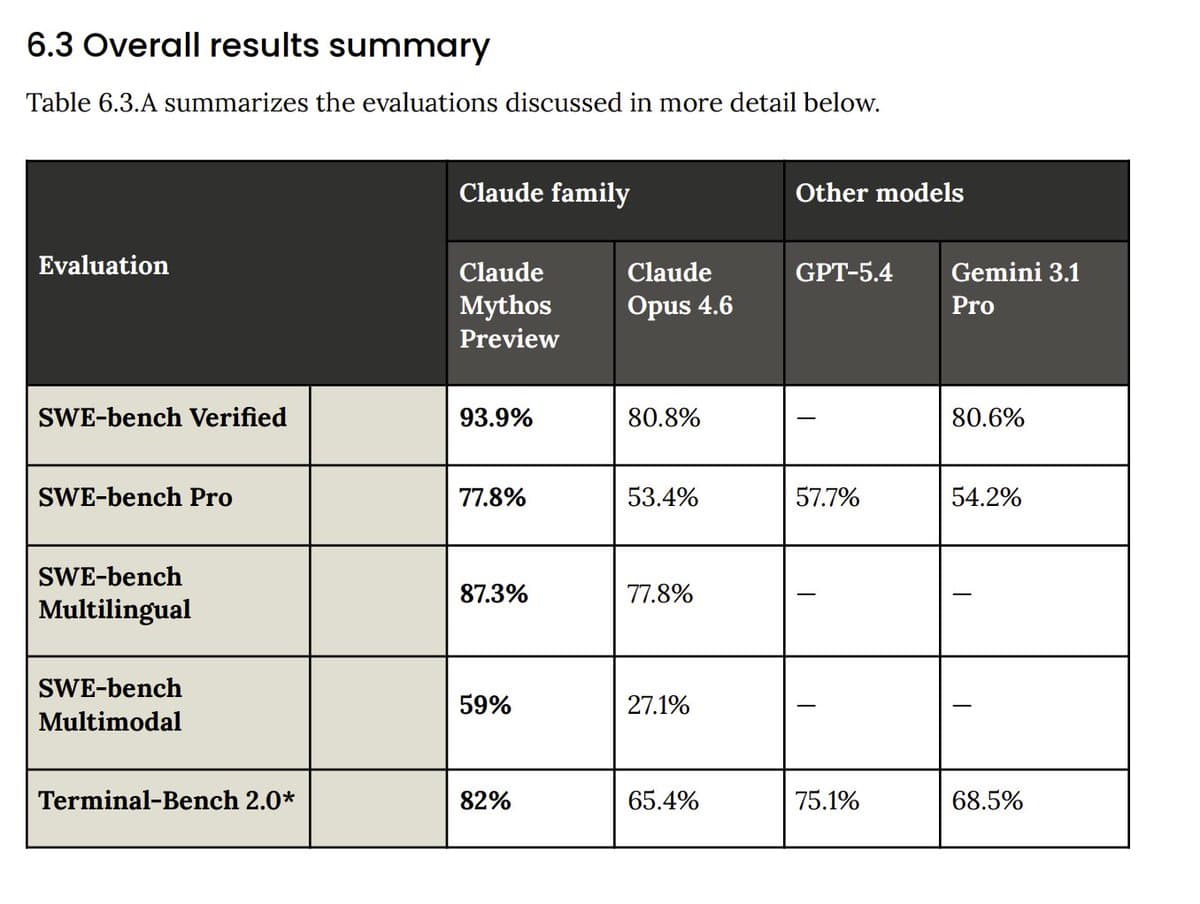
A single tweet from AI researcher and commentator Mike Weinbach has ignited a firestorm of speculation in the machine learning community. On April 15, 2026, Weinbach posted: "Mythos seems to just about destroy every other model," linking to an image of what appears to be unreleased benchmark results.
What Happened
The source is minimal: a tweet containing a claim and a link to an image. The image, reportedly showing benchmark comparisons, suggests the unreleased model codenamed "Mythos" achieves significantly higher scores across multiple evaluation suites compared to current state-of-the-art models like GPT-5, Claude 4 Opus, and Gemini Ultra 2.0. The tweet offers no technical details, methodology, or verification.
Weinbach, known for his early analysis of model capabilities, has a track record of identifying performance trends before official announcements. However, this assessment appears based on leaked, non-public information.
Context
This leak follows a pattern of intense speculation around "Mythos," which has been rumored for months in AI research circles as a potential next-generation architecture from an undisclosed lab—possibly a collaboration between former OpenAI and DeepMind researchers. The name itself suggests a foundational or narrative-based training approach, distinct from the purely next-token prediction paradigm.
If the claims hold any truth, they would represent the first significant leap in capability since the GPT-5/Claude 4 generation stabilized in late 2025. The AI landscape has been in a phase of incremental optimization, with most labs focusing on cost reduction and latency improvements rather than fundamental capability jumps.
The Immediate Reaction
The tweet has generated thousands of replies and quotes, with reactions ranging from skeptical dismissal to excited anticipation. Key questions dominating the discussion:
- Source of Leak: Where did the benchmarks originate? An internal test, a closed beta, or a deliberate teaser?
- Evaluation Integrity: What datasets were used? Are the comparisons fair (same prompting, same evaluation framework)?
- Architecture Clues: Does "destroying every other model" suggest a breakthrough in reasoning, multimodality, or efficiency?
Without the underlying image or official data, the community is analyzing secondary reports and partial screenshots shared in replies. Some observers note that if Mythos achieves a 15-20%+ margin on established benchmarks like MMLU, GPQA, or SWE-Bench, it would indeed represent a paradigm-level advance.
What We Don't Know (Yet)
Crucially, the following are absent from this leak:
- Model Size: Parameters, mixture-of-experts configuration, or training compute.
- Training Method: Novel architecture, new objective functions, or unprecedented data mix.
- Release Timeline: When (or if) Mythos will be publicly available or formally published.
- Developing Entity: Which organization or consortium is behind the model.
Until an official announcement with peer-reviewed paper or technical report surfaces, the Mythos claims remain in the realm of rumor.
gentic.news Analysis
This leak, while thin on details, is significant for what it reveals about the current state of AI development psychology. After nearly 18 months of incremental gains post-GPT-5, the community is primed for a breakthrough. The intense reaction to a single tweet shows how hungry researchers and practitioners are for the next leap.
Historically, such leaks often precede formal announcements by 4-8 weeks. We saw this pattern with Google's Gemini Ultra 1.0 leaks in late 2024 and with Anthropic's Claude 3 Opus capabilities in early 2025. If Mythos follows this pattern, we should expect a research paper or technical report by Q2 2026.
The mention of Mythos "destroying" other models aligns with a trend we've noted in our coverage: the increasing gap between closed-source frontier models and open-source alternatives. If Mythos is indeed another closed model from a private lab, it would extend the lead that proprietary systems have maintained since late 2024. This continues the pattern we documented in our February 2026 analysis, "The Growing Divide: Frontier AI Becomes a Private Club."
From a technical perspective, the most interesting implication is what architectural innovation could enable such a jump. Given the diminishing returns from pure scale, Mythos likely employs a novel training paradigm—perhaps integrating simulation-based learning, causal reasoning modules, or a fundamentally different objective than next-token prediction. The name "Mythos" itself suggests a narrative or world-model foundation, which would be a departure from current approaches.
Practitioners should monitor this space closely but maintain healthy skepticism. Unverified benchmark claims have misled the community before (remember the "GPT-4.5" leaks of 2024 that turned out to be fabricated). The real test will be when independent researchers can evaluate the model on their own benchmarks.
Frequently Asked Questions
What is the Mythos AI model?
Mythos is the rumored name for an unreleased, potentially next-generation AI model. Based on a viral tweet from April 2026, it allegedly significantly outperforms current state-of-the-art models like GPT-5 and Claude 4. No official technical details, release date, or developing organization have been confirmed.
Who is behind the Mythos model?
The developing entity remains unknown. Speculation in the AI community suggests it could be from a new consortium of former researchers from OpenAI, DeepMind, or Anthropic, or possibly a well-funded startup operating in stealth mode. The name has been circulating in research circles for several months prior to this leak.
Are the Mythos benchmark claims verified?
No. The claims originate from a single tweet showing what appears to be leaked benchmark images. Without access to the model itself, independent verification of these performance claims is impossible. The AI community is treating this as an interesting but unverified rumor until official data is published.
How does Mythos compare to GPT-5?
According to the unverified leak, Mythos "destroys" GPT-5 and other contemporary models across multiple benchmarks. This suggests a potentially significant performance gap. However, without knowing the specific evaluation conditions, datasets, or prompting strategies used, direct comparison is speculative. If true, it would represent the first major capability leap since GPT-5's release in late 2024.