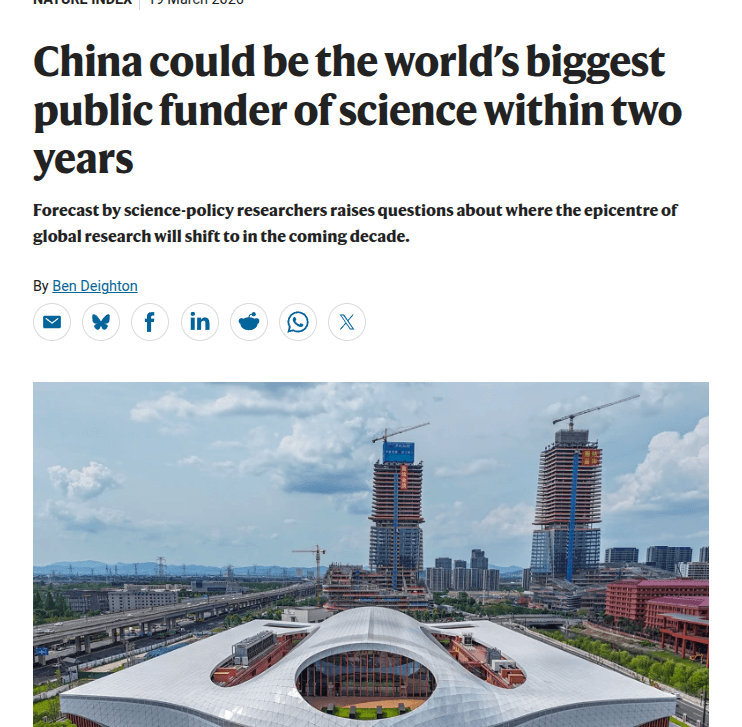
A new report published in Nature reveals a significant shift in the global scientific funding landscape: China is on the verge of surpassing the United States in public spending on research and development (R&D). This development, based on purchasing-power-adjusted figures, signals a potential reorientation of where the foundational priorities for a large share of global science are set.
The core finding is that China has dramatically increased state support for research at a much faster rate than the US, where government R&D growth has largely stalled. The analysis uses purchasing-power parity (PPP) adjustments to estimate the actual research capacity that funding can buy within each country, providing a more accurate comparison than nominal dollar amounts.
The Funding Shift
The report highlights that scientific leadership has historically followed sustained funding. Over recent years, China has executed a consistent strategy of ramping up state investment in R&D, while U.S. federal spending in this area has seen minimal growth. This divergence has closed the gap to the point where China's public R&D expenditure, when adjusted for PPP, is nearly equal to that of the United States.
This is not merely a symbolic milestone. The nation that controls a larger share of global public R&D investment inherently gains influence over research agendas, talent attraction, and the direction of long-term scientific inquiry across fields from biotechnology to artificial intelligence.
The Fundamental Research Gap
Despite the converging spending figures, the Nature report notes a critical and persistent weakness in China's scientific ecosystem: it "still trails badly in fundamental research." Fundamental (or basic) research is the early-stage, curiosity-driven work that often lacks immediate commercial application but forms the essential base layer for future technological breakthroughs in pharmaceuticals, semiconductors, advanced materials, and AI algorithms.
Historically, the United States has excelled in this high-risk, high-reward domain, with its university system and agencies like the National Science Foundation (NSF) and the National Institutes of Health (NIH) providing the stable, long-term funding necessary for foundational discoveries.
The Future Pipeline
The most consequential trend identified in the report may be the growth rates. China's government support for basic science "has grown much faster" than that of the US. This suggests that while there is a current deficit in fundamental research output, the financial pipeline that feeds future breakthroughs is beginning to tilt in China's favor.
Increased and sustained funding for basic science in China could, over time, expand its cadre of researchers focused on foundational questions, increase its output of high-impact papers in fields like mathematics and physics, and ultimately translate into a stronger position at the origin point of new technological paradigms.
gentic.news Analysis
This report underscores a strategic decoupling in global science policy. The U.S. approach has increasingly emphasized private sector R&D and applied, mission-driven research (e.g., through the CHIPS and Science Act), while China is executing a state-led plan to build capacity across the entire research stack, from basic science to commercialization. For AI practitioners, this has direct implications. Much of modern AI rests on fundamental research conducted decades ago in U.S. and European institutions. If China's increased basic research funding successfully cultivates a stronger ecosystem for theoretical computer science, mathematics, and cognitive science, we could see the intellectual origins of future AI paradigms diversify geographically.
The focus on PPP-adjusted spending is crucial. It reveals that China's spending buys more researcher salaries, lab equipment, and compute time domestically than a simple currency conversion would suggest. This efficiency amplifies the impact of its raw spending figures. However, money alone does not guarantee breakthrough science. The U.S. retains significant advantages in researcher mobility, academic freedom, and a deep network of global collaboration—intangibles that are harder to quantify but critical for innovation. The next decade will test whether China's financial investment can overcome its structural lag in fundamental research and create a truly competitive, discovery-led ecosystem.
Frequently Asked Questions
What is purchasing-power parity (PPP) adjusted R&D spending?
Purchasing-power parity is a metric used to compare the relative value of currencies by eliminating differences in price levels between countries. When applied to R&D spending, it estimates how much actual research—in terms of researcher salaries, laboratory materials, and equipment—a given amount of government funding can purchase within that country's economy. This provides a more accurate comparison of research capacity than simply converting budgets using market exchange rates.
Why is fundamental research important for AI development?
Fundamental research in fields like mathematics, statistical theory, and computational neuroscience provides the foundational principles upon which applied technologies are built. Breakthroughs in AI, such as the transformer architecture or novel optimization algorithms, often stem from deep, theoretical work that may not have an immediate commercial application. A strong base in fundamental science ensures a pipeline of new ideas that can be translated into future generations of AI models and systems.
Has the US lost its lead in science funding?
In terms of total public R&D spending adjusted for purchasing power, the U.S. lead has effectively vanished, according to this report. However, the U.S. still maintains a significant lead in total R&D spending when private sector investment (from companies like Google, Meta, and NVIDIA) is included. Furthermore, the U.S. continues to lead in the output and impact of fundamental research, though China's rapidly growing investment poses a long-term challenge to that position.
What are the implications for AI researchers worldwide?
For AI researchers, this shift may lead to increased funding opportunities and new large-scale research initiatives originating from China. It could also foster greater competition for top talent. The geographic center of gravity for publishing influential papers and setting research agendas may become more distributed. Researchers may need to engage with a broader, more globally diverse funding and collaboration landscape to remain at the forefront of the field.