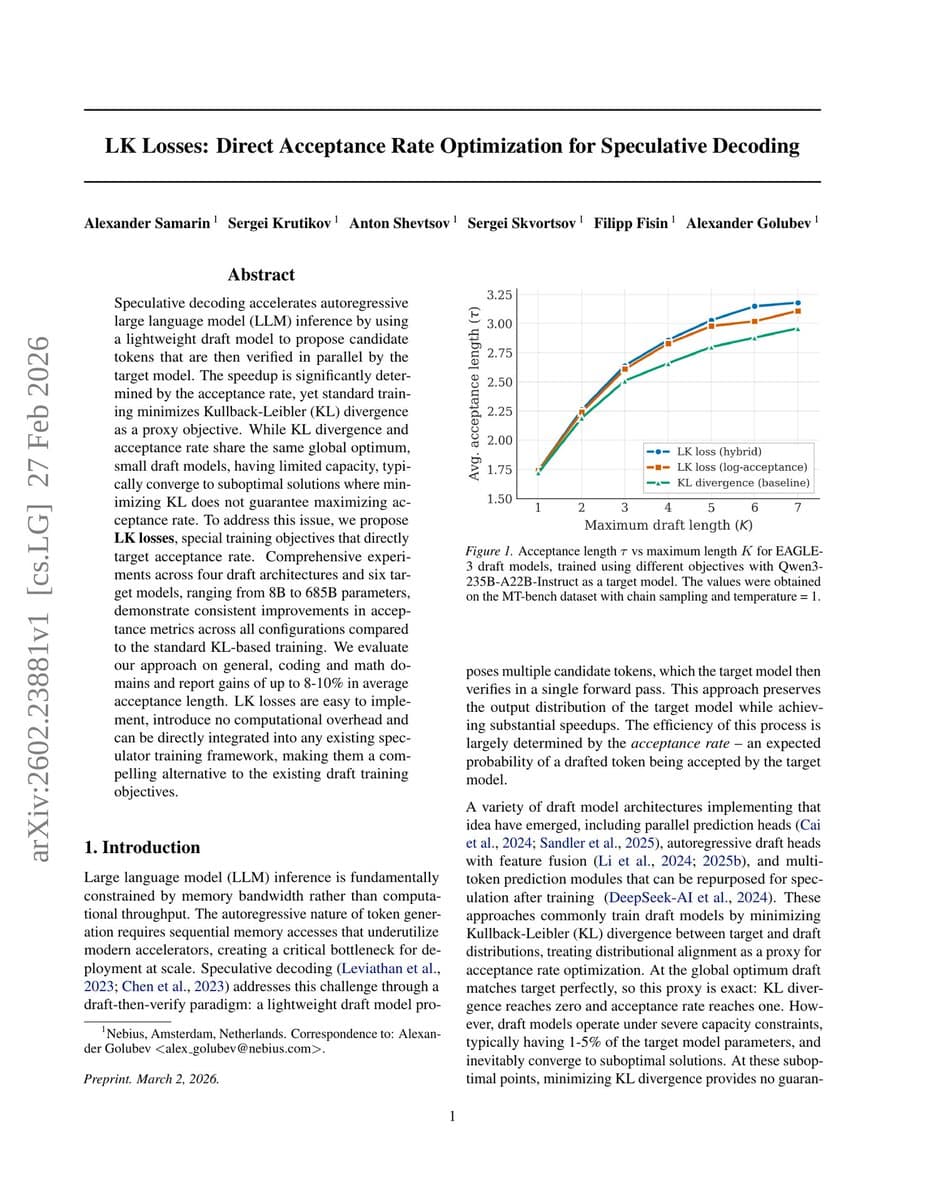
In the rapidly evolving landscape of artificial intelligence, one of the most persistent challenges has been the computational expense of running large language models (LLMs). While these models demonstrate remarkable capabilities, their practical deployment is often constrained by latency and resource requirements. A significant breakthrough has emerged from Nebius AI, whose researchers have developed a novel training objective called LK Losses that directly optimizes acceptance rates in speculative decoding—achieving 8-10% efficiency gains over traditional methods.
The Problem with Current Speculative Decoding
Speculative decoding has emerged as one of the most promising techniques for accelerating LLM inference. The approach works by using a smaller, faster "draft" model to generate multiple tokens in advance, which are then verified by the larger, more accurate "target" model. The efficiency gains come from the target model processing multiple tokens simultaneously during verification, rather than generating them sequentially.
However, the effectiveness of speculative decoding depends critically on the acceptance rate—how often the target model agrees with the draft model's predictions. Traditional training approaches have focused on minimizing KL divergence between the draft and target models, which measures how different their probability distributions are. While theoretically sound, this indirect approach doesn't directly optimize for what matters most in practice: maximizing acceptance rates.
How LK Losses Work Differently
Nebius AI's innovation lies in creating training objectives that directly optimize for acceptance rates. The researchers developed two complementary loss functions:
Lookahead Matching (LM) Loss: This encourages the draft model to predict tokens that the target model will accept with high probability
Knowledge Distillation (KD) Loss: This maintains the draft model's ability to generate coherent text independently
The key insight was recognizing that while KL divergence minimization ensures the draft model's distribution matches the target's, it doesn't necessarily maximize the probability that the target will accept the draft's specific token choices. LK Losses address this by directly training the draft model to make predictions that the target model will validate.
Impressive Results Across Model Sizes
The research paper demonstrates remarkable consistency in improvements. Across four different draft architectures and six target models ranging from 8 billion to 685 billion parameters, LK Losses consistently achieved 8-10% higher acceptance rates compared to models trained with traditional KL divergence minimization.
This consistency across such a wide range of model sizes is particularly significant because it suggests the approach is fundamentally sound rather than architecture-specific. The gains translate directly to inference speed improvements, as higher acceptance rates mean the target model spends less time rejecting and regenerating tokens.
Practical Implications for AI Deployment
The implications of this research extend far beyond academic interest. For organizations deploying LLMs at scale, even single-digit percentage improvements in efficiency can translate to substantial cost savings. Consider that:
- Cloud providers could offer faster inference at the same price point
- Applications requiring real-time responses become more feasible
- Energy consumption for AI inference could be significantly reduced
- Smaller organizations could access capabilities previously limited by computational constraints
The Broader Trend Toward Inference Optimization
Nebius AI's work represents part of a broader industry shift toward optimizing inference efficiency rather than just pursuing larger models. As LLMs have grown to hundreds of billions of parameters, the focus is increasingly shifting from pure capability to practical deployability.
Other approaches in this space include model quantization, pruning, and architectural innovations like mixture-of-experts. LK Losses complement these techniques by improving the efficiency of speculative decoding specifically, which has become a standard component of production LLM systems.
Challenges and Future Directions
While the results are impressive, several questions remain for future research:
- How do LK Losses interact with other optimization techniques?
- Can similar approaches be applied to other aspects of inference optimization?
- What are the theoretical limits of acceptance rate optimization?
- How does this approach scale with even larger models?
The researchers also note that their method requires access to the target model during draft model training, which may present practical challenges in some deployment scenarios.
Conclusion
Nebius AI's LK Losses represent a significant step forward in making large language models more practical and accessible. By directly optimizing for what matters in speculative decoding—acceptance rates—rather than relying on proxy metrics like KL divergence, the researchers have demonstrated consistent, architecture-agnostic improvements.
As AI systems continue to grow in both capability and computational requirements, innovations like LK Losses will play a crucial role in ensuring these technologies remain deployable in real-world applications. The work exemplifies the maturing of the AI field, where optimization and efficiency are becoming as important as raw capability.
Source: Nebius AI research on LK Losses for speculative decoding optimization