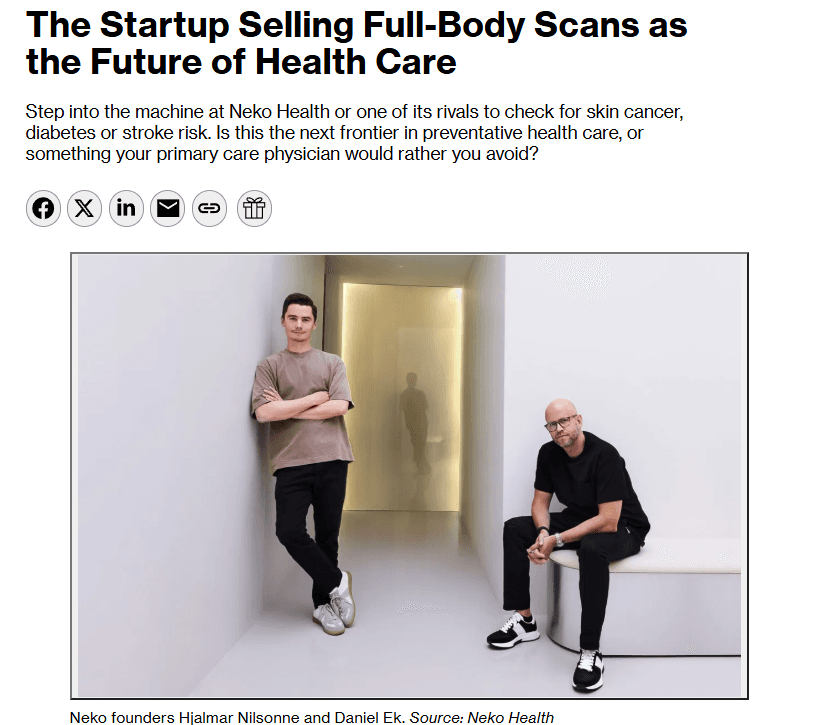
Neko Health, the preventive healthcare startup founded by Spotify co-founder and CEO Daniel Ek, is launching its AI-powered full-body health scanning service in the United States. The service, priced at $400, will debut in New York this spring, marking the company's first expansion outside of its native Sweden.
The company, valued at $1.8 billion, uses a combination of advanced imaging technology, blood tests, and proprietary AI algorithms to conduct a comprehensive, non-invasive health scan in under 10 minutes. The stated goal is to detect early signs of major diseases, including cancer, cardiovascular disease, and diabetes.
What's New: US Expansion and Service Model
Neko Health's US launch represents a significant step for the direct-to-consumer preventive health screening market. The New York clinic will offer the same core service as in Sweden: a rapid, full-body scan that collects over 50 million data points, which are then analyzed by AI systems to flag potential health risks.
The process involves a multi-sensor scanning booth that measures thousands of parameters related to skin, blood vessels, heart rhythm, and body composition. This is paired with a standard blood test. The AI software correlates this data to identify biomarkers and patterns associated with disease risk. Patients receive a digital report, with findings reviewed by Neko Health's in-house medical team. The company states that approximately 1.2% of patients are flagged for potentially life-threatening conditions requiring immediate follow-up.
The Medical Debate: Early Detection vs. Overdiagnosis
The expansion brings a heated medical debate to the US market. Proponents of the technology argue that proactive, data-rich screening can catch diseases like melanoma or aortic aneurysms at their most treatable stages, potentially saving lives. Neko Health positions its service as a complement to, not a replacement for, traditional primary care.
However, critics, including many in the radiology and epidemiology communities, warn of significant downsides. The primary concerns are:
- False Positives: AI systems may flag benign variations as risks, leading to unnecessary anxiety, invasive follow-up tests, and added healthcare costs.
- False Negatives: A clean scan could provide false reassurance, causing patients to ignore symptoms that develop later.
- Overdiagnosis: Detecting slow-growing conditions that would never have caused harm in a patient's lifetime, leading to overtreatment.
- Lack of Long-Term Data: There is limited independent, peer-reviewed evidence demonstrating that this type of broad screening improves long-term health outcomes in asymptomatic populations.
Technical and Business Details
While Neko Health keeps its core AI algorithms proprietary, the scanning hardware integrates established technologies like high-resolution digital photography, reflectance confocal microscopy, and photoplethysmography. The AI's role is to synthesize this multimodal data into a unified risk assessment.
The $400 price point positions it as a premium concierge health service, targeting consumers willing to pay out-of-pocket for advanced diagnostics. The company does not currently work with US health insurers, meaning the cost is entirely patient-borne.
gentic.news Analysis
Neko Health's US entry is a high-profile test case for the consumerization of advanced medical diagnostics, a trend heavily fueled by AI. Daniel Ek's involvement provides significant capital and visibility, following a pattern of tech entrepreneurs applying software-centric, scalable models to complex industries like healthcare. This mirrors moves by other tech founders, such as Anne Wojcicki (23andMe) in consumer genetics.
The expansion also intersects with a broader trend of AI integration into medical imaging, a field we've covered extensively. For instance, our analysis of Butterfly Network's handheld ultrasound devices showed how AI is democratizing access to imaging, while our report on Google's ARDA project highlighted the potential and pitfalls of AI in cancer screening. Neko Health's model differs by targeting the consumer directly with a bundled, multi-system screening product, rather than selling AI tools to clinicians.
A key question is whether the regulatory environment will catch up. In the US, the FDA clears AI-based medical devices for specific, narrow indications (e.g., detecting diabetic retinopathy in retinal images). Neko Health's system, which provides a broad wellness report, may operate in a regulatory gray area as a "wellness" tool rather than a diagnostic device, similar to early iterations of wearable ECG monitors. The company's ability to scale will depend on navigating this landscape and producing clinical outcomes data that satisfies skeptical physicians.
Frequently Asked Questions
How much does a Neko Health scan cost?
A Neko Health full-body scan costs $400. This is an out-of-pocket expense, as the service is not currently covered by health insurance in the United States.
What does the Neko Health scan actually detect?
The scan uses AI to analyze data from imaging sensors and blood tests to screen for early signs and risk factors associated with major diseases. The company focuses on conditions like skin cancer (melanoma), cardiovascular disease (e.g., atherosclerosis, atrial fibrillation), and metabolic disorders like diabetes and fatty liver disease. It is designed as a preventive screening tool, not a definitive diagnostic test.
Are Neko Health scans accurate?
The accuracy is a point of debate. Neko Health reports that 1.2% of its patients are flagged for potentially life-threatening conditions. However, medical experts warn that all screening tests carry risks of false positives (indicating a problem where none exists) and false negatives (missing a real problem). There is limited independent, long-term data on the clinical outcomes of patients who use this specific service.
Who is the founder of Neko Health?
Neko Health was founded by Daniel Ek, who is also the co-founder and CEO of the music streaming service Spotify. He launched the healthcare startup with the aim of using technology to enable proactive, preventive medicine.