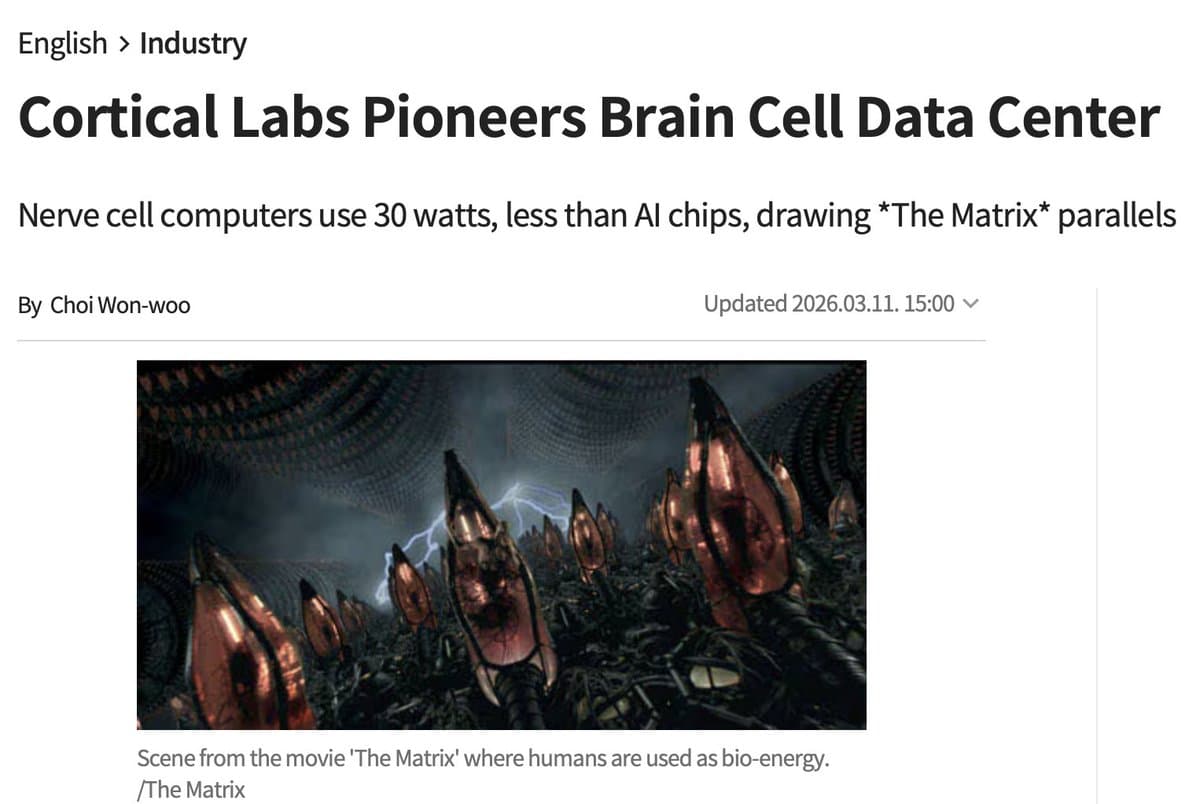
In a development that sounds more like science fiction than current technology, Australian startup Cortical Labs is creating what they call a "biological data center" - computing systems powered by living human brain cells rather than traditional silicon chips. This radical approach to computation represents one of the most intriguing frontiers in both artificial intelligence and biotechnology.
The CL1 Computer: Where Biology Meets Technology
Cortical Labs' CL1 computer represents a fundamental departure from conventional computing architecture. Instead of relying on semiconductor chips with transistors etched in silicon, the system connects living human neurons to electrodes, creating what researchers call a "biological neural network." This setup allows the neurons to receive input, process information, and generate output - essentially performing computational tasks using biological rather than electronic components.
What makes this system particularly remarkable is its demonstrated capability: the biological computer has learned to play the classic video game Doom. While this might seem like a novelty, it represents a significant proof of concept for biological computation. The neurons required approximately one week to learn this task, demonstrating that biological systems can adapt and respond to structured inputs in ways that resemble learning in both biological brains and artificial neural networks.
Energy Efficiency: The Game-Changing Advantage
The most immediately compelling aspect of Cortical Labs' biological computing approach is its extraordinary energy efficiency. The CL1 system reportedly consumes only about 30 watts of power while operating - a fraction of what traditional AI hardware requires for similar computational tasks.
This energy advantage could have profound implications for the future of data centers and AI infrastructure. Current AI models, particularly large language models and other deep learning systems, require massive amounts of energy for both training and inference. Data centers worldwide are consuming increasing percentages of global electricity, with AI computation representing a growing portion of that demand.
If biological computing can be scaled effectively, it could dramatically reduce the environmental impact of AI development and deployment. The 30-watt consumption figure is particularly striking when compared to the thousands of watts consumed by GPU clusters performing similar learning tasks.
The Science Behind Biological Computation
At its core, Cortical Labs' approach leverages the fundamental properties of neurons as information processing units. Neurons naturally communicate through electrical and chemical signals, forming networks that can process information in parallel and adapt their connections based on experience - properties that researchers have been trying to replicate in artificial neural networks for decades.
By connecting neurons to electrodes, researchers can both stimulate the neurons (providing input) and measure their responses (receiving output). The learning occurs as the neurons adapt their connections and responses to the patterns of stimulation they receive. This biological learning mechanism differs fundamentally from the mathematical optimization processes used in traditional machine learning, potentially offering different strengths and capabilities.
Current Limitations and Challenges
Despite the promising demonstrations, experts caution that biological computing remains highly experimental and faces significant challenges before it could become practical for widespread use.
One major limitation is cell lifespan. Unlike silicon chips that can operate for years or decades, living cells have finite lifespans and require specific environmental conditions to survive. Maintaining stable biological systems in computing environments presents substantial engineering challenges.
Training methods for biological computers also remain unclear and underdeveloped. While the Doom demonstration shows that learning is possible, researchers don't yet have systematic methods for training biological neural networks for specific tasks, nor do they fully understand how to optimize this learning process.
Scalability represents another significant hurdle. Current systems contain relatively small numbers of neurons compared to both biological brains and artificial neural networks. Scaling up to systems with millions or billions of neurons while maintaining stability and functionality will require breakthroughs in both biology and engineering.
Ethical Considerations and Future Implications
The development of biological computing raises important ethical questions that researchers and society will need to address. Using human neurons in computing systems blurs traditional boundaries between biological and technological systems, raising questions about consciousness, sentience, and the moral status of these hybrid systems.
There are also practical ethical considerations regarding the source of human neurons and how they are maintained. Unlike traditional computing components that are manufactured, biological components require different sourcing and maintenance approaches that must be developed responsibly.
Looking forward, biological computing could potentially offer capabilities that differ from traditional AI systems. Biological neurons process information in ways that are fundamentally different from digital computers, potentially offering advantages in areas like pattern recognition, adaptability, and energy efficiency for certain types of tasks.
The Road Ahead for Cortical Labs
Cortical Labs' work represents just the beginning of what could become an entirely new field of computing. The company will need to address the significant technical challenges while also navigating the ethical landscape of biological computation.
Success in this field could lead to hybrid computing systems that combine biological and electronic components, leveraging the strengths of both approaches. Such systems might offer unprecedented efficiency for specific computational tasks while opening new possibilities for human-computer integration.
The demonstration with Doom, while seemingly playful, serves as an important proof of concept that biological systems can perform meaningful computational work. As researchers develop better methods for interfacing with, training, and maintaining biological neural networks, we may see more sophisticated applications emerge.
Source: Based on reporting from Cortical Labs via @kimmonismus on X/Twitter