What Happened
A new research paper, submitted to arXiv on March 25, 2026, provides an empirical evaluation of a critical but often overlooked component of Retrieval-Augmented Generation (RAG) systems: document chunking. The study, "Evaluating Chunking Strategies For Retrieval-Augmented Generation in Oil and Gas Enterprise Documents," directly tests the performance of four different chunking strategies on a proprietary corpus of complex enterprise documents. This follows a week of significant arXiv activity, with the repository appearing in 42 articles, underscoring its role as the primary channel for disseminating cutting-edge, pre-peer-review AI research.
The core finding is that the choice of how to split a document into searchable "chunks" is not merely an implementation detail but a fundamental determinant of RAG quality and efficiency. The researchers quantified this by applying four strategies to a challenging dataset of oil and gas documents, which included text-heavy manuals, table-heavy specifications, and complex Piping and Instrumentation Diagrams (P&IDs).
Technical Details: The Four Chunking Strategies
The study compared the following methods:
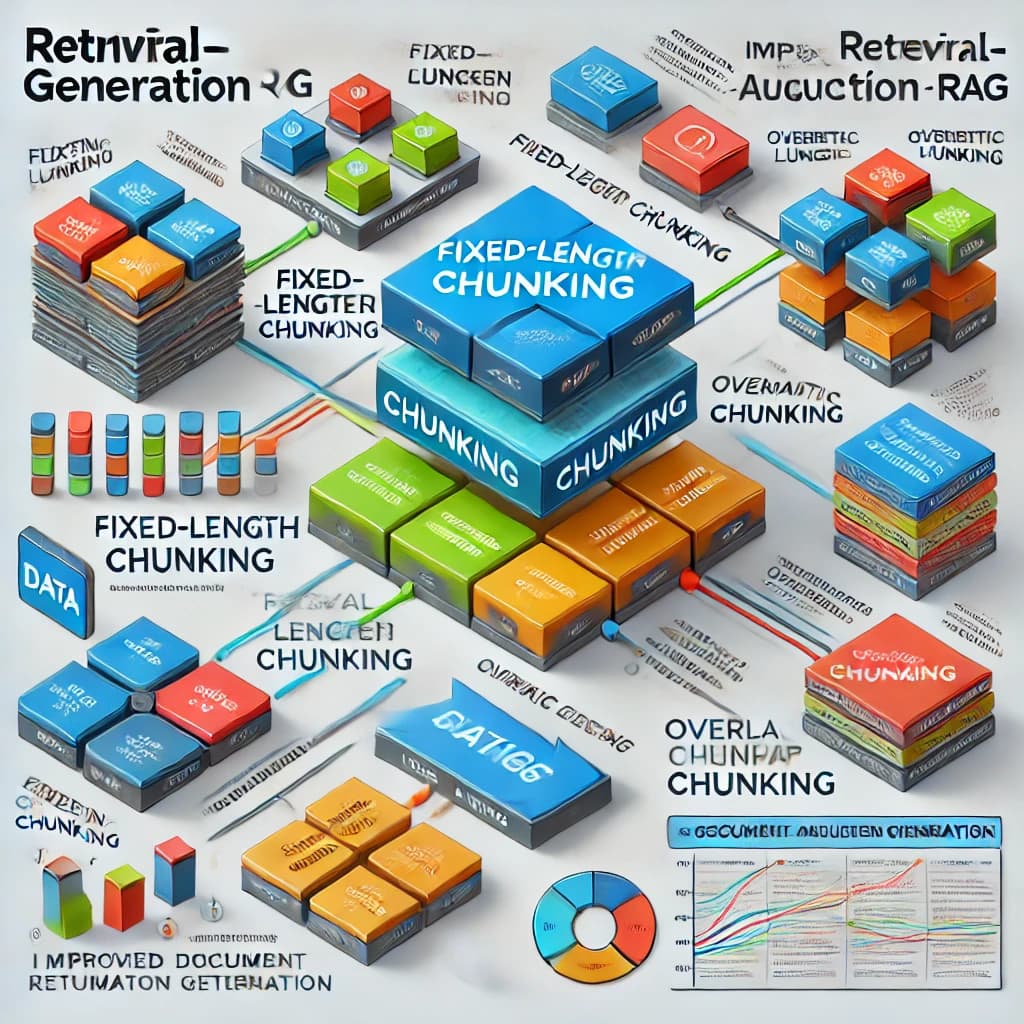
- Fixed-Size Sliding Window: The baseline method. It splits text into chunks of a predetermined token length with a small overlap between consecutive chunks. It's simple but often breaks apart semantically coherent units.
- Recursive Chunking: A hierarchical approach that attempts to split text by separators (like
\n\n,\n,., etc.) until chunks are of a desired size. It aims to keep paragraphs or sentences intact. - Breakpoint-Based Semantic Chunking: A more advanced method that uses embeddings to identify natural semantic boundaries. It aims to create chunks where the sentences within are semantically similar to each other.
- Structure-Aware Chunking: The novel approach evaluated. This method explicitly parses and preserves the inherent document structure (e.g., sections, subsections, headers, lists) during chunk creation. It treats the document as a tree and creates chunks that align with its logical nodes.
The evaluation measured retrieval effectiveness (e.g., top-K accuracy, recall) and computational cost (primarily embedding generation time).
Key Findings
- Structure-Aware Chunking is the Overall Winner. The research found that explicitly preserving document structure led to "higher overall retrieval effectiveness, particularly in top-K metrics." This makes intuitive sense for enterprise documents like manuals and specs, where the answer to a query is often contained within a specific, titled section. A chunk that cleanly encapsulates a full section is more likely to be retrieved correctly than one that arbitrarily cuts it in half.
- It's Also More Efficient. The structure-aware method "incurred significantly lower computational costs than semantic or baseline strategies." Semantic chunking requires generating embeddings for every candidate split point to find boundaries, which is computationally expensive. Structure-aware chunking uses a faster, rule-based parser, making it more scalable for large document corpora.
- A Hard Limit for Text-Only RAG. The most critical finding for practitioners is that all four methods demonstrated limited effectiveness on P&IDs. These are visual, spatially encoded engineering diagrams. Simply applying Optical Character Recognition (OCR) to extract text and then chunking it destroys the crucial visual relationships between components. The paper concludes this "underscor[es] a core limitation of purely text-based RAG within visually and spatially encoded documents."
Retail & Luxury Implications
While the study uses oil and gas documents, its conclusions are directly transferable to the retail and luxury sector, which deals with its own complex, multi-format enterprise knowledge.
Applicable Document Types in Retail/Luxury:
- Text-Heavy Manuals: Brand guidelines, compliance manuals, standard operating procedures (SOPs) for store operations, clienteling protocols, and sustainability reports.
- Table-Heavy Specifications: Product tech packs, material composition sheets, global pricing lists, supplier catalogs, and inventory SKU databases.
- Visually/Spatially Encoded Documents: Store floor plans, visual merchandising guides, packaging design mockups, fashion lookbooks, and campaign mood boards.
Strategic Takeaway: For building internal RAG systems (e.g., a corporate knowledge assistant for designers, planners, or store staff), a structure-aware chunking strategy should be the default starting point for textual documents. It promises better answer quality and lower running costs. However, teams must immediately recognize that any system aiming to answer questions about visual assets—like "show me all handbag designs from Fall/Winter 2024 that used a chain strap"—cannot rely on text-chunking of OCR'd files. This aligns with the industry's growing investment in multimodal models that can understand both image and text, a necessity highlighted by the paper's authors as "future work."
This research provides a data-backed rationale for moving beyond naive chunking. It suggests that the next wave of competitive advantage in enterprise AI won't just come from using a more powerful LLM, but from implementing more intelligent data preparation pipelines that respect the native structure and modality of business documents.
gentic.news Analysis
This paper arrives at a pivotal moment for RAG adoption in enterprise. Our coverage this week shows a strong preference for RAG over fine-tuning for production AI systems (March 24 trend report) and debates around custom models vs. retrieval (March 25 article on Mistral Forge). This study provides concrete, architectural guidance for those betting on the retrieval path. It confirms that the "garbage in, garbage out" principle applies acutely to RAG: sophisticated retrieval models are wasted on poorly chunked data.
The finding on P&ID failure is a sobering counterpoint to the general RAG enthusiasm. It connects directly to a core challenge in luxury: knowledge is often visual. A purely text-based corporate brain would be blind to the visual heritage and design language that defines a luxury house. This underscores why investments in multimodal foundational models and vision-language models (VLMs) are not just for consumer-facing applications but are critical for internal knowledge management.
Furthermore, the computational efficiency finding is crucial for cost-conscious enterprises. As RAG systems scale to thousands of documents, the embedding cost for semantic chunking can become significant. The structure-aware approach offers a path to higher performance and lower operational expense—a rare win-win in AI engineering.
Finally, this research, shared via arXiv, is part of a larger trend of rapid, open dissemination of applied AI knowledge. For technical leaders in retail, monitoring arXiv and synthesizing findings from adjacent industries (like oil and gas, healthcare, or finance) is becoming an essential strategy for anticipating pitfalls and identifying best practices before they hit the mainstream tech press.