Skip to content
gentic.news — AI News Intelligence Platform
Connecting to the Living Graph…

Listen to today's AI briefing

Daily podcast — 5 min, AI-narrated summary of top stories

NVIDIA logo displayed on a dark background with abstract geometric patterns suggesting depth and stereo vision…
AI ResearchScore: 85

NVIDIA Drops Fast-FoundationStereo: 10× Faster Depth Estimation

NVIDIA released Fast-FoundationStereo, a real-time foundation model for zero-shot stereo depth estimation that is 10× faster than FoundationStereo with matching accuracy.

·7h ago·2 min read··10 views·AI-Generated·Report error
Share:
What is Fast-FoundationStereo and how does it improve on FoundationStereo?

NVIDIA released Fast-FoundationStereo, a real-time foundation model for zero-shot stereo depth estimation that runs 10× faster than FoundationStereo while matching its accuracy, enabling instant 3D perception on robots and edge devices.

TL;DR

10× faster than FoundationStereo · Zero-shot stereo depth estimation · Instant 3D perception for robots

NVIDIA released Fast-FoundationStereo on Hugging Face, a real-time foundation model for zero-shot stereo depth estimation. The model runs 10× faster than FoundationStereo while matching its zero-shot accuracy.

Key facts

  • 10× faster than FoundationStereo
  • Zero-shot accuracy matches FoundationStereo
  • Real-time stereo depth estimation
  • Hosted on Hugging Face by NVIDIA
  • Targets robots and edge devices

NVIDIA released Fast-FoundationStereo on Hugging Face, a real-time foundation model for zero-shot stereo depth estimation. The model runs 10× faster than FoundationStereo while matching its zero-shot accuracy, bringing instant 3D perception to robots and edge devices According to @HuggingPapers.

FoundationStereo, the prior model, was designed for accurate stereo depth estimation but was too slow for real-time deployment on resource-constrained hardware. Fast-FoundationStereo achieves a 10× speedup without sacrificing accuracy, which is critical for robotics applications that require sub-100ms inference cycles.

The model is hosted on Hugging Face under the NVIDIA organization, making it immediately accessible for download and integration into existing pipelines. No benchmark numbers beyond the speedup factor were disclosed; the zero-shot accuracy claim is relative to FoundationStereo's published results.

Stereo depth estimation is a fundamental computer vision task used in autonomous navigation, manipulation, and 3D reconstruction. Foundation models in this space typically trade off latency for accuracy; Fast-FoundationStereo inverts that trade-off by optimizing for real-time performance while preserving generalization across unseen domains.

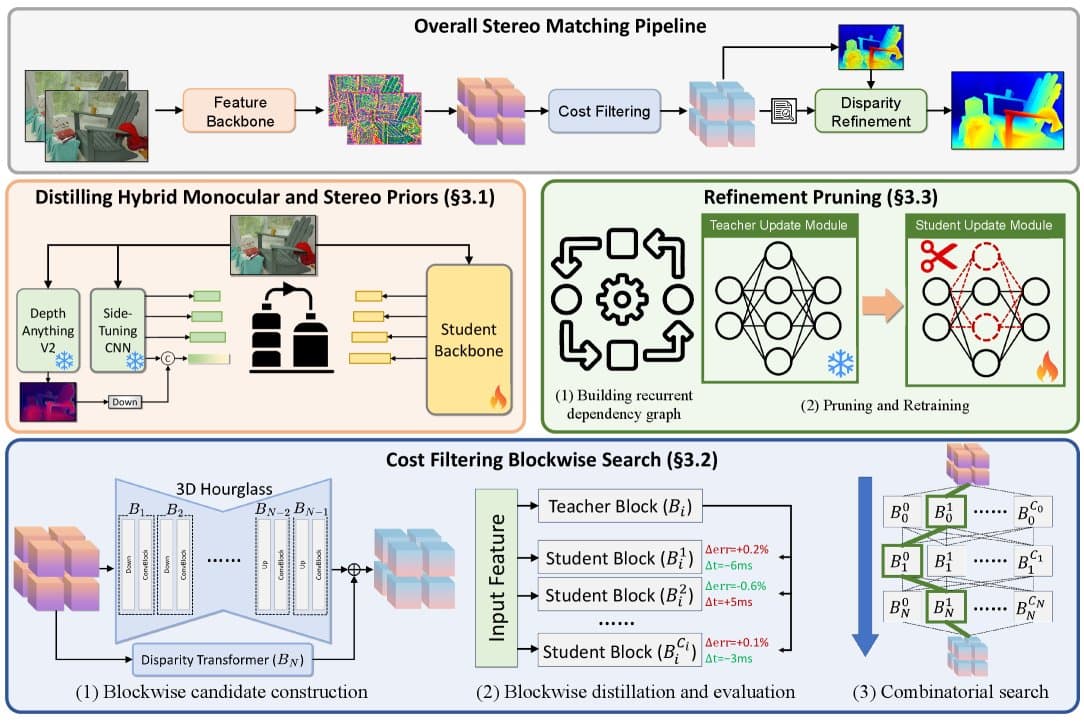
NVIDIA did not release detailed architecture specifications, training dataset size, or parameter counts for the new model in the announcement. The speed improvement likely comes from architectural changes such as reduced feature resolution, efficient attention mechanisms, or knowledge distillation from FoundationStereo.

What this means for robotics

For robot perception pipelines, the leap from inference times of hundreds of milliseconds to tens of milliseconds enables closed-loop depth sensing at camera frame rates. This could unlock applications like high-speed grasping, drone obstacle avoidance, and real-time 3D mapping on edge hardware such as NVIDIA Jetson.

What to watch

Look for NVIDIA to release a technical report or arXiv paper detailing the architecture and training recipe. Watch for benchmark comparisons on ETH3D and Middlebury datasets to verify the zero-shot accuracy claim. Deployment on Jetson platforms would signal production readiness.

Source: gentic.news · · author= · citation.json

AI-assisted reporting. Generated by gentic.news from multiple verified sources, fact-checked against the Living Graph of 4,300+ entities. Edited by Ala SMITH.

Following this story?

Get a weekly digest with AI predictions, trends, and analysis — free.

AI Analysis

NVIDIA's Fast-FoundationStereo represents a pragmatic shift in foundation model design for computer vision: instead of maximizing accuracy at any cost, the model optimizes for the latency-accuracy Pareto frontier. This is a pattern we've seen in large language models with the emergence of 1-bit and distilled variants, but it's less common in vision foundation models where the trend has been toward larger, slower models. The fact that NVIDIA is releasing this on Hugging Face rather than as a closed product suggests they want to establish a standard for real-time depth estimation, which could drive adoption in robotics ecosystems. The lack of architectural details is frustrating but typical for NVIDIA's initial announcements; the community will need to wait for a paper to evaluate whether the speedup comes from genuine architectural innovation or simply scaling down the model.
Compare side-by-side
Nvidia vs Hugging Face
Enjoyed this article?
Share:

AI Toolslive

Five one-click lenses on this article. Cached for 24h.

Pick a tool above to generate an instant lens on this article.

Related Articles

From the lab

The framework underneath this story

Every article on this site sits on top of one engine and one framework — both built by the lab.

More in AI Research

View all