In what industry analysts are calling a watershed moment for artificial intelligence infrastructure, NVIDIA has established such overwhelming market dominance that traditional competitive dynamics have fundamentally shifted. The company's strategic positioning at the intersection of hardware acceleration, software ecosystems, and developer mindshare has created what appears to be an insurmountable lead in the AI processor market.
The Architecture of Dominance
NVIDIA's rise to near-total market control didn't happen overnight but represents a decade-long strategic execution. The company's CUDA platform, first introduced in 2006, created a software moat that competitors have struggled to breach. While other companies focused solely on hardware specifications, NVIDIA invested billions in creating a complete ecosystem where AI researchers and developers could build, train, and deploy models with unprecedented efficiency.
This ecosystem advantage became particularly pronounced during the transformer architecture revolution that began with Google's "Attention Is All You Need" paper in 2017. NVIDIA's hardware-software integration proved uniquely suited to the parallel processing demands of large language models, creating a feedback loop where more developers chose NVIDIA platforms, which led to more optimization, which attracted even more developers.
Competitive Landscape: The Vanishing Alternatives
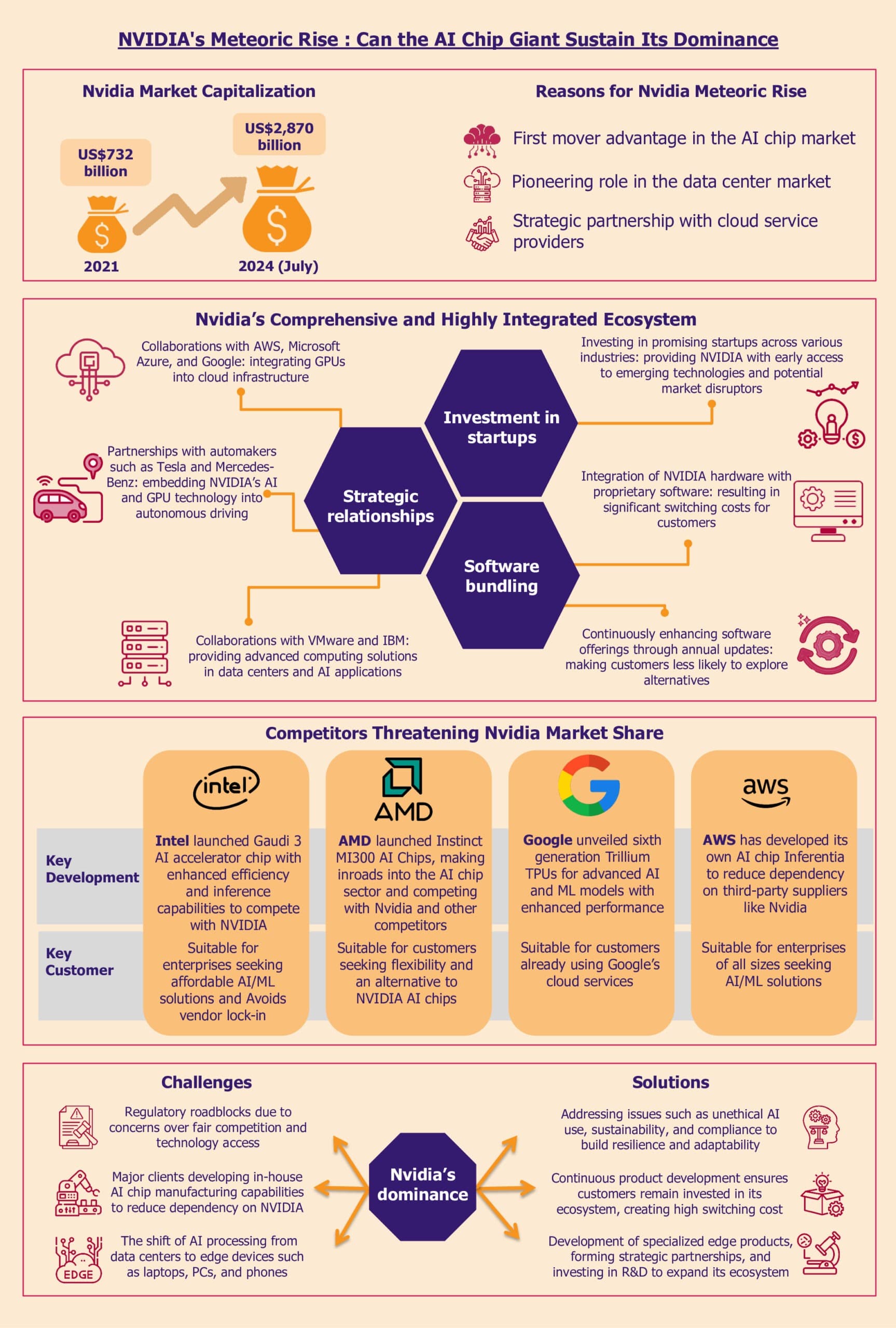
The competitive landscape tells a telling story. AMD's Instinct MI300 series, while technically competitive in raw performance metrics, has struggled to gain significant market share against NVIDIA's H100 and newer Blackwell architectures. Intel's Gaudi accelerators have found some niche applications but remain far from mainstream adoption in AI training. Even custom silicon from cloud giants like Google (TPU) and Amazon (Trainium) has captured only specific segments rather than challenging NVIDIA's general-purpose dominance.
Startups in the AI chip space face even steeper challenges. Without the software ecosystem, developer tools, and optimization libraries that NVIDIA provides, newcomers must convince customers to completely rework their AI infrastructure—a proposition few organizations are willing to entertain given the massive existing investments in NVIDIA-based systems.
The Financial and Strategic Implications
NVIDIA's market capitalization tells the story of its dominance. From approximately $300 billion in early 2020 to over $3 trillion in 2024, the company's valuation reflects not just current earnings but the strategic position it occupies in what many consider the most important technological revolution of our time.
This dominance creates complex dynamics for the broader AI industry. On one hand, NVIDIA's continued R&D investment—approximately $8.7 billion in 2023 alone—drives rapid hardware advancement that benefits the entire field. On the other hand, concentrated market power raises concerns about pricing power, innovation pace, and the long-term health of competitive markets.
The Ecosystem Lock-In Phenomenon
Perhaps NVIDIA's most formidable advantage lies in what economists call "switching costs." Organizations that have built their AI infrastructure around NVIDIA's ecosystem face enormous barriers to change. Retraining staff, rewriting code, and rearchitecting systems represents such significant investment that even technically superior alternatives struggle to gain traction.
This lock-in extends through multiple layers:
- Hardware layer: CUDA-optimized code running on NVIDIA GPUs
- Software layer: Libraries like cuDNN, TensorRT, and RAPIDS
- Developer layer: Millions of engineers trained on NVIDIA platforms
- Research layer: Academic papers optimized for and benchmarked on NVIDIA hardware
Future Challenges and Regulatory Scrutiny
As NVIDIA's dominance becomes more pronounced, regulatory attention is increasing. Competition authorities in multiple jurisdictions are examining whether the company's practices—particularly around its software licensing and ecosystem control—might constitute anti-competitive behavior. However, proving harm in fast-moving technology markets remains challenging, especially when customers continue to voluntarily choose NVIDIA solutions.
The company also faces technical challenges in maintaining its lead. As AI models grow increasingly large and complex, new architectural approaches may emerge that favor different hardware characteristics. Quantum-inspired computing, neuromorphic architectures, or photonic processors could potentially disrupt the current paradigm, though most experts believe such transitions remain years away.
The Global Supply Chain Dimension
NVIDIA's dominance has significant implications for global technology supply chains. The company's reliance on Taiwan Semiconductor Manufacturing Company (TSMC) for advanced chip manufacturing creates geopolitical considerations, particularly given tensions between China and Taiwan. Diversification efforts are underway, but building alternative manufacturing capacity at the required scale and sophistication represents a multi-year challenge.
Conclusion: A New Competitive Reality
NVIDIA's achievement represents both a remarkable business success story and a potential inflection point for AI development. The company hasn't merely outperformed competitors—it has redefined what competition means in the AI hardware space. Through visionary long-term investment in both hardware and ecosystem development, NVIDIA has created a position that may prove durable for years to come.
The question facing the industry is whether this concentration of power will ultimately accelerate or hinder AI progress. Will NVIDIA's continued investment drive faster innovation than a more fragmented market would produce? Or will the lack of competitive pressure lead to complacency and slower advancement? These questions will likely define the next chapter of artificial intelligence development.
Source: Analysis based on industry reports, financial disclosures, and competitive positioning as referenced in discussions of NVIDIA's market position.