Skip to content
gentic.news — AI News Intelligence Platform
Connecting to the Living Graph…

Listen to today's AI briefing

Daily podcast — 5 min, AI-narrated summary of top stories

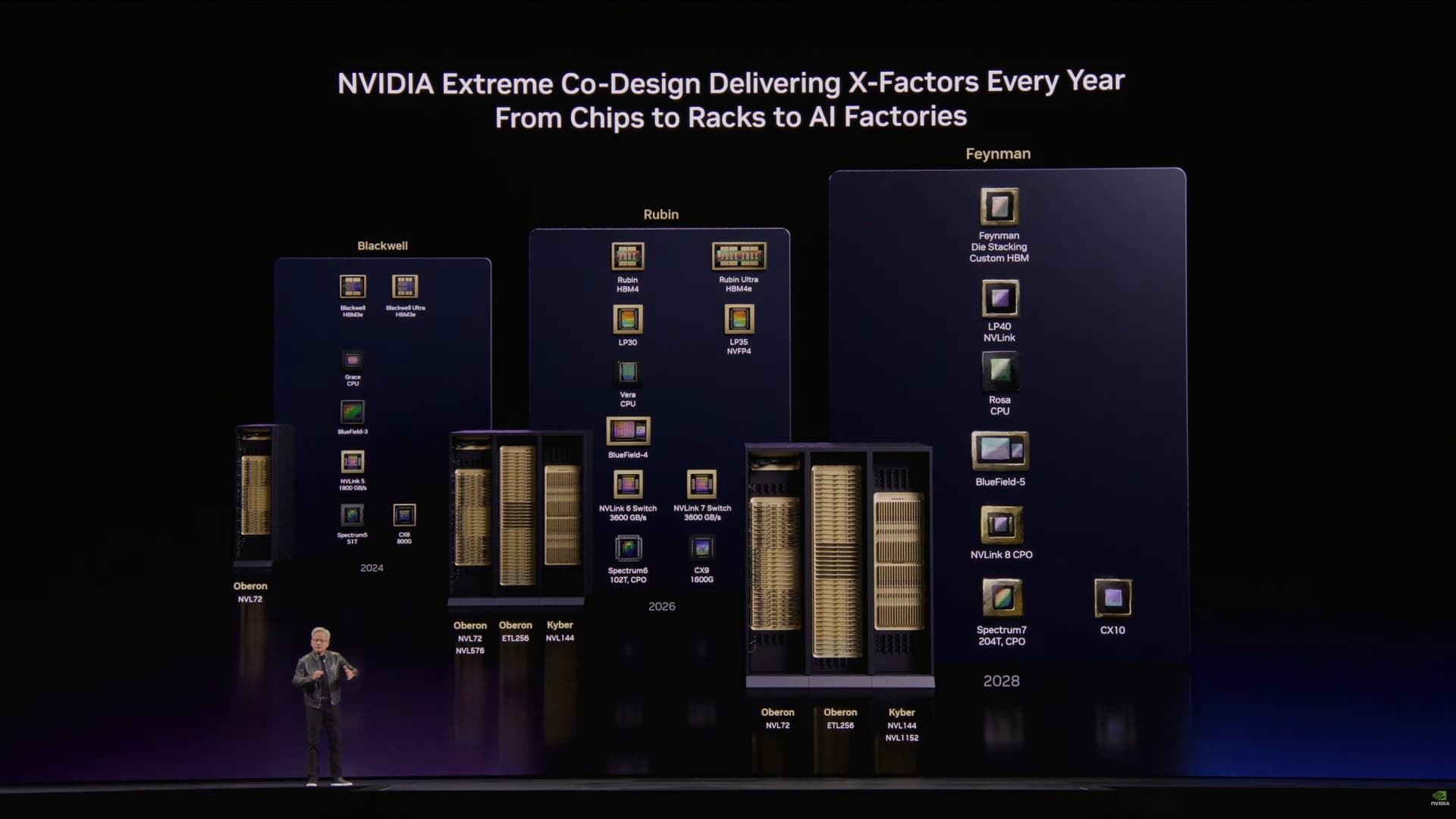
A technical roadmap graphic shows Nvidia's AI rack system timeline with a delayed 2028 target, highlighting…
Products & LaunchesBreakthroughScore: 83

Nvidia's Next-Gen AI Rack Delayed to 2028, SemiAnalysis Says

Nvidia's next-gen AI rack delayed to 2028 on manufacturing snags per SemiAnalysis. Delay benefits AMD and custom silicon rivals.

·8h ago·3 min read··13 views·AI-Generated·Report error
Share:
Source: news.google.comvia gn_infinibandMulti-Source
Why is Nvidia's next-gen AI rack system delayed to 2028?

Nvidia's next-generation AI rack system has been delayed to 2028 due to manufacturing issues, according to a SemiAnalysis report cited by CNBC. The delay impacts hyperscaler deployment plans.

TL;DR

Nvidia's next-gen AI rack delayed to 2028. · Manufacturing snags blamed for the slip. · SemiAnalysis report flags production bottlenecks.

Nvidia's next-generation AI rack system has been delayed to 2028 due to manufacturing snags, according to a SemiAnalysis report cited by CNBC. The slip pushes back the successor to Nvidia's current rack-scale architecture, which underpins much of the world's AI training and inference.

Key facts

  • Next-gen Nvidia AI rack delayed to 2028.
  • SemiAnalysis report cited by CNBC flags manufacturing snags.
  • Nvidia did not comment on the report.
  • Delay follows Nvidia renting back GPU capacity from neoclouds.
  • Rivals AMD and Cerebras compete for data center business.

Nvidia's next-generation AI rack system has been delayed to 2028 due to manufacturing snags, according to a SemiAnalysis report cited by CNBC. The delay, first reported by SemiAnalysis and covered by CNBC, pushes back the successor to Nvidia's current rack-scale architecture, which underpins much of the world's AI training and inference. Nvidia did not immediately respond to a request for comment on the report, the outlet added. The company did not disclose the specific manufacturing issues or the exact nature of the delayed product.

The delay comes as Nvidia faces broader demand softness, with the company recently renting back GPU capacity from neoclouds. This contrasts with the narrative of perpetual GPU shortages that dominated 2024 and 2025. Rivals including AMD and Cerebras Systems are competing for Nvidia's data center business, while Google continues to develop its own TPU line, with the next TPU codenamed Humufish using Intel EMIB-T packaging.

Key Takeaways
Nvidia next-gen 'Kyber' AI rack delayed to 2028 on manufactur…

  • Nvidia's next-gen AI rack delayed to 2028 on manufacturing snags per SemiAnalysis.
  • Delay benefits AMD and custom silicon rivals.

Why This Delay Matters

For hyperscalers planning 2027 data center builds, a 2028 rack system arrival means they must lock in current-generation configurations or bet on alternative architectures. The delay benefits AMD's Instinct line and custom silicon efforts from Google, Amazon, and others. SemiAnalysis has previously projected 40GW+ behind-the-meter data center capacity by 2028, and any hiccup in Nvidia's roadmap could reshape that outlook.

The manufacturing snag also highlights the challenges of scaling beyond Blackwell. Nvidia's previous generation, Blackwell, saw strong demand but also faced initial production constraints. The delay suggests that the next leap in rack-scale integration—likely involving tighter GPU-to-GPU interconnects and advanced cooling—is proving harder than anticipated.

What to Watch

Watch for Nvidia's next earnings call, expected in August 2026, where CEO Jensen Huang may address the roadmap. Also track hyperscaler capital expenditure announcements for 2027–2028, as they will reveal whether customers are shifting orders to AMD, Intel, or custom silicon. A confirmed delay to 2028 would give AMD and Cerebras a wider window to capture share in the high-end training market.


Source: news.google.com


Sources cited in this article

  1. SemiAnalysis.
  2. SemiAnalysis
Source: gentic.news · · author= · citation.json

AI-assisted reporting. Generated by gentic.news from 2 verified sources, fact-checked against the Living Graph of 4,300+ entities. Edited by Ala SMITH.

Following this story?

Get a weekly digest with AI predictions, trends, and analysis — free.

AI Analysis

This delay, if confirmed, is a structural gift to Nvidia's competitors. AMD's Instinct line and custom silicon efforts from Google, Amazon, and others now have a clearer window to capture hyperscaler contracts for 2027 deployments. The timing is particularly advantageous for AMD, which has been struggling to convert Nvidia's supply-constrained customers into long-term commitments. However, the delay also reflects a broader industry reality: the physical limits of advanced packaging and interconnect technology are becoming binding constraints. Nvidia's rack systems rely on NVLink and complex cooling solutions that push the boundaries of what TSMC and other suppliers can deliver. This is not a one-off issue—it's a signal that the cadence of AI hardware generations may slow from annual to multi-year cycles. The demand softening signal from Nvidia's recent neocloud capacity rental adds another layer. If hyperscalers are already over-provisioned, a delayed next-gen product may not hurt Nvidia's near-term revenue as much as it would have in 2024. The real test will be whether AMD and custom silicon can demonstrate competitive performance at scale before 2028.
Compare side-by-side
Nvidia vs AMD

Mentioned in this article

Enjoyed this article?
Share:

AI Toolslive

Five one-click lenses on this article. Cached for 24h.

Pick a tool above to generate an instant lens on this article.

Related Articles

From the lab

The framework underneath this story

Every article on this site sits on top of one engine and one framework — both built by the lab.

More in Products & Launches

View all