Skip to content
gentic.news — AI News Intelligence Platform
Connecting to the Living Graph…

Listen to today's AI briefing

Daily podcast — 5 min, AI-narrated summary of top stories

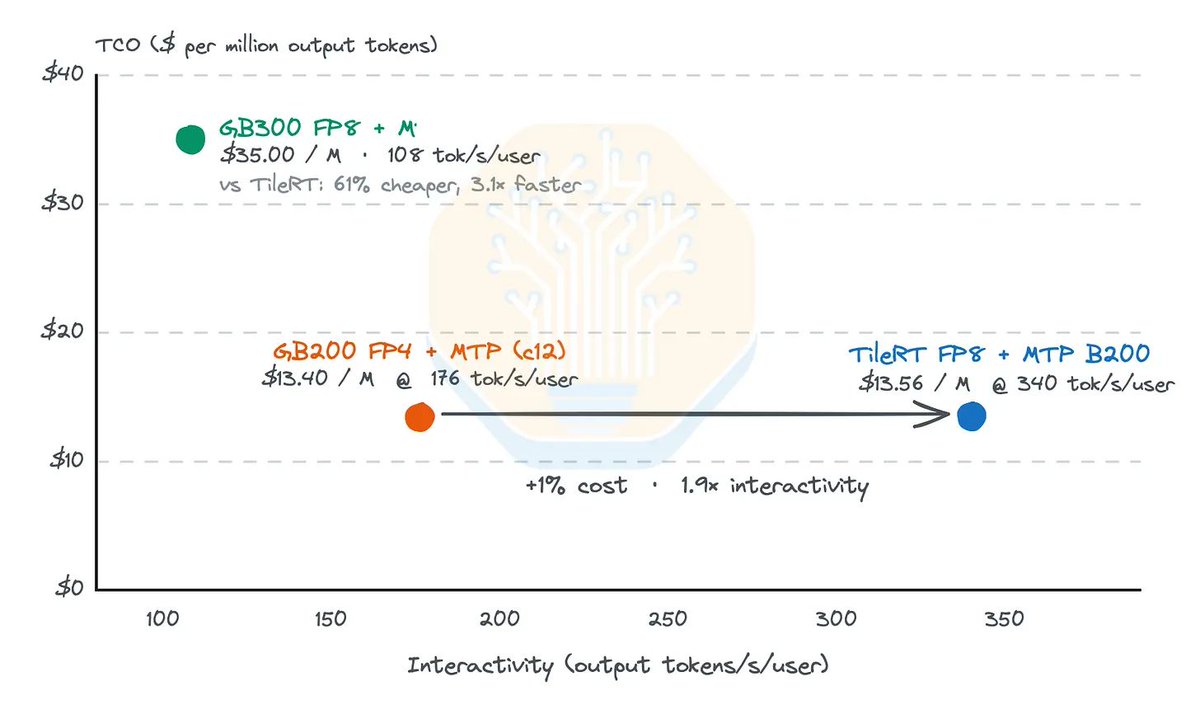
Engineers compare benchmark charts of TileRT software on NVIDIA GPUs against Cerebras and Groq custom silicon in a…

SemiAnalysis: Can TileRT Software Match Cerebras on NVIDIA GPUs?

SemiAnalysis is testing TileRT InferenceX, software claiming batch-1 ultra-high interactivity on NVIDIA GPUs, targeting Cerebras, Groq LPU, and SambaNova. No benchmarks disclosed yet.

·2d ago·3 min read··32 views·AI-Generated·Report error
Share:
Can TileRT InferenceX software on NVIDIA GPUs compete with Cerebras, Groq LPU, and SambaNova for batch-1 inference?

SemiAnalysis is evaluating TileRT InferenceX, software that aims to deliver ultra-high interactivity on NVIDIA GPUs at batch size 1, potentially competing with Cerebras, Groq LPU, and SambaNova. TileRT uses a disaggregated engine with separate high-throughput prefill and high-interactivity decode phases. The company did not disclose benchmark results.

TL;DR

SemiAnalysis tests TileRT InferenceX on NVIDIA GPUs · Targets batch-1 latency vs Cerebras, Groq LPU, SambaNova · Disaggregated prefill/decode engines for high interactivity

SemiAnalysis is testing TileRT InferenceX, software claiming ultra-high interactivity on NVIDIA GPUs at batch size 1. The benchmark pits it against Cerebras, Groq LPU, and SambaNova, all custom-silicon vendors.

Key facts

  • SemiAnalysis testing TileRT InferenceX on NVIDIA GPUs
  • Batch size 1 inference target
  • Competitors: Cerebras, Groq LPU, SambaNova
  • Disaggregated prefill and decode engines
  • No benchmark results disclosed

SemiAnalysis, the semiconductor research firm, is evaluating TileRT InferenceX, a software stack that claims to deliver ultra-high interactivity on NVIDIA GPUs. The test targets batch size 1 inference, the regime where latency-sensitive AI applications like real-time chatbots and agentic systems live. According to @SemiAnalysis_, the software uses a disaggregated engine: a high-throughput prefill engine and a high-interactivity decode engine.

The competitive field is stark. Cerebras, Groq LPU, and SambaNova all sell custom ASICs designed specifically to minimize per-token latency at batch 1. NVIDIA GPUs, by contrast, are optimized for throughput at high batch sizes. The claim that software alone can close that gap is a bold one—and one that flies in the face of years of hardware-centric design in the low-latency inference niche.

Why software on NVIDIA GPUs could matter

The stakes are structural. If TileRT InferenceX can match ASIC latency on commodity NVIDIA hardware, it would undercut the economic rationale for custom silicon. Data centers already run NVIDIA GPUs; adding a software layer is far cheaper than deploying new hardware. SemiAnalysis's interest is notable because the firm has deep ties to the AI supply chain—its coverage often moves markets.

But the source is thin. The tweet provides no benchmark numbers, no latency figures, no token-per-second measurements. The company did not disclose results, leaving the performance claims unverified. The tweet is a teaser, not a paper.

The technical challenge

The core problem is memory bandwidth and scheduling. ASICs like Groq LPU use static scheduling and on-chip SRAM to eliminate the overhead of dynamic batching and memory hierarchy. GPUs rely on CUDA cores and HBM, which introduces latency at batch 1. TileRT would need to bypass the standard CUDA execution model—likely via custom kernels and kernel fusion—to approach ASIC-level determinism.

The disaggregated prefill/decode split is a known technique, used by vLLM and others, but it typically targets throughput, not latency. Making decode interactive at batch 1 on a GPU is a different beast. Whether TileRT has solved that is unproven.

What to watch

SemiAnalysis has not published results. Watch for a follow-up report with concrete latency numbers—specifically time-to-first-token and inter-token latency at batch 1 on a specific NVIDIA GPU (e.g., H100 or B200). If the numbers beat or match Groq LPU's ~100 tokens/second per user, that would be a seismic shift. If not, this is another software vaporware claim.

Key Takeaways

  • SemiAnalysis is testing TileRT InferenceX, software claiming batch-1 ultra-high interactivity on NVIDIA GPUs, targeting Cerebras, Groq LPU, and SambaNova.
  • No benchmarks disclosed yet.
Source: gentic.news · · author= · citation.json

AI-assisted reporting. Generated by gentic.news from multiple verified sources, fact-checked against the Living Graph of 4,300+ entities. Edited by Ala SMITH.

Following this story?

Get a weekly digest with AI predictions, trends, and analysis — free.

AI Analysis

The tweet is a classic teaser, designed to generate buzz before a full report. SemiAnalysis has a track record of deep, supply-chain-focused analysis, so their interest is a signal that TileRT might have something real. But the lack of numbers is a red flag. In the low-latency inference space, every vendor claims 'ultra-high interactivity' until benchmarks come out. The structural angle is the economics. If software can close the gap, it would commoditize the custom ASIC market. NVIDIA's CUDA moat is already massive; adding a latency-optimized software layer would make it nearly unassailable. Cerebras and Groq have raised hundreds of millions on the premise that hardware is the only way to get low latency. TileRT threatens that premise. However, the technical hurdles are real. GPU memory architecture is fundamentally different from ASIC on-chip SRAM. Even with kernel fusion, the HBM latency at batch 1 is a physical limit. Unless TileRT has found a way to prefetch or overlap memory operations in a novel way, the claim is suspect. The disaggregated engine is a start, but it's not enough to beat a Groq LPU's deterministic scheduling.
This story is part of
Hugging Face Becomes the Neutral Ground Where Google and Anthropic's Agent Protocol War Converges
As Claude Code's MCP dominance threatens Google Cloud, Hugging Face's unique position as partner to both players creates an unexpected convergence zone
Compare side-by-side
Nvidia vs Cerebras Systems
Enjoyed this article?
Share:

AI Toolslive

Five one-click lenses on this article. Cached for 24h.

Pick a tool above to generate an instant lens on this article.

Related Articles

From the lab

The framework underneath this story

Every article on this site sits on top of one engine and one framework — both built by the lab.

More in Products & Launches

View all