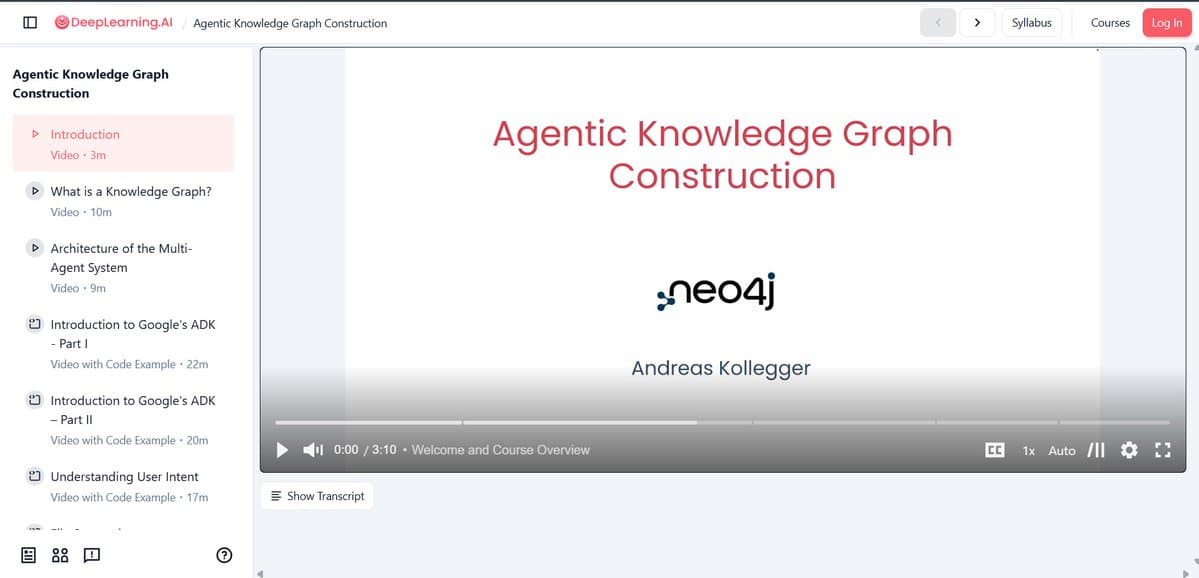
Neo4j and Andreas Kollegger released a free course on agentic knowledge graph construction. It teaches a multi-agent system on Google's Agent Development Kit that merges structured and unstructured data into a linked knowledge graph.
Key facts
- Course built with Neo4j, taught by Andreas Kollegger
- Multi-agent system on Google's Agent Development Kit (ADK)
- Agents process CSV and text in parallel, then merge
- Stores chunks and entities as linked nodes, not just vectors
- Pitched as better grounding than plain RAG
Neo4j and Andreas Kollegger have released a free course on agentic knowledge graph construction according to @_vmlops. The course builds a multi-agent system on Google's Agent Development Kit (ADK), where one agent extracts the user's goal and graph type through conversation, while separate agent groups process structured data (CSV) and unstructured data (text) in parallel. Final agents merge both into one connected knowledge graph, storing chunks and extracted entities as linked nodes, not just vector embeddings.
The pitch is better grounding than plain RAG for high-stakes use cases where accuracy of retrieval actually matters. This positions knowledge graphs as a structural alternative to vector-only retrieval, a contrast that has been gaining traction as RAG's limitations become more apparent in production.
The course is built in partnership with Neo4j, the graph database company, and taught by Kollegger, a known figure in the graph space. The source did not disclose the course length, platform, or whether it is self-paced or scheduled.
Key Takeaways
- Neo4j and Andreas Kollegger released a free course on agentic knowledge graph construction using Google's ADK, promising better grounding than RAG.
- The course teaches parallel processing of CSV and text into a linked graph.
Why this matters

This is not just another tutorial. It signals a shift toward agentic workflows that combine structured and unstructured data into a unified graph, rather than relying solely on vector embeddings. For engineers building retrieval systems, the course offers a concrete pattern for improving accuracy in domains like legal, medical, or financial search, where a single wrong answer is costly.
The use of Google's ADK, rather than a proprietary framework, suggests an effort to standardize agent orchestration. Whether this approach will displace RAG remains to be seen, but the course gives developers a hands-on way to evaluate it.
What's missing

The announcement does not specify the course's cost (though it is described as "dropped," implying free), the number of modules, or the expected time commitment. The source also does not mention any code repository or community forum for support, which could be a barrier for learners.
Given the partnership with Neo4j, it is likely the course will heavily feature Neo4j's tools, but the source does not confirm this. Interested developers should check the course page for prerequisites and whether it requires a Neo4j instance or offers a cloud sandbox.
What to watch
Watch for the course's full syllabus and whether Neo4j releases a companion blog post or GitHub repo with code. Also track adoption signals: if major AI conferences or enterprises cite this pattern in the next quarter, agentic knowledge graphs could move from tutorial to production standard.