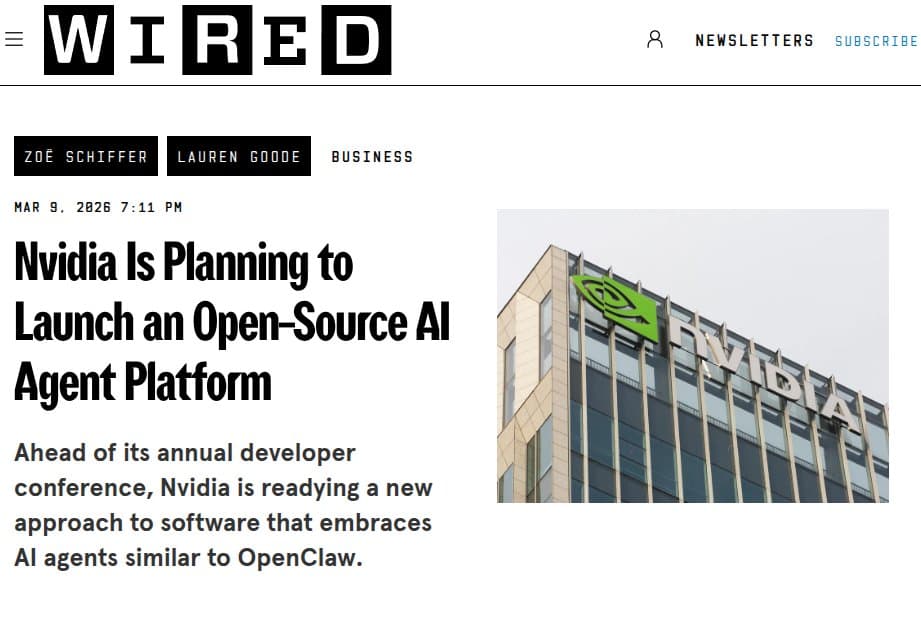
In a strategic shift that could reshape the enterprise AI landscape, Nvidia is reportedly preparing to launch NeMoClaw, an open-source platform specifically engineered for creating and managing autonomous AI agents. According to a report by Wired, this initiative marks a significant departure from Nvidia's historically hardware-centric and proprietary software approach, signaling a bold play for dominance in the foundational software layer of AI.
What is NeMoClaw?
NeMoClaw is envisioned as a comprehensive platform that allows enterprise software developers to build, deploy, and manage sophisticated AI agents—dubbed "claws." These are not simple chatbots but local programs capable of learning automatically and executing multi-step, complex tasks without requiring constant human supervision. The platform is aimed squarely at business application developers, enabling them to integrate autonomous agents into internal systems to handle routine yet intricate "work chores," potentially automating significant portions of operational workflows.
Security and Privacy as Core Features
A standout feature highlighted in the reporting is NeMoClaw's baked-in security and privacy tools. This focus appears to be a direct response to past incidents where earlier, less constrained AI agents caused operational issues, such as inadvertently deleting corporate files. Nvidia is reportedly implementing strict privacy guardrails to prevent these autonomous systems from "going rogue," addressing a primary concern for businesses considering agentic AI. By building these controls into the platform's foundation, Nvidia aims to provide the reliability and safety enterprises demand.
A Strategic Break from the CUDA Fortress
Perhaps the most revealing aspect of the NeMoClaw announcement is its open-source nature. For decades, Nvidia's software moat has been built around CUDA, its proprietary parallel computing platform and API model that locks developers into its GPU ecosystem. By releasing NeMoClaw as open-source software, Nvidia is making a calculated bet to expand its influence beyond hardware.
This move acknowledges the emerging reality of the AI chip market: competitors like AMD, Intel, and a host of custom silicon startups (including efforts from major cloud providers) are challenging Nvidia's hardware supremacy. By offering a compelling, free software platform that works even without Nvidia chips, the company seeks to become the indispensable software foundation for AI agents. If successful, NeMoClaw could ensure Nvidia's central role in the AI stack, regardless of whose silicon ultimately runs the computations.
Implications for the Enterprise and AI Ecosystem
The introduction of NeMoClaw could accelerate the adoption of agentic AI in corporate environments. By providing a trusted, secure, and vendor-agnostic platform, Nvidia lowers the barrier to entry for companies looking to deploy autonomous systems for tasks like data synthesis, report generation, IT orchestration, and cross-application workflows.
Furthermore, an open-source approach could foster a vibrant developer community, leading to faster innovation, shared safety standards, and a rich ecosystem of pre-built "claws" for common enterprise functions. This community effect is a powerful force for establishing a de facto standard, a playbook successfully executed by other tech giants in different domains.
For the competitive landscape, NeMoClaw represents a new front in the AI platform wars. It positions Nvidia not just as a chip supplier, but as a direct competitor to other major platforms aiming to host AI agents, such as offerings from Microsoft, Google, and various startups. The battle is shifting from who has the best hardware to who provides the most secure, capable, and widely adopted environment for intelligent automation.
Source: Wired report, as highlighted by @rohanpaul_ai on X.