NVIDIA Open-Sources NeMo Claw: A Local Security Sandbox for AI Agents

NVIDIA Open-Sources NeMo Claw: A Local Security Sandbox for AI Agents

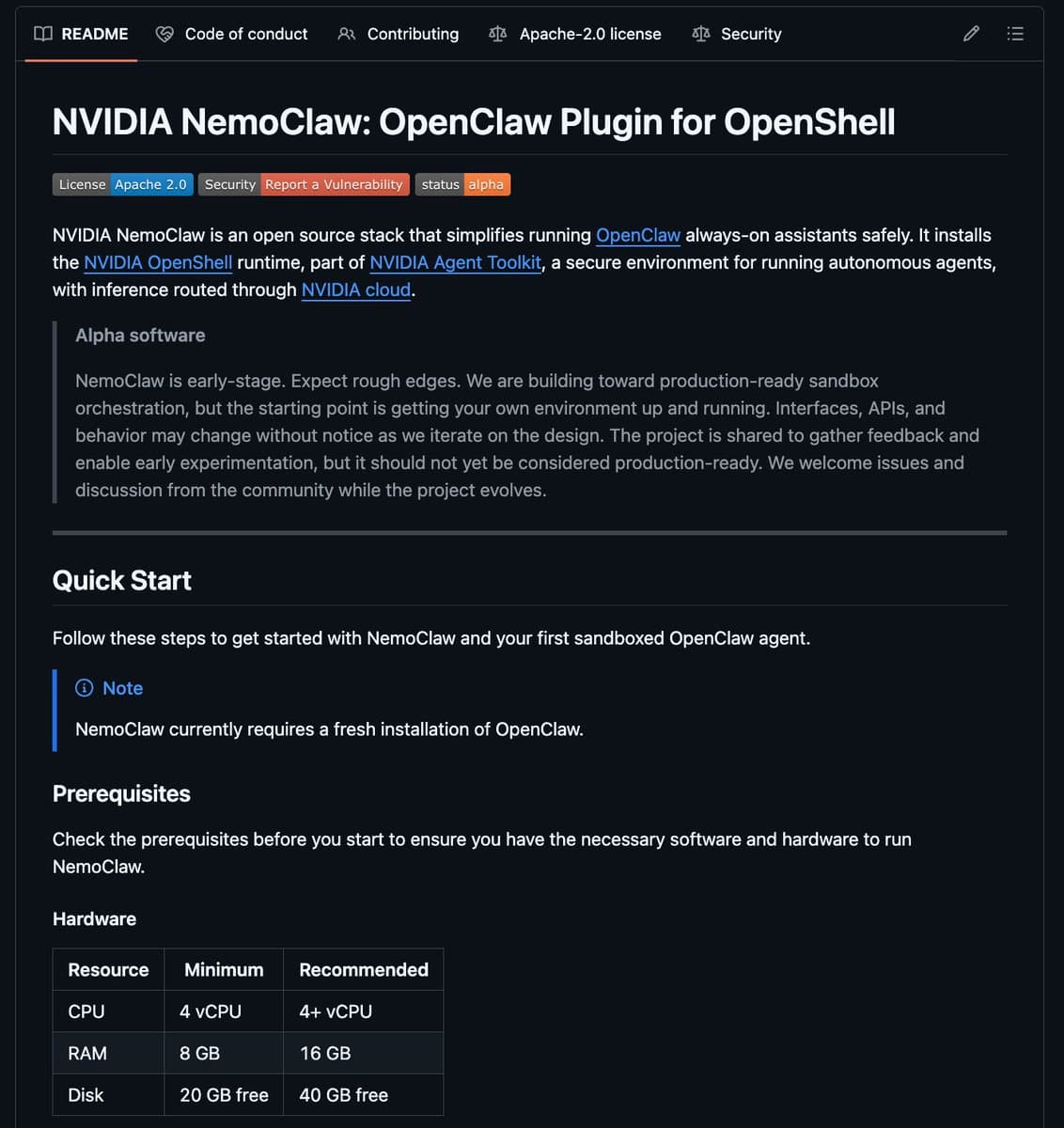
NVIDIA has open-sourced NeMo Claw, a security sandbox designed to run AI agents locally. It isolates models from cloud services, blocks unauthorized network calls, and secures model APIs via a single installation script.

2h ago·2 min read·6 views·via @hasantoxr
Share:

What Happened

NVIDIA has released NeMo Claw as an open-source project. According to the announcement, it is a "full security sandbox for running AI agents locally." The core promise is to enable local execution of AI models and agents while implementing security controls that typically require complex manual configuration.

The key claimed features are:

  • Local Execution: Keeps model inference and agent operations on the local machine, preventing data from being sent to cloud services.
  • Network Security: Blocks unauthorized outbound network calls from the AI agents or models running within the sandbox.
  • API Lockdown: Secures access to model APIs (presumably including local inference endpoints) as part of the sandbox environment.
  • Simplified Deployment: The entire setup is reportedly achievable with "one install script."

The project is described as "100% Opensource," with a link provided to the repository.

Context

The release addresses a growing concern in the AI development community: the security and privacy implications of AI agents. As agents become more capable of performing tasks autonomously—such as file manipulation, web browsing, or tool use—they present new attack surfaces and data exfiltration risks. Running agents locally is a common request for privacy-sensitive applications, but securing them requires significant system-level expertise.

NVIDIA's NeMo platform is a suite of tools for building, customizing, and deploying generative AI models. NeMo Claw appears to be an extension focused on the secure deployment and runtime of AI agents built with or compatible with the NeMo ecosystem. An open-source, locally-focused security layer could lower the barrier for developers and enterprises wanting to experiment with or deploy AI agents without relying on managed cloud services or building custom security containment from scratch.

Note: At the time of writing, the linked repository and any official NVIDIA documentation should be consulted for detailed technical specifications, supported platforms, and exact security guarantees.
AI Analysis

If NeMo Claw delivers on its premise, it represents a pragmatic tooling shift rather than a research breakthrough. Its value is in productization and simplification. The hard problems in AI agent security—like guaranteeing that an agent with filesystem access won't exfiltrate data through encoded outputs, or safely granting it limited network access—are not solved by a sandbox alone. NeMo Claw's utility will depend on its implementation: whether it uses robust OS-level isolation (e.g., containers, VMs, gVisor) and how it mediates and audits agent actions. For practitioners, the immediate question is compatibility. Does it only sandbox agents built with NVIDIA's NeMo framework, or is it runtime-agnostic? The 'one install script' claim suggests a focus on developer experience, but the trade-off is often flexibility. Engineers should examine whether it imposes specific model formats (like TensorRT-LLM) or if it can wrap arbitrary Python environments. Its open-source nature is critical, allowing security reviews and customizations, which are essential for trust in a security-critical layer. This move aligns with NVIDIA's broader strategy of providing the full software stack for AI deployment, from training (NeMo) to inference (TensorRT-LLM, Triton) and now secured execution. It's a competitive response to the growing ecosystem of cloud-based agent platforms (e.g., OpenAI's GPTs, Microsoft's Copilot Studio) and open-source agent frameworks (CrewAI, AutoGen), offering a differentiated on-premise, security-focused path. The success of NeMo Claw will hinge on its performance overhead, ease of use, and the granularity of security policies it supports.
Original sourcex.com

Trending Now

More in Products & Launches

Browse more AI articles