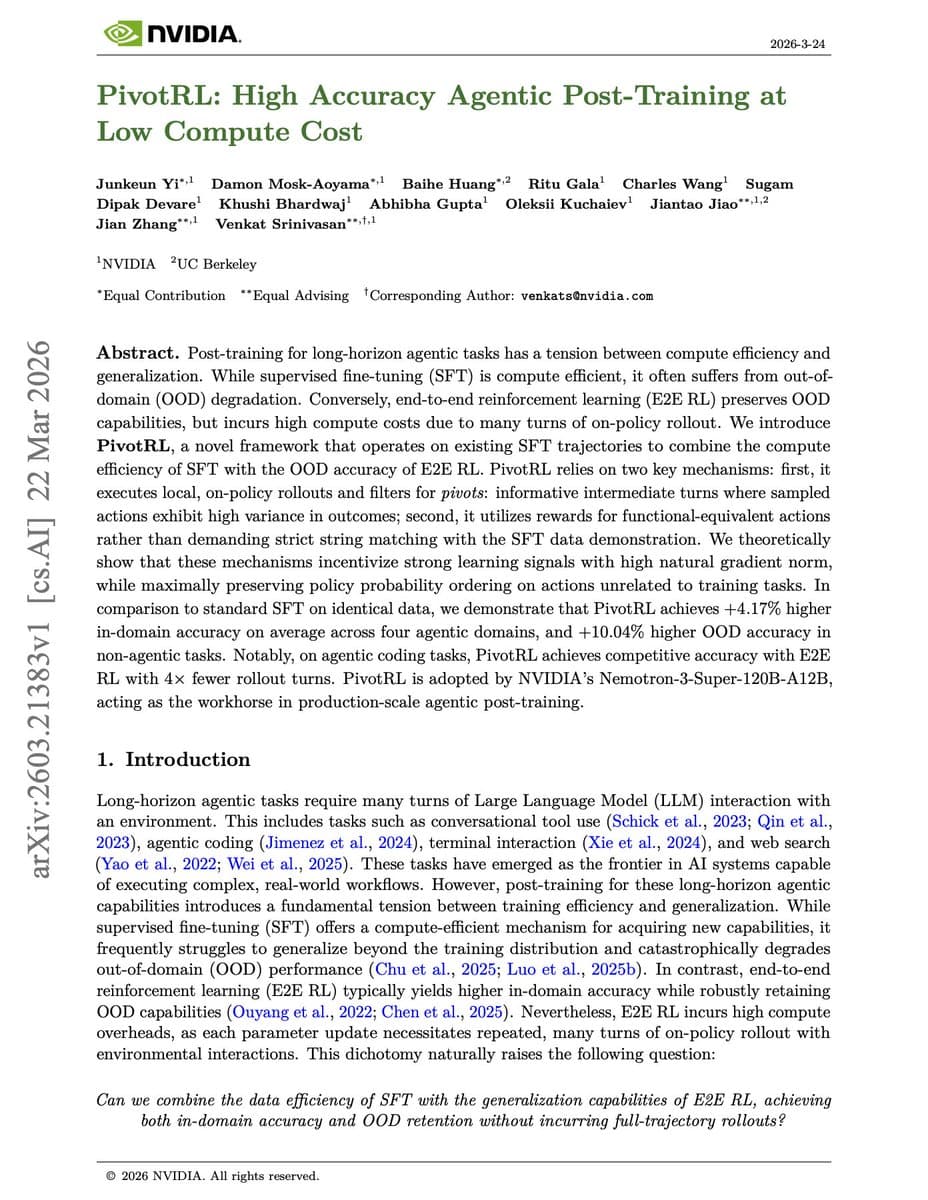
NVIDIA has published research on PivotRL, a new framework designed to dramatically reduce the computational cost of applying reinforcement learning (RL) to fine-tune AI agents for complex, multi-turn tasks. The core problem it addresses is straightforward but critical: traditional end-to-end RL for agents requires generating and scoring complete, multi-step trajectories for every parameter update, which becomes prohibitively expensive for long-horizon reasoning.
PivotRL proposes a practical middle ground between standard supervised fine-tuning (SFT) and full RL. According to the research, it has already been deployed as the "workhorse" for the agentic post-training of NVIDIA's Nemotron-3-Super-120B model.
What the Researchers Built: A Smarter, Cheaper Training Signal
PivotRL is not a new RL algorithm but a training framework that operates on existing SFT trajectories. Its key innovation is the identification of "pivots"—specific, informative intermediate turns within a multi-step interaction where the model's sampled actions lead to mixed or uncertain outcomes. These are the moments where the training signal is highest.
Instead of performing exhaustive, end-to-end rollouts from scratch for every learning step, PivotRL focuses computational effort only on these pivot points. It trains the model by exploring alternative actions at these junctures and evaluating their downstream consequences, effectively applying RL-style credit assignment locally rather than globally.
Key Results: Efficiency Gains Without Sacrificing Performance
The paper presents concrete benchmarks comparing PivotRL against standard SFT and full end-to-end RL (E2E RL). The results highlight a significant efficiency breakthrough.
On SWE-Bench, a benchmark for evaluating AI agents on real-world software engineering issues, PivotRL achieved competitive accuracy with full E2E RL while being far more efficient:
Rollout Turns Used 4x fewer Baseline Wall-Clock Time 5.5x less BaselineBeyond raw efficiency, the method addresses a known weakness of SFT. The researchers found that while SFT improves in-domain performance, it often degrades out-of-domain (OOD) generalization because it overfits to the specific trajectories in the dataset.
- Standard SFT: Achieved +9.94 average in-domain gain but degraded OOD performance by -9.83 points.
- PivotRL: Achieved a higher +14.11 average in-domain gain while maintaining near-zero OOD change (+0.21), effectively preserving the base model's generalization capabilities.
How PivotRL Works: Targeting High-Signal Moments
The technical process can be broken down into three main stages:
Trajectory Collection & Pivot Identification: The framework starts with a dataset of successful trajectories (e.g., from SFT). It then analyzes these trajectories to find pivot turns. A pivot is defined as a step where the model's action has high learning potential—typically where the probability mass is spread across multiple plausible actions, or where a small change could significantly alter the trajectory's success.
Localized Rollout & Credit Assignment: At each identified pivot, the model samples alternative actions. A reward model or environment then evaluates the consequences of these alternative paths. This creates a targeted dataset of
(state, action, reward)pairs focused solely on the critical decision points.Efficient Policy Optimization: The model is updated using these high-signal, pivot-centric data points via policy gradient methods. Because rollouts are only performed from pivot states and not from the start of every episode, the computational cost is drastically reduced.
This approach combines the data efficiency of SFT (reusing existing trajectories) with the generalization benefits of RL (learning from rewards and exploring alternatives).
Why It Matters: Making Agent RL Practical
The significance of PivotRL is its potential to shift the economics of developing advanced AI agents. End-to-end RL has been a gold standard for improving agent robustness and generalization but is often relegated to research or large-scale corporate projects due to its immense computational appetite. By cutting wall-clock time by 5.5x and rollout turns by 4x, PivotRL makes sophisticated RL training accessible for a broader range of models and applications.
Its immediate deployment in training the Nemotron-3-Super-120B agent underscores its practical utility for NVIDIA. For the broader AI engineering community, it provides a blueprint for how to structure agent training pipelines to be more cost-effective without sacrificing the core benefits of reinforcement learning.
gentic.news Analysis
This research from NVIDIA is a direct and pragmatic response to the escalating computational costs of agent training, a trend we've tracked closely. It follows a series of industry moves toward more efficient training paradigms, such as Google's recent work on JEST for data selection and Meta's research into joint example selection. PivotRL differs by focusing specifically on the RL fine-tuning stage, which is arguably the most expensive phase for agentic models.
The deployment within the Nemotron-3-Super-120B pipeline is telling. NVIDIA's Nemotron family is positioned as a key competitor in the open-weight model space, challenging models like Meta's Llama 3 and Mistral AI's offerings. By integrating PivotRL, NVIDIA is not just publishing an academic paper; it is hardening a competitive advantage—the ability to produce highly capable agent models with a more efficient training budget. This aligns with the broader industry trend we noted in our coverage of AI chip shortages, where software efficiency is becoming as critical as hardware performance.
Technically, PivotRL's success hinges on the quality of pivot identification. If the method fails to locate the truly critical decision points, its efficiency gains could come at the cost of learning suboptimal policies. The strong results on SWE-Bench suggest their heuristic is effective for coding agents, but its generalizability to other domains like embodied AI or strategic gameplay remains to be validated. Nevertheless, this work provides a compelling framework that other research teams and companies will likely build upon, potentially making "pivot-based training" a standard technique in the agent development toolkit.
Frequently Asked Questions
What is PivotRL?
PivotRL is a training framework developed by NVIDIA researchers for fine-tuning AI agents using reinforcement learning. It drastically reduces computational cost by identifying and focusing training only on critical "pivot" turns within existing successful trajectories, instead of running full, expensive multi-step rollouts for every update.
How much faster is PivotRL than standard RL for agents?
According to the research paper, PivotRL achieved competitive performance on the SWE-Bench coding benchmark while using 4 times fewer rollout turns and requiring 5.5 times less wall-clock time compared to traditional end-to-end reinforcement learning training.
What model did NVIDIA use PivotRL on?
NVIDIA has already deployed PivotRL in production as the primary method for the agentic post-training of its Nemotron-3-Super-120B large language model. This indicates the framework is considered robust and effective enough for use on state-of-the-art, commercially relevant models.
Does PivotRL work better than standard supervised fine-tuning (SFT)?
Yes, in key aspects. The research shows that while standard SFT improved in-domain performance, it hurt the model's out-of-domain generalization by nearly 10 points. PivotRL achieved even greater in-domain gains (+14.11 vs. +9.94 for SFT) while keeping out-of-domain performance nearly unchanged, thus preserving the base model's ability to generalize to new tasks.