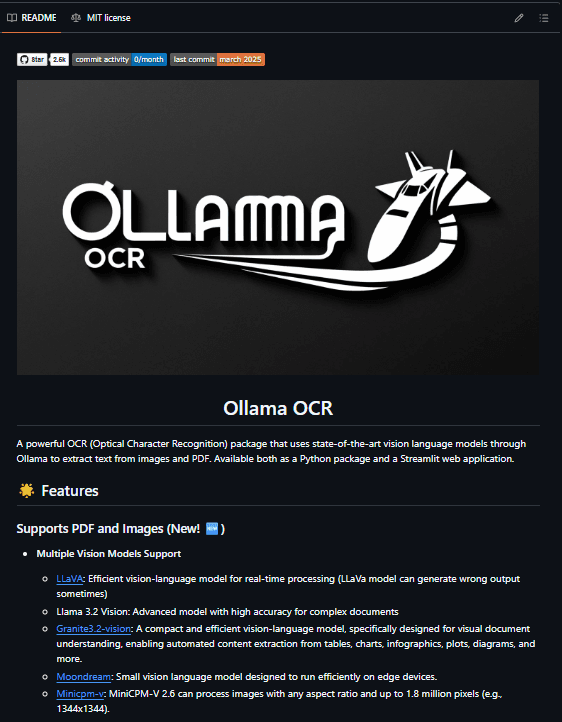
Ollama-OCR, a new open-source tool with 2.3k GitHub stars, converts scanned documents into clean markdown using local vision models. It runs entirely offline via Ollama, supporting models like llava, llama 3.2 vision, and granite3.2-vision.
Key facts
- 2.3k GitHub stars as of announcement.
- Supports 5+ vision models: llava, llama 3.2 vision, granite3.2-vision, moondream, minicpm-v.
- Output formats: markdown, plain text, JSON, tables, key-value pairs.
- Batch processing with parallel execution and progress tracking.
- Includes Streamlit web app for no-code usage.
Ollama-OCR is an open-source utility that extracts text from scanned documents and images by leveraging Ollama's local vision models. According to @_vmlops, the tool eliminates reliance on cloud APIs or paid OCR subscriptions, processing everything on the user's machine.
How It Works
Users can swap between models such as llava, llama 3.2 vision, granite3.2-vision, moondream, and minicpm-v to balance speed and accuracy. Output formats include markdown, plain text, JSON, structured tables, and key-value pairs. The tool supports batch processing of entire folders in parallel with built-in progress tracking, and includes image preprocessing before feeding data to the model. A Streamlit web app is bundled for those who prefer a graphical interface over the command line.
Local-First Advantage
Ollama-OCR's key differentiator is its local-first architecture. Unlike cloud-based OCR services (e.g., Google Cloud Vision, AWS Textract), no data leaves the user's machine. This makes it attractive for privacy-sensitive workflows in legal, medical, and enterprise document processing. The tool is installed via pip and requires only an existing Ollama installation with a compatible vision model.
Unique Take
Ollama-OCR is not a new model but a lightweight orchestration layer that commoditizes OCR by abstracting away model switching. Its real value is in the flexibility to switch between vision models without code changes, and the ability to batch process documents locally. This mirrors the broader trend of "model-agnostic tooling" that lets users pick the best model for each task without vendor lock-in. The 2.3k stars suggest strong early adoption among developers who want to avoid cloud costs and data privacy risks.
Limitations
The tool's accuracy and latency depend entirely on the chosen vision model. High-accuracy models like llama 3.2 vision may be slower on CPU-only machines. The source does not disclose performance benchmarks or supported image formats beyond standard scanned documents.
Key Takeaways
- Ollama-OCR extracts text from scanned docs locally using Ollama vision models.
- 2.3k stars, no cloud APIs needed.
What to watch

Watch for benchmark comparisons between Ollama-OCR and cloud OCR services (Google Cloud Vision, AWS Textract) on accuracy and speed. Also monitor GitHub star growth and contributions, which could indicate enterprise adoption for local document processing.