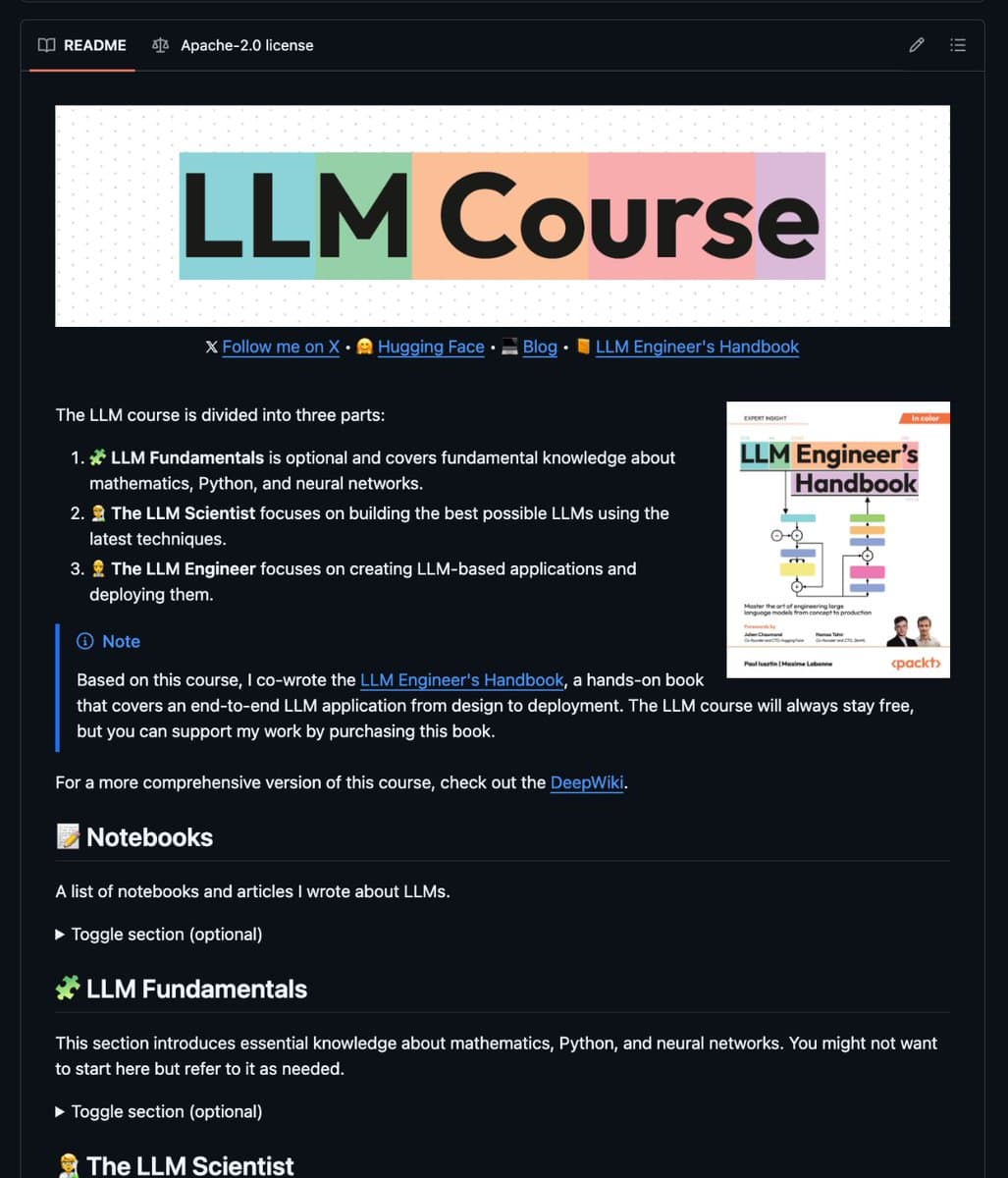
A new open-source GitHub repository is making waves in the artificial intelligence education space by offering what some are calling a complete replacement for paid large language model (LLM) courses. Created by Maxime Labonne, the LLM Course repository provides comprehensive, structured learning materials that guide users from zero knowledge to advanced techniques like fine-tuning, model merging, quantization, and deployment—all completely free of charge.
What the LLM Course Offers
The repository is organized into three main sections that mirror professional development paths in the AI industry:
1. LLM Fundamentals
This foundational section covers essential prerequisites including mathematics, Python programming, neural networks, and natural language processing (NLP) basics. These modules ensure learners have the necessary background before diving into more complex LLM concepts.
2. The LLM Scientist
This intermediate section focuses on core LLM architecture, pre-training methodologies, alignment techniques (like reinforcement learning from human feedback), and model evaluation. This path is designed for those interested in the research and development aspects of language models.
3. The LLM Engineer
The most practical section addresses real-world implementation with modules on retrieval-augmented generation (RAG), AI agents, optimization techniques, deployment strategies, and security considerations. This prepares learners for production-level applications.
Practical Implementation with "One-Click" Notebooks
What sets this repository apart is its emphasis on hands-on learning through Google Colab notebooks that require no local GPU or cloud credits. Key practical modules include:
- Fine-tuning Llama 3.1 with Unsloth: Users can fine-tune Meta's latest open-source model directly in Colab
- Model merging with MergeKit: Combine different models without requiring GPU resources
- Quantization in one click: Convert models to GGUF, GPTQ, EXL2, and AWQ formats for efficient deployment
- Ablation without retraining: Experiment with model components through ablation studies
These notebooks lower the barrier to entry significantly, allowing anyone with internet access to experiment with advanced LLM techniques that previously required expensive hardware or cloud resources.
Licensing and Accessibility
The entire course is released under the Apache 2.0 license, making it freely available for both personal and commercial use. This permissive licensing structure encourages widespread adoption and modification, potentially accelerating innovation in the LLM space by democratizing access to cutting-edge techniques.
Implications for AI Education
The emergence of such comprehensive open-source educational resources represents a significant shift in how technical skills are acquired in the fast-moving AI field. Traditional paid courses, which can cost hundreds or thousands of dollars, now face direct competition from freely available, community-maintained alternatives that are often more current with the latest developments.
This development aligns with broader trends in open-source AI, where high-quality resources are increasingly available to anyone motivated to learn. The practical focus—emphasizing implementation over theory—addresses a common criticism of academic AI programs that sometimes lag behind industry needs.
The Future of Technical Education
As noted in the original source material from @hasantoxr, this repository "just replaced every paid LLM course on the internet"—a bold claim that nonetheless highlights how open-source resources are reshaping technical education. The combination of structured learning paths with immediately applicable notebooks creates a powerful educational package that could serve as a model for other technical domains.
The success of such initiatives may pressure commercial educational providers to either lower prices, improve quality, or specialize in areas where open-source alternatives are weaker—such as personalized mentorship, certification, or career services.
Source: Based on reporting from @hasantoxr on X/Twitter regarding Maxime Labonne's LLM Course GitHub repository.