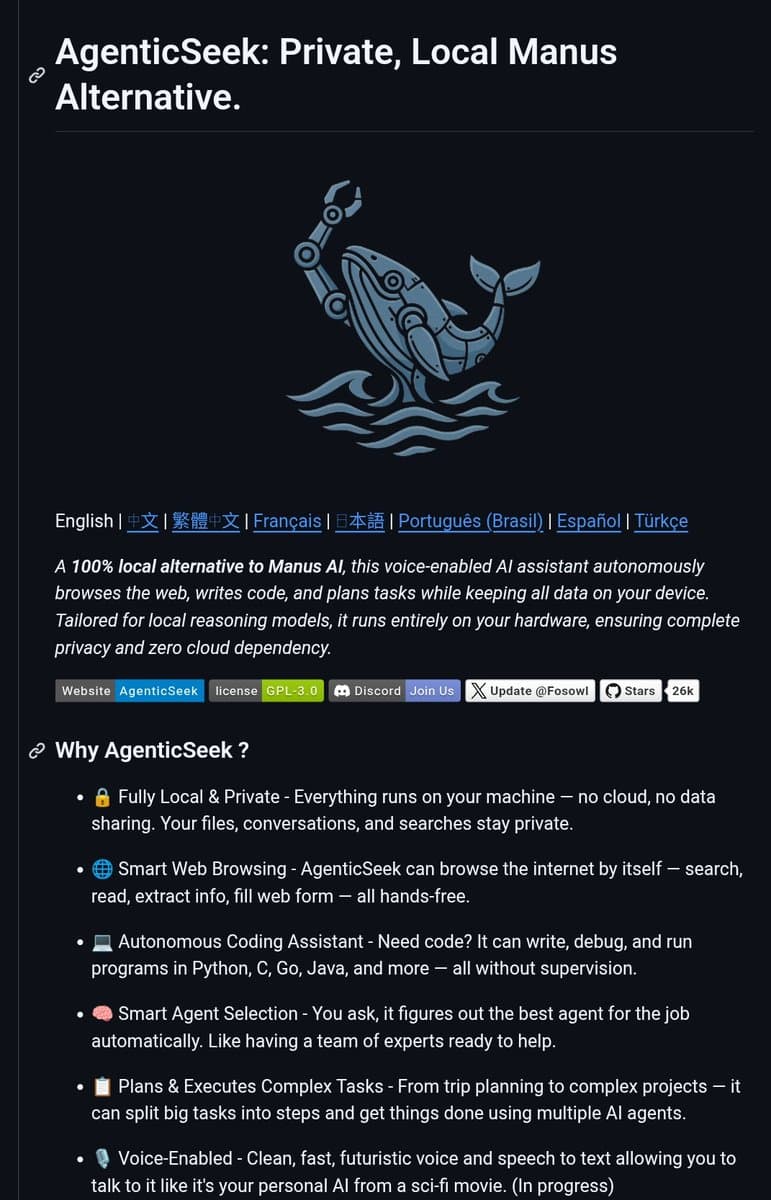
An open-source developer has released a project that positions itself as a fully local alternative to AI agent platforms like Manus. The system, showcased in a brief social media announcement, claims to deliver autonomous web browsing, multi-language code writing and execution, voice input, and multi-agent task planning—all running 100% on a user's own hardware without requiring API keys, subscriptions, or external data transmission.
What the Project Does
The core promise is a self-contained AI agent stack that operates offline. According to the announcement, the system can:
- Autonomously browse the web, presumably to gather information or interact with web services.
- Write and execute code in several programming languages, including Python, Go, C, and Java. This suggests it has a local code interpreter or execution environment.
- Accept voice input, indicating some level of integrated speech-to-text capability.
- Perform multi-agent task planning, where different AI sub-agents might collaborate on a complex objective.
The defining characteristic is its fully local operation. The developer emphasizes "no API keys, no subscriptions, no surveillance," positioning it as a privacy-focused, cost-free alternative to cloud-based agent services that typically rely on paid LLM APIs (like OpenAI's GPT-4 or Anthropic's Claude) and may log user interactions.
The project was linked in the announcement, though specific technical details, architecture, model choices, and system requirements were not provided in the source material.
Technical Implications & Open Questions
Building a capable, fully local AI agent is a significant technical challenge. It requires:
- A powerful local LLM: The core reasoning engine must be a large language model capable of planning, coding, and web navigation. This likely necessitates a model with at least 7B parameters (like CodeLlama or DeepSeek-Coder variants) and potentially much larger, which demands substantial GPU RAM (e.g., 16GB+).
- Integrated toolset: The system must bundle or interface with local tools: a headless browser (like Puppeteer or Playwright) for web tasks, language runtimes (Python, Go, etc.) for code execution, and a speech-to-text model (like Whisper) for voice input.
- Orchestration framework: The "multi-agent task planning" suggests an orchestration layer, possibly similar to frameworks like LangChain or AutoGen, but designed to work with local models and tools.
The primary trade-off for local operation is performance. Local LLMs, while rapidly improving, generally lag behind top-tier cloud models in reasoning and coding benchmarks. Tasks may be slower and potentially less reliable. The system's practical capabilities and the hardware required to run it effectively remain to be validated.
gentic.news Analysis
This development taps directly into two powerful and converging trends in the AI ecosystem: the push for local/private AI and the maturation of open-source agent frameworks.
It follows a clear pattern of community-driven projects filling gaps left by commercial platforms. Manus, while a pioneer in AI agent interfaces, operates as a cloud-based service. This creates natural demand for an open-source, self-hostable counterpart—similar to how projects like Ollama and LM Studio emerged as local alternatives to cloud LLM APIs. The emphasis on "no surveillance" resonates strongly with developers and enterprises concerned about data privacy and vendor lock-in, a concern we highlighted in our analysis of EU AI Act compliance challenges for cloud AI services.
Technically, this project sits at the intersection of several entities we track. It likely leverages the Llama or Mistral family of models (given their permissive licenses and strong coding capabilities), integrates tool-calling frameworks inspired by LangChain, and may use browsing automation tools common in the RPA (Robotic Process Automation) space. Its success will depend on how seamlessly it stitches these components together into a stable, user-friendly package.
If the implementation is robust, it could pressure commercial agent platforms to offer local deployment options. However, the key challenge will be usability and performance parity. The project's viability hinges on whether it can deliver a sufficiently capable agent experience on consumer-grade hardware, or if it remains a tool primarily for developers with high-end GPUs.
Frequently Asked Questions
What is Manus, and what does this project replace?
Manus is a cloud-based platform that provides an interface and infrastructure for creating and deploying AI agents that can perform tasks like web research, data analysis, and automation. This open-source project aims to replicate core Manus-like functionalities—such as web browsing and code execution—but runs entirely on a user's local computer, eliminating the need for the Manus service, its API, or any subscription fees.
What are the hardware requirements to run this local AI agent?
The specific requirements are not detailed in the announcement, but they are likely significant. Running a capable local LLM for complex agent tasks typically requires a modern NVIDIA or AMD GPU with at least 16GB of VRAM (for a 7B-13B parameter model in 4-bit quantization). For larger models or faster performance, 24GB+ VRAM (like an RTX 4090) is preferable. A powerful CPU and ample system RAM are also necessary to handle the browser automation and code execution environments.
Is this project truly private and secure since it runs locally?
Running the AI agent locally fundamentally increases privacy versus cloud services, as your data (prompts, browsed web pages, generated code) never leaves your machine. However, "local" does not automatically mean "secure." The project's overall security would depend on the security of the individual components (the LLM, the browser automation tool, the code execution sandbox) and how they are integrated. Users must still trust the downloaded software package and ensure it is run in a safe environment.
How does the coding capability compare to cloud-based AI coding assistants?
Local LLMs have made tremendous strides in coding (e.g., DeepSeek-Coder, CodeLlama), but the best cloud models like GPT-4, Claude 3 Opus, or Gemini Advanced currently hold a lead in complex reasoning, large context windows, and accuracy for intricate tasks. This local agent's coding proficiency will be capped by the capability of the local LLM at its core. For many routine scripting and automation tasks, it may be sufficient, but for highly complex or novel programming challenges, cloud models may still outperform.