OpenAI has released a 13-page policy document titled "Blueprint for the Intelligence Age," marking a significant shift in its public positioning. The document explicitly states the company is "beginning a transition toward superintelligence: AI systems capable of outperforming the smartest humans even when they are assisted by AI." Rather than treating this as a distant hypothetical, OpenAI frames it as an active transition requiring immediate policy planning on the scale of a "New Deal."
The blueprint outlines two main pillars: building an "Open Economy" and ensuring a "Resilient Society," accompanied by concrete policy proposals and initial funding commitments.
What OpenAI Proposes: The Policy Blueprint
The document contains specific, actionable proposals across economic and safety domains.
For an Open Economy
- Public Wealth Fund & Stakeholder Capitalism: Proposes a fund where every citizen gets a stake in AI-driven economic growth. Suggests shifting the tax base from payroll toward capital gains and corporate income to offset shrinking payroll revenue from automation.
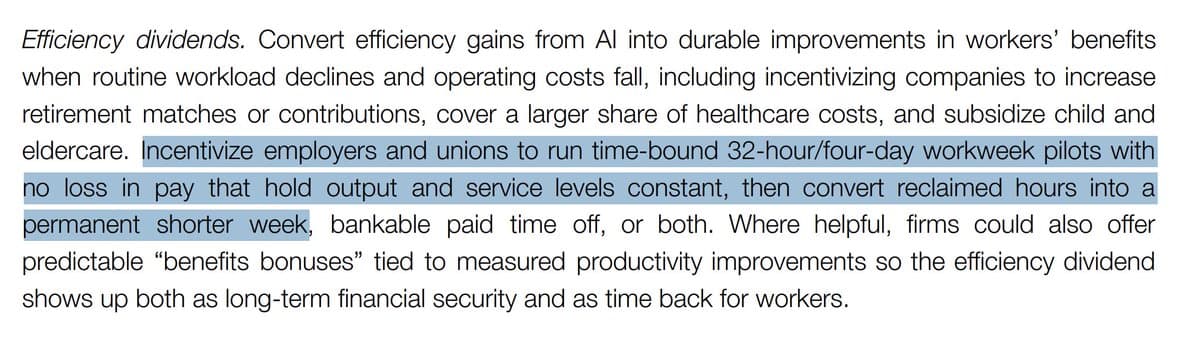
- Labor & Safety Nets: Advocates for 32-hour workweek pilots, portable benefits untied from employers, and auto-scaling safety nets triggered by displacement metrics. It also proposes giving workers a formal voice in AI deployment decisions.
- Infrastructure & Innovation: Calls for treating AI access as basic infrastructure, offering "startup-in-a-box" resources for AI-native entrepreneurs, and fast-tracking energy grid expansion to power compute needs.
- Scientific Acceleration: Suggests investing in distributed, AI-enabled labs to accelerate discovery and in the care economy as a transition path for displaced workers.
For a Resilient Society
- Safety & Governance: Proposes an "AI trust stack" for provenance and verification, a competitive auditing market for frontier models, and mandatory incident reporting. It calls for frontier AI companies to adopt Public Benefit Corporation structures.
- Containment & Coordination: Recommends developing containment playbooks for dangerous released models and establishing an international AI safety network for joint evaluations and crisis coordination, modeled on aviation safety institutions.
- Democratic Input: Advocates for codified rules for government AI use and democratic public input on AI alignment standards.
A notable strategic element is OpenAI's call for stricter controls only on a narrow set of frontier models while keeping the broader ecosystem open. This positions potential regulation as targeted rather than industry-wide.
Backing Words with Resources
OpenAI is supporting this policy push with initial resources:
- Up to $100,000 in fellowships and $1 million in API credits for policy research aligned with the blueprint's themes.
- Opening a new DC policy workshop in May 2026 to engage directly with policymakers.
gentic.news Analysis
This document represents OpenAI's most comprehensive and concrete foray into public policy to date. It is a strategic move to shape the regulatory conversation from a position of perceived inevitability—framing superintelligence not as an "if" but as a "when" that requires proactive governance. The proposals, particularly the Public Wealth Fund and tax shifts, are ambitious and politically complex, suggesting OpenAI is preparing for a long-term advocacy role beyond technical research.
The call for targeted regulation on frontier models is a clear attempt to create a regulatory moat. By agreeing to stricter oversight only for the most powerful systems (a category currently occupied by OpenAI's own models and a handful of competitors like Anthropic's Claude and Google's Gemini Frontier), OpenAI could cement its market position while appearing cooperative. This aligns with a trend we've noted where leading labs (📈 OpenAI) are increasingly engaging in policy to steer the competitive landscape, as seen in our coverage of Anthropic's constitutional AI advocacy and Google's participation in the U.S. AI Safety Institute Consortium.
The timing is significant. Releasing this blueprint now, as the 2026 U.S. election cycle begins to heat up and global AI governance efforts at the UN and G7 continue, allows OpenAI to insert its preferred frameworks into nascent policy debates. The commitment of fellowship funding and a DC presence indicates this is not a one-off paper but the start of a sustained influence operation. The success of these ideas will depend heavily on whether other industry players, civil society, and governments find the "targeted frontier regulation" approach palatable or see it as an attempt by the current frontrunner to write rules in its own favor.
Frequently Asked Questions
What does OpenAI mean by 'superintelligence'?
In this document, OpenAI defines superintelligence as "AI systems capable of outperforming the smartest humans even when they are assisted by AI." They are framing the development of such systems as an active transition already beginning, rather than a distant future scenario.
What is the proposed 'Public Wealth Fund'?
The Public Wealth Fund is a policy proposal where the economic gains generated by AI automation and growth would be pooled into a public fund. Every citizen would receive a stake or dividend from this fund, akin to models like the Alaska Permanent Fund, aiming to distribute the wealth created by AI broadly across society.
How is OpenAI funding this policy push?
OpenAI is committing initial resources to support research and engagement around these ideas, including up to $100,000 in fellowships, $1 million in API credits for related policy research, and the opening of a dedicated policy workshop in Washington, D.C., in May 2026.
Does this mean OpenAI has already built a superintelligent AI?
No. The publication is a policy framework and a statement of direction. The document states the company is "beginning a transition toward" superintelligence, which is a forecast of their research trajectory. It is not an announcement of a product launch or a technical breakthrough.