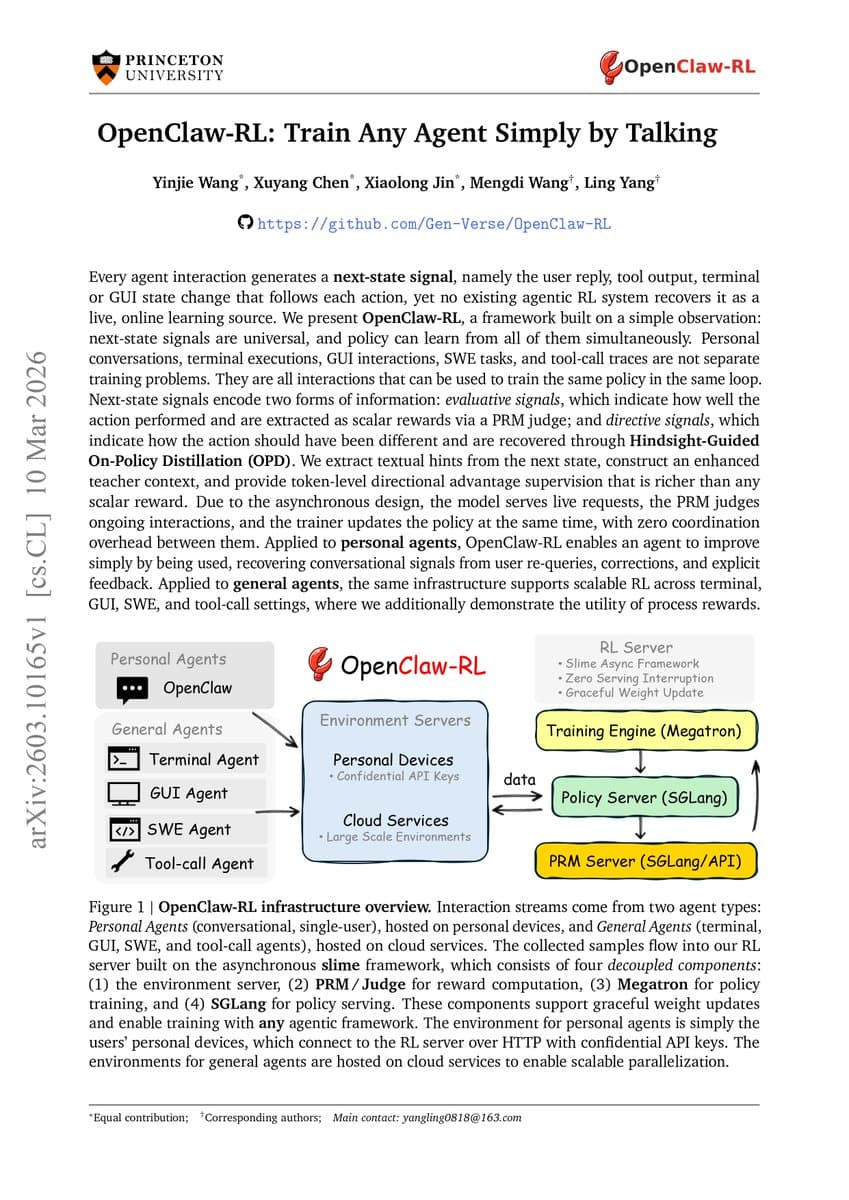
Researchers at Princeton University have unveiled a groundbreaking AI system called OpenClaw-RL that fundamentally reimagines how artificial intelligence learns from human interaction. Unlike traditional models that require separate training phases with curated datasets, this system trains itself in real-time through normal conversation and tool usage, capturing every user signal as valuable training data.
The Architecture: Four Async Loops for Continuous Learning
At the heart of OpenClaw-RL is an innovative architecture that runs four fully decoupled asynchronous loops:
- Serving loop - Handles user interactions and provides responses
- Rollout loop - Manages the agent's actions and tool usage
- PRM (Process Reward Model) judging loop - Evaluates outcomes
- Training loop - Continuously updates the model
What makes this revolutionary is that none of these loops wait for the others. While the model is answering your current question, the system is already training on your previous interaction. This creates a seamless learning cycle where improvement happens continuously in the background.
Capturing the Full Spectrum of User Signals
Traditional reinforcement learning systems often discard valuable user feedback data, but OpenClaw-RL captures everything simultaneously:
- Every re-asked question becomes a dissatisfaction signal
- Every passing test serves as a success signal
- Every error trace provides explicit information about what went wrong
- Every tool output and GUI state change contributes to the training signal
As reported by @hasantoxr on X, "Most RL systems throw away the most valuable data they collect. Every time a user re-asks a question, that's a dissatisfaction signal. Every passing test is a success signal. Every error trace tells the model exactly what went wrong."
Two-Pronged Learning Approach
OpenClaw-RL employs two complementary methods to extract maximum learning from each interaction:
Binary Reinforcement Learning
This approach turns every user reaction into a scalar reward signal. The system doesn't need explicit feedback—if you re-ask a question, that's automatically interpreted as a -1 reward. Terse or implicit user responses are all captured and quantified.
Hindsight OPD (Optimal Policy Distillation)
Where Binary RL provides broad signals, Hindsight OPD delivers granular, token-level guidance. When a user says "you should have checked the file first," the system doesn't just register this as negative feedback—it extracts the specific hint, builds an enhanced teacher context, and provides per-token correction supervision that scalar rewards alone cannot match.
Impressive Performance Gains
The results speak for themselves:
- Personal agent score improved from 0.17 to 0.81 after just 36 conversations
- Tool-call accuracy reached 0.30 compared to 0.17 with outcome-only training
- The system works across multiple domains including terminal operations, GUI interactions, software engineering tasks, and tool-call agents within the same learning loop
Practical Applications and Implications
OpenClaw-RL demonstrates remarkable adaptability in real-world scenarios:
- Educational assistants that learn student preferences—if a student doesn't want "AI-sounding" responses, the agent adapts after approximately 36 homework sessions
- Teaching tools that customize feedback style—if a teacher wants friendly, specific feedback, the system learns this preference after about 24 grading sessions
- General-purpose assistants that continuously improve their understanding of individual user needs and communication styles
The Future of Personalized AI
This development represents a significant shift toward truly personalized artificial intelligence. Instead of one-size-fits-all models that require massive retraining to adapt to individual users, OpenClaw-RL enables agents to learn and evolve through natural interaction patterns.
The system's ability to work across multiple agent types—terminal, GUI, software engineering, and tool-call agents—within the same learning framework suggests a path toward more unified, general-purpose AI assistants that can specialize based on user interaction without explicit programming.
As AI systems become more integrated into daily workflows, the ability to learn continuously from normal use rather than requiring dedicated training sessions could dramatically accelerate adoption and effectiveness across professional and personal contexts.
Source: @hasantoxr on X/Twitter reporting on Princeton University's OpenClaw-RL research