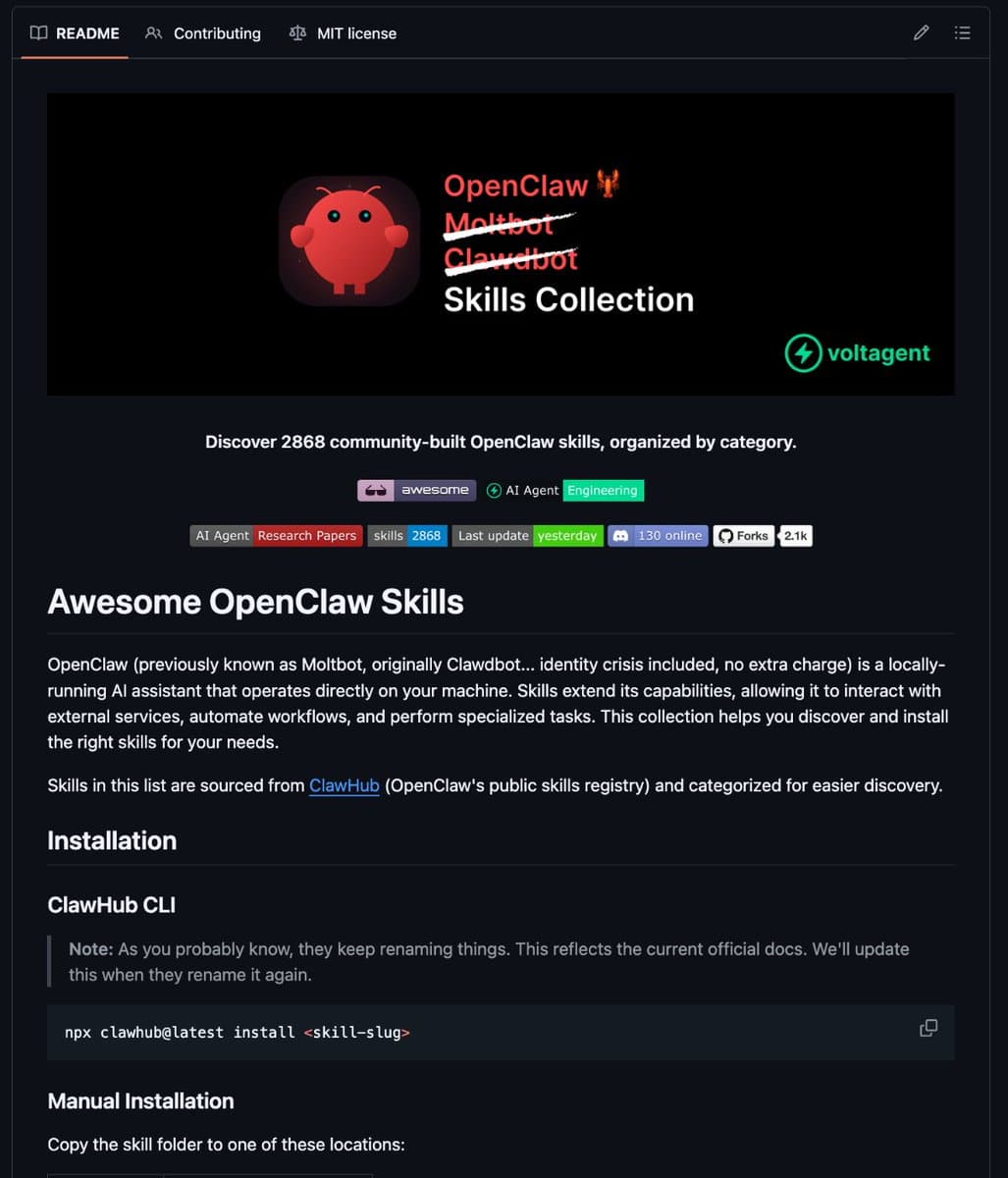
In a significant development for the AI community, a new GitHub repository has surfaced that could fundamentally change how developers build and deploy AI agents. Called awesome-openclaw-skills, this repository boasts a collection of over 1,715 production-ready AI agent skills that can be installed in seconds with a single command-line interface (CLI) command.
What Is OpenClaw Skills?
OpenClaw Skills represents a curated collection of modular capabilities designed specifically for AI agents. According to the repository's description, these are "production-ready" skills that developers can integrate into their AI systems with minimal effort. The project appears to be part of the broader OpenClaw ecosystem, which focuses on creating open-source tools for AI agent development.
What makes this repository particularly noteworthy is its sheer scale and accessibility. With 1,715+ skills already available, it provides one of the most comprehensive collections of AI agent capabilities currently available in the open-source community.
Key Features and Capabilities
The repository organizes skills across multiple categories, with browser automation being prominently featured. One specific skill mentioned in the announcement is browser-automation, accessible via https://t.co/dalrdX4IV6, though the actual GitHub URL would be different.
Based on similar projects in the AI agent space, these skills likely include:
- Web interaction capabilities (browsing, form filling, data extraction)
- API integrations with popular services
- Data processing and analysis functions
- Communication tools (email, messaging, notifications)
- Automation workflows for repetitive tasks
- Specialized domain knowledge for specific industries
Installation and Implementation
The repository emphasizes ease of use, claiming that skills are "literally one CLI command away from giving your AI agent real capabilities." This suggests a package manager-like system where developers can simply run something like:
openclaw install browser-automation
This approach mirrors how developers currently work with libraries and frameworks in traditional software development, bringing similar convenience to the AI agent ecosystem.
The Broader Context: The Rise of Modular AI Agents
This development comes at a time when the AI community is increasingly moving toward modular, composable AI systems. Rather than building monolithic AI applications from scratch, developers are looking for ways to assemble powerful agents from pre-built components.
Several trends are driving this shift:
Accelerated Development Cycles: With pre-built skills, developers can focus on higher-level architecture rather than reinventing common capabilities.
Standardization: Collections like OpenClaw Skills help establish common interfaces and patterns for AI agent capabilities.
Community Collaboration: Open repositories allow developers worldwide to contribute and benefit from shared improvements.
Potential Impact on AI Development
The availability of such a comprehensive skill repository could have several important implications:
For Individual Developers: Lowering the barrier to entry for creating sophisticated AI agents, enabling solo developers or small teams to build systems that previously required large engineering resources.
For Enterprises: Accelerating the deployment of AI solutions by providing tested, production-ready components that can be customized for specific business needs.
For the AI Ecosystem: Potentially establishing de facto standards for how AI agent capabilities are packaged and distributed, similar to how Docker transformed containerization or how npm revolutionized JavaScript development.
Challenges and Considerations
While promising, such repositories also raise important questions:
- Security: How are these skills vetted for security vulnerabilities, especially when they involve external API calls or data processing?
- Quality Control: With 1,715+ skills, maintaining consistent quality and documentation becomes challenging.
- Dependency Management: As with any package ecosystem, managing dependencies and version compatibility could become complex.
- Licensing: Understanding the licensing terms for each skill and ensuring compliance in commercial applications.
The Future of AI Agent Development
If successful, OpenClaw Skills could represent a milestone in the maturation of AI agent development. We might see:
Specialized Skill Marketplaces: Platforms where developers can discover, rate, and purchase specialized AI agent capabilities.
Cross-Platform Compatibility: Skills that work across different AI agent frameworks and platforms.
Automated Skill Composition: AI systems that can automatically select and combine skills to solve complex problems.
Domain-Specific Collections: Curated skill sets for specific industries like healthcare, finance, or education.
Getting Started
For developers interested in exploring OpenClaw Skills, the repository appears to be hosted on GitHub, though the exact URL wasn't provided in the announcement. Searching for "awesome-openclaw-skills" on GitHub should reveal the repository, where documentation and installation instructions would be available.
As with any rapidly evolving open-source project, developers should:
- Review the documentation thoroughly
- Start with non-critical applications
- Contribute back improvements or report issues
- Stay updated on security advisories
Conclusion
The emergence of awesome-openclaw-skills represents more than just another GitHub repository—it signals a shift toward more accessible, modular AI agent development. By providing over 1,700 ready-to-use capabilities through a simple installation process, this project has the potential to dramatically accelerate AI adoption across industries.
As the AI landscape continues to evolve at breakneck speed, tools like OpenClaw Skills that lower barriers and promote standardization will play crucial roles in determining how quickly and widely AI agents become integrated into our digital lives. The true test will be in how the community adopts, contributes to, and extends this collection of capabilities in the coming months.
Source: Twitter announcement by @hasantoxr (https://twitter.com/hasantoxr/status/2027121655974351337)