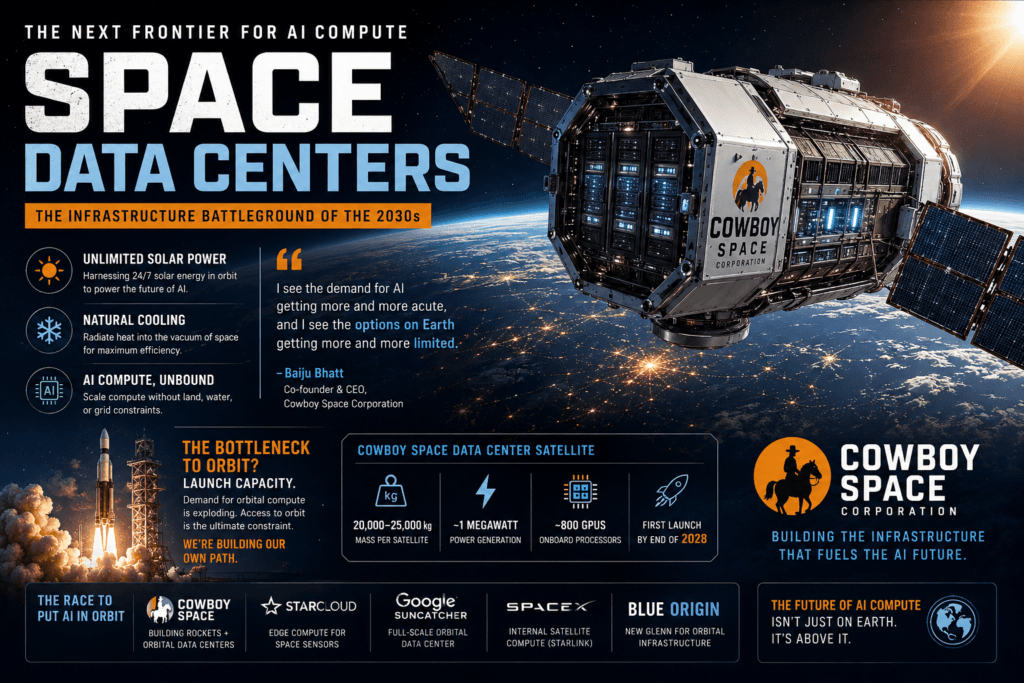
Data Center Dynamics (DCD) is floating orbital AI data centers as a potential compute frontier, citing space-based infrastructure. The concept faces fundamental physics hurdles—power, cooling, latency—that no current player has publicly solved.
Key facts
- LEO solar panels yield ~1.4 kW per square meter
- H100 GPUs draw up to 700W each
- LEO round-trip latency: 20-40ms
- Falcon 9 launch cost: ~$2,700/kg
- No company has announced orbital AI plans
Data Center Dynamics (DCD) is asking whether orbital AI data centers represent the next frontier for compute infrastructure According to @DCDnews. The question, posed as a tweet linking to a broader piece, arrives as terrestrial data center capacity strains against power grid limits and cooling constraints.
Key Takeaways
- DCD floats orbital AI data centers as next compute frontier.
- Physics and economics hurdles—power, cooling, latency, launch costs—remain unsolved.
- No concrete plans announced.
The physics problem
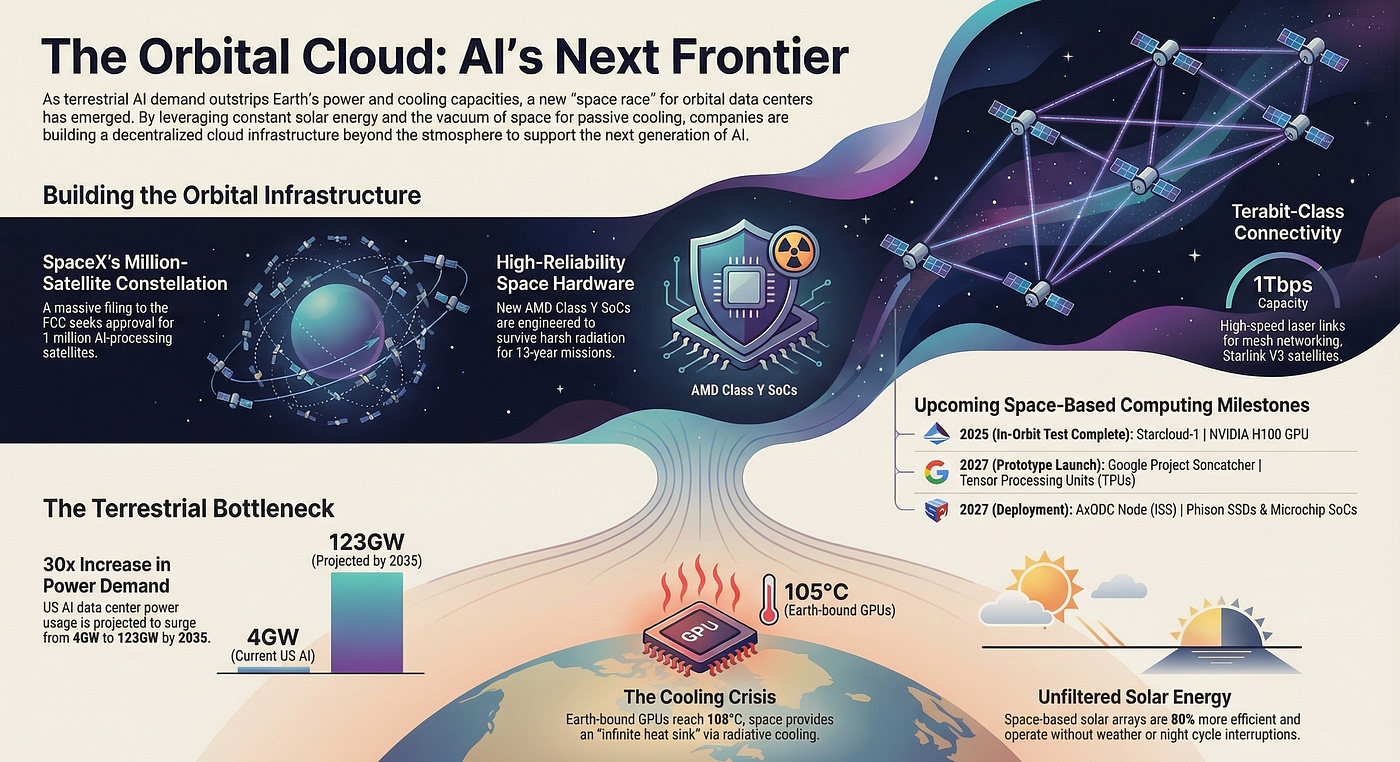
Orbital compute would require solving power generation and heat dissipation in vacuum conditions. Solar panels in low Earth orbit deliver roughly 1.4 kW per square meter, but AI accelerators like NVIDIA's H100 draw up to 700W each—a single rack would need several hundred square meters of panel. Radiative cooling in vacuum is far less efficient than convective cooling on Earth, meaning dense GPU clusters would throttle or melt without exotic thermal management.
Latency is the second killer. A satellite in LEO orbits at roughly 7.8 km/s, giving a round-trip signal delay of 20-40ms to a ground station—fine for some workloads, fatal for interactive AI inference. Geostationary orbit at 35,786 km adds 240ms one-way, making real-time applications impossible.
The economics question
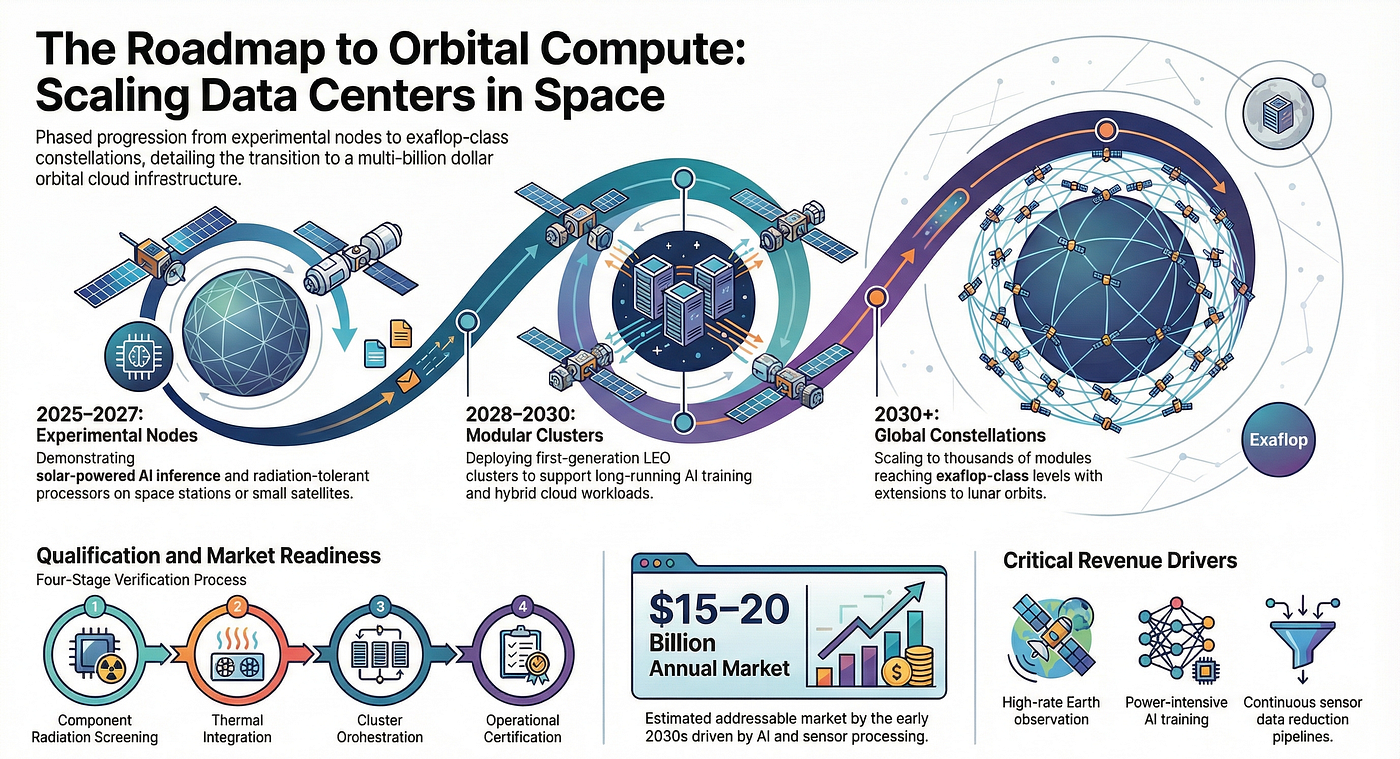
Launch costs have fallen to roughly $2,700/kg on reusable Falcon 9 flights, but a single rack of H100s weighs over 500 kg and consumes 40kW. The capital expenditure for launch, radiation-hardened hardware, and orbital maintenance would dwarf terrestrial colocation costs. No hyperscaler has publicly committed to orbital compute for AI training or inference.
The concept is not new—Microsoft tested an Azure data center on the ocean floor in 2018, and various startups have proposed space-based compute for edge applications. But AI's power density and latency sensitivity make it a fundamentally different problem. DCD's question is speculative, but it reflects a real industry anxiety: terrestrial power constraints are pushing compute architects to consider increasingly exotic locations.
What to watch
Watch for any hyperscaler or defense contractor filing for orbital compute spectrum or launch licenses in 2026. Also track NVIDIA's roadmap for radiation-tolerant GPU variants—a necessary precondition for any serious space AI play. If neither appears within 12 months, treat orbital AI as a thought experiment, not a pipeline.