Google released Gemini 3.7 Flash, announced via an X post from Omar Sanseviero on February 2026. The model targets long-horizon software engineering and PDF understanding.
Key facts
- Gemini 3.7 Flash announced February 2026
- Improved long-horizon software engineering capabilities
- Enhanced PDF understanding claimed
- No benchmark scores or pricing disclosed
- Announced via X post by Omar Sanseviero
Google has released Gemini 3.7 Flash, a new tier in its Flash model line aimed at developers who need sustained, multi-step coding work without the cost of the full Pro tier. According to @omarsar0, the model brings "improved capabilities for long-horizon software engineering tasks" alongside stronger PDF understanding.
Key Takeaways
- Google released Gemini 3.7 Flash with improved long-horizon coding and PDF understanding.
- No benchmarks or pricing disclosed.
What's actually new
The announcement is thin on specifics. No benchmark scores, no context window figures, no pricing details — just the capability claim. For a model family that has historically shipped with detailed technical reports, this is a notable departure. The Flash tier has always been Google's answer to the cost-performance tradeoff, sitting below the Pro tier for production workloads where latency and price matter more than peak reasoning ability.
What "long-horizon" means in practice is agentic workflows — the kind where a model must maintain state across dozens of tool calls, edit multiple files, run tests, and iterate. This is the same territory that Anthropic's Claude Opus 4.5 and OpenAI's GPT-5.2 have been competing on for the past year. Google's positioning here suggests Flash is no longer just a fast-answer model but a genuine agentic workhorse.
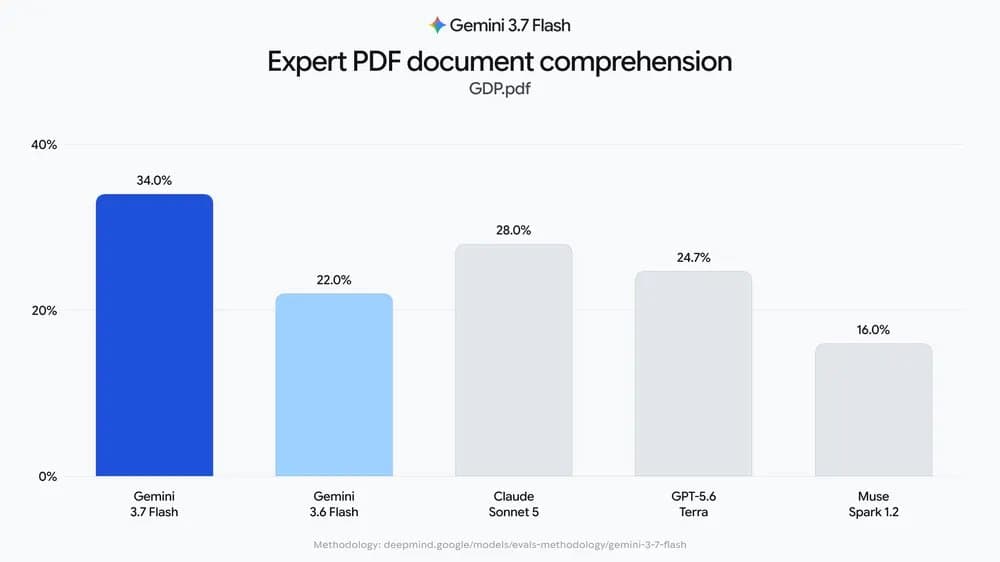
The PDF understanding claim is more specific. Document parsing has been a weak spot for many models, particularly with complex layouts, tables, and scanned content. If Gemini 3.7 Flash genuinely improves on this, it could matter for enterprise workflows that process contracts, financial filings, and research papers at scale.
The competitive context

Google is shipping this into a crowded field. The Flash line has historically undercut competitors on price while delivering close-to-Pro performance on many tasks. The question is whether the long-horizon improvements close the gap on agentic benchmarks like SWE-Bench Verified and Terminal-Bench, where the Pro tier has been competitive but not dominant.
There's also the question of what this means for the broader Gemini API. Google has been bundling Flash models into its AI Studio and Vertex AI offerings, and the 3.7 numbering suggests this is a point release rather than a full generational jump. The company did not disclose pricing, context window size, or latency figures in the announcement.
What's missing
No benchmark numbers means developers are flying somewhat blind. Google has historically published detailed evals for Gemini releases, and the absence here is conspicuous. It's possible the company is saving the full technical report for a later date, or it's possible the improvements are incremental enough that they don't warrant a formal paper.
The announcement also doesn't clarify whether this is a replacement for Gemini 3.5 Flash or a parallel tier. Model versioning in the Gemini line has been confusing — Google has shipped Flash, Flash-Lite, and Pro variants across multiple generations, and keeping track of which is current requires checking the documentation.
For developers, the practical question is whether to switch. If the long-horizon improvements are real, this could be the model that makes multi-file agentic workflows affordable at scale. If they're marginal, the Flash tier remains what it's always been: a fast, cheap option for simple tasks.
What to watch: Google typically ships benchmark numbers within weeks of a model announcement. Watch for the Gemini API documentation update and any SWE-Bench or Terminal-Bench scores. Also watch whether pricing shifts — if Flash 3.7 undercuts the previous tier, that's a signal Google is serious about winning the agentic coding market on cost.