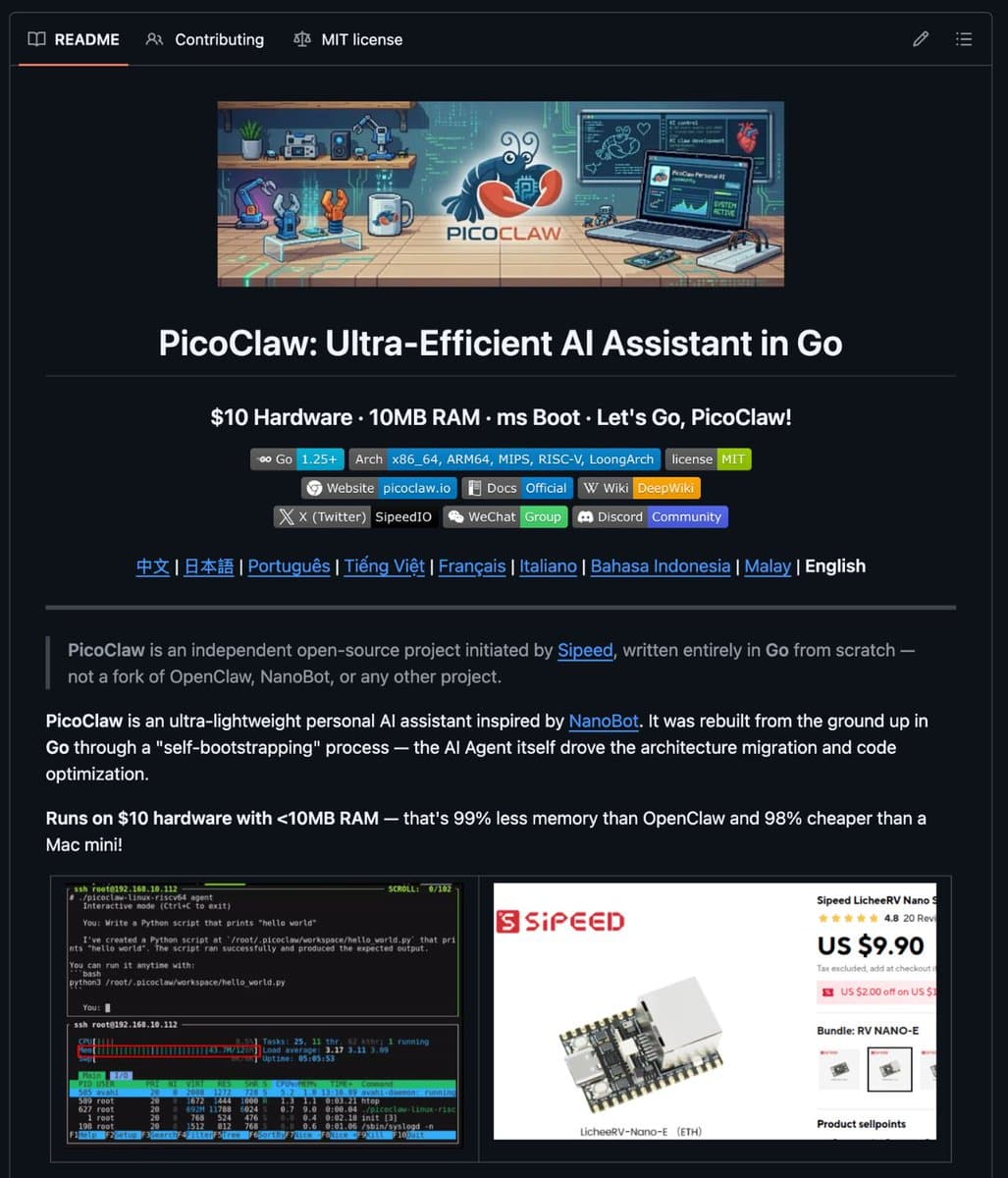
Chinese developers have released PicoClaw, an open-source AI agent framework that directly challenges OpenClaw with dramatically lower hardware requirements and cost. Where OpenClaw requires a $599 Mac Mini with 1GB RAM, PicoClaw runs on a $10 RISC-V board with just 10MB RAM while offering the same core functionality.
What Happened
According to developer announcements, PicoClaw provides equivalent AI agent capabilities to OpenClaw—including Telegram bot integration, file operations, web search, and multi-agent workflows—but in a single Go binary with zero dependencies. The developers claim 400x faster startup times compared to OpenClaw's setup, with the entire system costing approximately 1% of OpenClaw's hardware requirement.
Technical Details
PicoClaw's architecture represents a significant departure from typical AI agent frameworks that assume substantial computing resources. The system runs on RISC-V architecture, an open standard instruction set architecture that has gained traction in embedded systems and edge computing. With only 10MB RAM requirement, PicoClaw demonstrates extreme optimization for memory-constrained environments.
Key technical aspects:
- Single Go binary: No external dependencies, simplifying deployment
- RISC-V compatibility: Runs on affordable development boards like SiFive HiFive or StarFive VisionFive
- 10MB RAM requirement: Orders of magnitude less than typical AI frameworks
- Same feature set: Telegram bots, file operations, web search, multi-agent workflows
Performance Claims
The developers report several performance advantages:
- 400x faster startup: Instant initialization versus OpenClaw's boot time
- 99% cheaper hardware: $10 RISC-V board versus $599 Mac Mini
- 60x less RAM: 10MB versus 1GB minimum requirement
- Full feature parity: All core OpenClaw capabilities maintained
How It Compares
Hardware Cost $599 Mac Mini $10 RISC-V board 98.3% cheaper Minimum RAM 1GB 10MB 99% less memory Startup Time Standard boot 400x faster Near-instant Architecture x86/ARM RISC-V Open standard Deployment Full OS Single binary Zero dependencies Open Source Yes Yes Both availableWhat This Means in Practice
PicoClaw enables AI agent deployment in environments previously cost-prohibitive for OpenClaw. Developers can now embed AI agent functionality in IoT devices, edge computing nodes, and low-cost automation systems without requiring substantial computing infrastructure. The single binary deployment eliminates dependency management headaches common in AI application deployment.
Limitations and Caveats
While the announcement makes bold claims, several questions remain unanswered:
- No performance benchmarks comparing actual task execution (only startup time)
- Unclear how web search and complex workflows perform on limited hardware
- No details on model compression or optimization techniques used
- Compatibility with existing OpenClaw configurations and workflows unknown
gentic.news Analysis
This development continues the trend of AI democratization moving from cloud-centric to edge-optimized deployments. The RISC-V architecture choice is particularly significant, as it represents a shift away from proprietary ARM and x86 ecosystems toward open standards in AI inference. This aligns with our previous coverage of the RISC-V AI accelerator ecosystem, which highlighted growing momentum for RISC-V in machine learning applications.
The timing is notable given the recent OpenClaw 2.0 release we covered last month, which focused on enhanced multi-agent coordination but maintained substantial hardware requirements. PicoClaw's approach contradicts the prevailing assumption that sophisticated AI agents require substantial computing resources, potentially opening new markets for embedded AI applications.
From a technical perspective, achieving feature parity with OpenClaw on 1% of the RAM represents either breakthrough optimization or significant trade-offs in capability. The Go implementation suggests heavy use of compiled efficiency and minimal runtime overhead, but the real test will be how well complex workflows execute on resource-constrained hardware. This development mirrors the broader industry trend we've documented in our Edge AI Compression Techniques series, where model size reductions of 10-100x have become increasingly common.
Frequently Asked Questions
What is RISC-V and why does it matter for AI?
RISC-V is an open standard instruction set architecture (ISA) that anyone can implement without licensing fees. For AI applications, RISC-V enables custom hardware optimizations for specific workloads and reduces dependency on proprietary architectures from ARM, Intel, and AMD. The open nature allows for specialized AI accelerators to be designed cost-effectively.
Can PicoClaw really do everything OpenClaw does with 1% of the RAM?
The developers claim feature parity, but real-world performance on complex workflows remains unverified. While startup time and basic operations may work well on limited hardware, memory-intensive tasks like large file processing or complex web scraping might reveal limitations. Independent benchmarking will be necessary to validate these claims.
How does a $10 RISC-V board compare to a $599 Mac Mini in processing power?
The Mac Mini uses Apple's M-series chips with dedicated neural engines and substantial CPU/GPU resources. A $10 RISC-V board typically has a single-core processor running at hundreds of MHz with minimal cache and no specialized AI hardware. The performance gap is substantial, making PicoClaw's claimed capabilities particularly surprising if accurate.
Is PicoClaw compatible with existing OpenClaw configurations?
The announcement doesn't specify compatibility details. While both systems offer similar features, they likely have different configuration formats, API interfaces, and extension mechanisms. Migration would probably require some adaptation unless the developers specifically designed PicoClaw as a drop-in replacement.
What are the practical use cases for such a resource-constrained AI agent?
PicoClaw enables AI agent deployment in IoT devices, embedded systems, edge computing nodes, and low-cost automation controllers. Potential applications include smart home automation with local processing, industrial monitoring systems, educational tools for low-resource environments, and distributed AI networks where each node has minimal computing power.