Key Takeaways
- Pinterest's engineering team details the MIQPS algorithm, which dynamically identifies 'important' vs.
- 'noise' query parameters per domain by testing if their removal changes a page's visual fingerprint.
- This solves the costly problem of ingesting and processing duplicate product pages from varied merchant URLs.
The Innovation — What the Source Reports

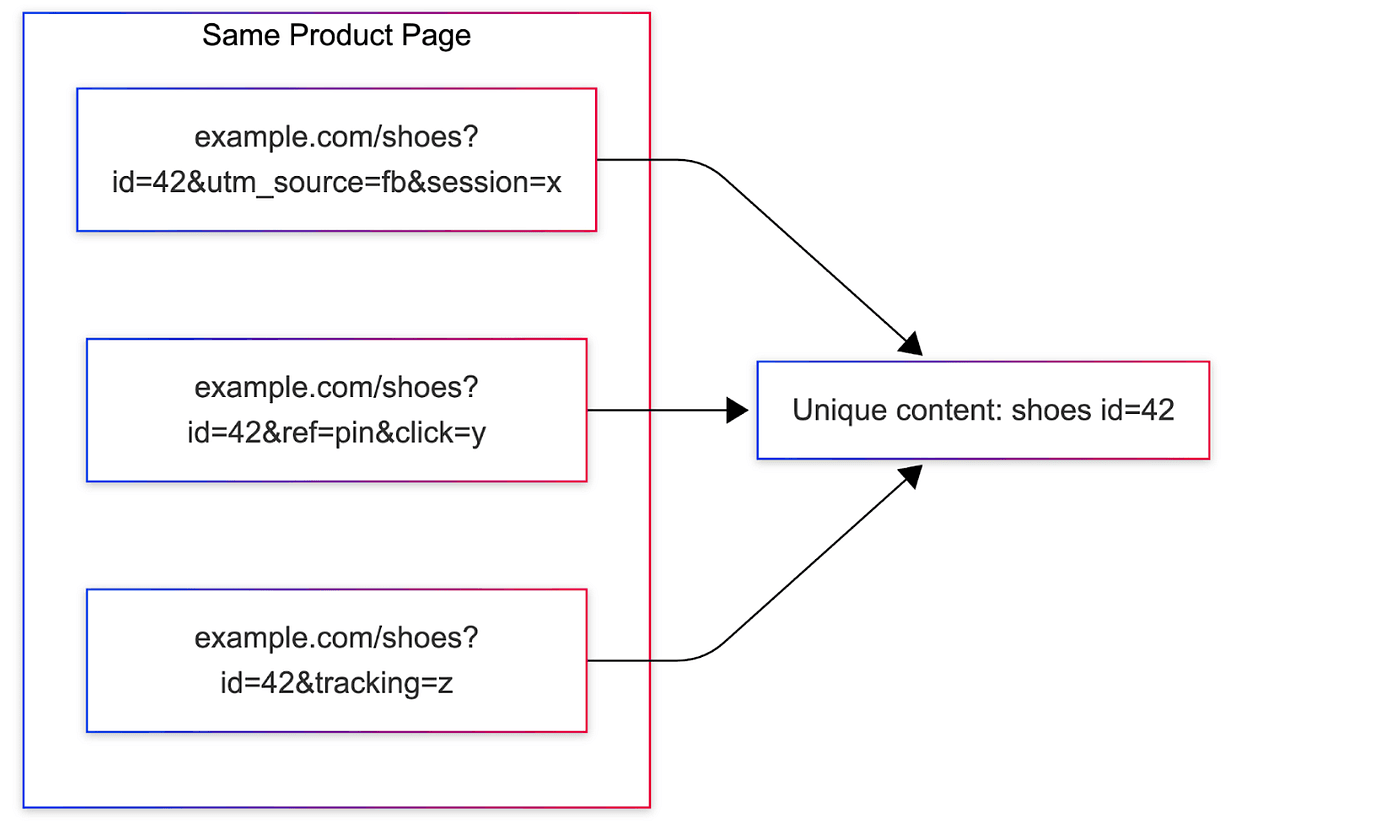
Pinterest's engineering team has published a deep dive into a core infrastructure problem: URL normalization at scale. When ingesting content from millions of merchant domains, Pinterest encounters the same product page under dozens of different URLs, each decorated with unique tracking parameters, session tokens, or analytics tags (e.g., utm_source, ref, click_id).
Manually creating rules to strip these "neutral" parameters for every e-commerce platform is impossible. The inefficiency is stark: each unique URL variant is independently fetched, rendered, and processed, wasting significant computational resources before downstream systems can deduplicate by content.
Their solution is the Minimal Important Query Param Set (MIQPS) algorithm. Its core insight is empirical: if removing a query parameter changes the content of a page, that parameter is important; if it doesn’t, it’s noise and can be safely stripped.
Technical Details — How MIQPS Works
The algorithm is domain-specific and context-aware, recognizing that the same parameter name (e.g., ref) can be a tracking tag on one page and a critical identifier on another.
- Collect & Group: The system builds a corpus of URLs per domain, then groups them by their query parameter pattern (the sorted set of parameter names). This ensures parameters are evaluated in the correct context.
- Sample & Test: For each parameter within a pattern, the system samples URLs with distinct values for that parameter. It then fetches and renders both the original URL and a modified version with the parameter removed.
- Classify via Content Fingerprint: A content ID—a hash of the page's rendered visual content—is computed for both URLs. If removing the parameter changes the content ID beyond a defined threshold, the parameter is classified as non-neutral (important). Otherwise, it's neutral (safe to drop).
Crucially, Pinterest notes that relying on HTML canonical tags (<link rel="canonical">) is unreliable at scale, as they are often missing, incorrect, or themselves contain tracking parameters. Visual content comparison serves as a more robust ground truth.
The output is a MIQPS map: a configuration that tells downstream systems exactly which parameters to preserve for each URL pattern on each domain, enabling precise, dynamic normalization.
Retail & Luxury Implications — Beyond Pinterest's Walls
While this is an infrastructure blog post from Pinterest, the problem it solves is universal for any retailer, brand, or platform aggregating product data from diverse sources.
For Marketplaces & Aggregators: Any company building a unified shopping catalog—from luxury resale platforms to brand aggregators—faces the same URL deduplication challenge. Ingesting the same Gucci bag or Rolex watch from dozens of affiliate links or partner feeds creates data bloat and muddies inventory counts. A MIQPS-like system could clean this data at the point of ingestion, ensuring a single, canonical product record.
For Brand E-commerce Operations: Large luxury houses with complex, global sites often have multiple URL structures and tracking parameters across regions and campaigns. Internal data pipelines that feed PIM (Product Information Management) systems, analytics dashboards, or CRM platforms could use similar logic to canonicalize product URLs, ensuring accurate attribution and clean data flow.
The Core Principle is Transferable: The methodology—empirically testing parameter importance against a content fingerprint—isn't locked to Pinterest's rendering engine. As the post notes, alternatives like DOM hashing or checksumming HTTP responses could be used. For a luxury brand, the "content fingerprint" could be derived from key product attributes (SKU, model, material) extracted from the page, making the system lighter and domain-specific.
Implementation Approach & Complexity

Implementing a similar system requires significant engineering investment:
- Rendering/Content Fetching Infrastructure: You need a scalable way to fetch and compute a fingerprint for URL variants. This is computationally expensive.
- Pipeline Orchestration: Building the corpus, running batch analyses per domain, and managing the resulting configuration maps is a non-trivial data engineering task.
- Parameter Tuning: The algorithm has knobs (sample size
S, thresholdT) that require tuning for accuracy vs. coverage.
For most retail companies, a simpler initial approach might involve combining known platform-specific rules (for Shopify, Salesforce Commerce Cloud, etc.) with a focused MIQPS-style analysis for their top 20-50 key partner or affiliate domains, where the pain of duplication is highest.
Governance & Risk Assessment
- Privacy: The system must be designed to avoid fetching URLs containing personal data (e.g., session IDs that might be logged in). Sampling and testing should occur in a sandboxed, non-user-facing pipeline.
- Accuracy & Conservatism: As Pinterest notes, the system defaults to marking parameters as important if there isn't enough data, erring on the side of preserving content. Incorrectly stripping a key parameter (like
variant_id) could lead to missing products, a critical error for commerce. - Maturity: This is presented as a production system at Pinterest scale. The concept is mature, but the implementation is a major backend engineering undertaking, not an off-the-shelf solution.
gentic.news Analysis
This technical deep dive from Pinterest's Content Acquisition and Media Platform team highlights a pervasive but under-discussed data quality problem in digital commerce. While the article is framed around Pinterest's discovery engine, the underlying issue of product URL canonicalization is a foundational data challenge for the entire retail ecosystem.
This work aligns with a broader industry trend of using empirical, data-driven methods to solve messy real-world problems, moving beyond brittle hand-coded rules. It connects to the technical priorities of other content and commerce aggregators. For instance, Farfetch or Mytheresa, which aggregate luxury inventory from numerous boutiques and brands, likely face analogous challenges in normalizing product URLs and feeds from diverse partners. Similarly, luxury brands with complex digital estates (e.g., LVMH brands with numerous regional sites and campaign microsites) could apply this principle internally to clean data flows for global analytics and attribution.
The approach is pragmatic, acknowledging the unreliability of web standards (like canonical tags) and opting for a content-based ground truth. For retail AI practitioners, the lesson is to identify the immutable core signal—in this case, the visual product page—and use it to filter out the noise of tracking and analytics. Implementing such a system requires serious platform engineering muscle, but the payoff in computational savings and data cleanliness is substantial, forming a cleaner base layer for all downstream AI and analytics tasks, from recommendation engines to inventory forecasting.