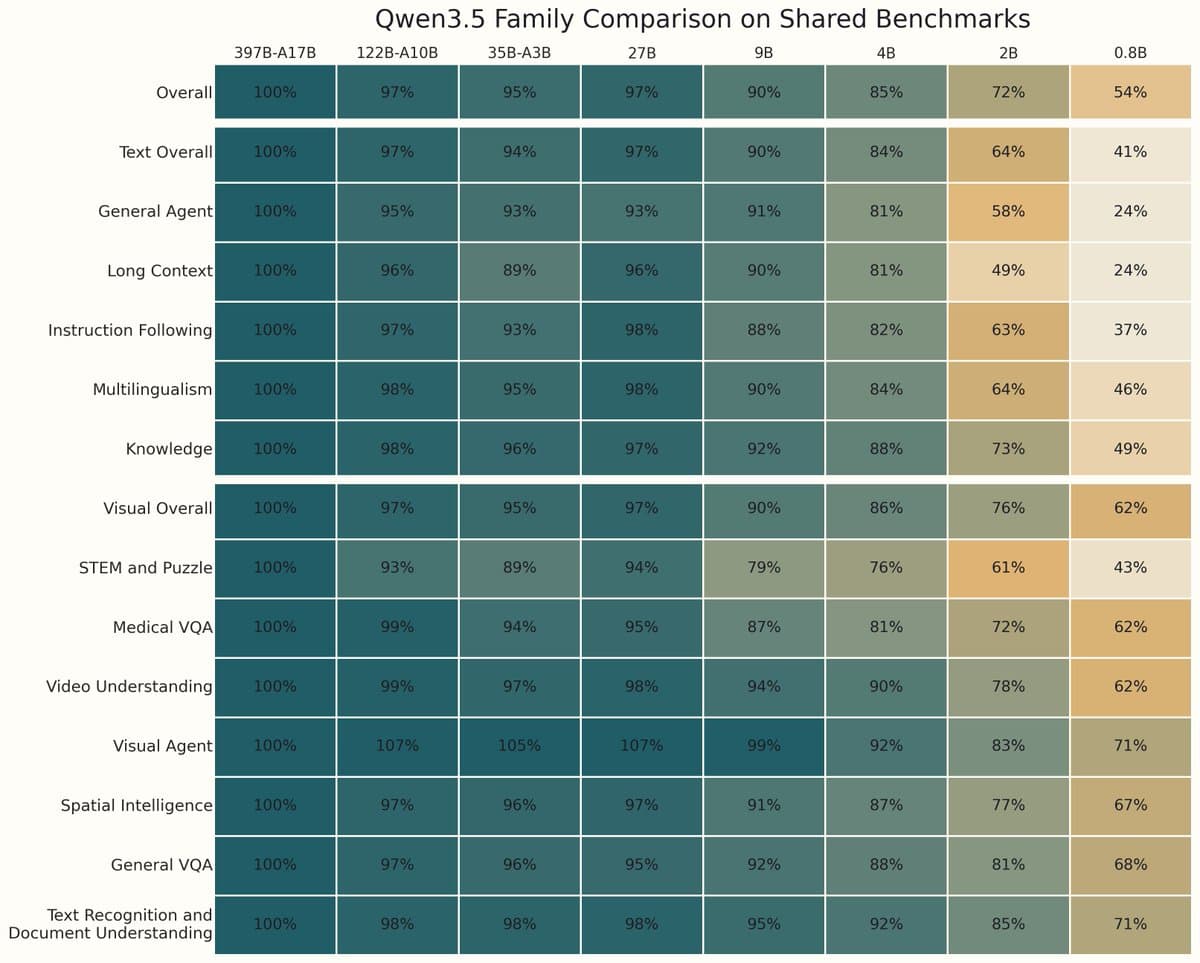
New benchmark comparisons of Alibaba's Qwen3.5 large language model family reveal a striking pattern: models with 27 billion parameters and above demonstrate substantially superior performance compared to their smaller counterparts. This analysis, shared via social media by AI researcher @kimmonismus, highlights a critical threshold in the model scaling curve where capabilities become "really useful" for practical applications.
The Benchmark Comparison
The shared benchmark data compares various Qwen3.5 model sizes across standardized evaluation metrics. While the specific benchmarks weren't detailed in the source, the clear conclusion is that models below 27B parameters show "noticeably less effective" performance across these shared measurements. This suggests that the 27B parameter mark represents a significant inflection point in the Qwen3.5 architecture's capability scaling.
Understanding the Scaling Dynamics
This finding aligns with broader research in large language model development, where performance doesn't scale linearly with parameter count. Instead, researchers have observed various "emergent abilities" that appear only after models reach certain size thresholds. The Qwen3.5 analysis suggests that 27B parameters represents one such critical threshold where the model transitions from limited utility to practical applicability.
The observation that "Qwen seems to be really useful from 27b upwards" indicates that this parameter count enables capabilities that smaller models simply cannot match. This could include improved reasoning, better instruction following, more coherent long-form generation, or superior performance on complex tasks that require multi-step processing.
Implications for Model Deployment
For organizations considering Qwen3.5 deployment, this analysis provides crucial guidance. Smaller models (below 27B parameters) may be suitable for limited applications where computational resources are severely constrained, but they come with significant performance trade-offs. The 27B+ models, while requiring more computational resources, offer substantially better return on investment for serious applications.
This threshold finding also has implications for:
- Cost-performance optimization: Organizations must weigh the computational costs of larger models against the performance benefits
- Deployment strategy: Different model sizes may be appropriate for different use cases within the same organization
- Research direction: Understanding why 27B represents a threshold could inform more efficient architecture designs
Competitive Landscape Context
The Qwen series represents China's most prominent open-source large language model initiative, competing with Western models like Llama, Mistral, and proprietary systems from OpenAI and Anthropic. Understanding its performance characteristics at different scales helps developers and researchers make informed choices about which models to adopt for specific applications.
This benchmark analysis comes at a time when the AI community is increasingly focused on finding optimal model sizes that balance capability with efficiency. The clear threshold at 27B parameters suggests that Alibaba's Qwen3.5 architecture may have particular scaling characteristics worth further investigation.
Practical Considerations for Developers
For developers working with Qwen3.5, this analysis suggests several practical considerations:
- Proof-of-concept projects might use smaller models, but production systems likely require 27B+ parameters
- Fine-tuning decisions should account for this performance threshold when selecting base models
- Infrastructure planning must accommodate the computational requirements of larger models
- Performance expectations should be calibrated according to model size
Looking Forward
As the Qwen series continues to evolve, future versions may alter this scaling dynamic. However, the current analysis provides valuable empirical evidence about where the "sweet spot" lies in the Qwen3.5 family. This information is particularly valuable given the open-source nature of these models, allowing for transparent evaluation and comparison.
The benchmark comparison shared by @kimmonismus contributes to the growing body of evidence that model size thresholds exist across different architectures, though the specific parameter counts where these thresholds occur may vary between model families and training approaches.
Source: Analysis shared by @kimmonismus on X/Twitter, evaluating Qwen3.5 model family performance across shared benchmarks.