In the rapidly evolving landscape of artificial intelligence, one of the most persistent challenges has been the efficient processing of long-context documents. As AI models increasingly handle lengthy texts—from legal documents and research papers to extended conversations and technical manuals—the computational costs have grown prohibitively expensive. Every additional token in the input contributes to quadratic attention costs, higher latency, and increased memory requirements, creating significant barriers to practical deployment.
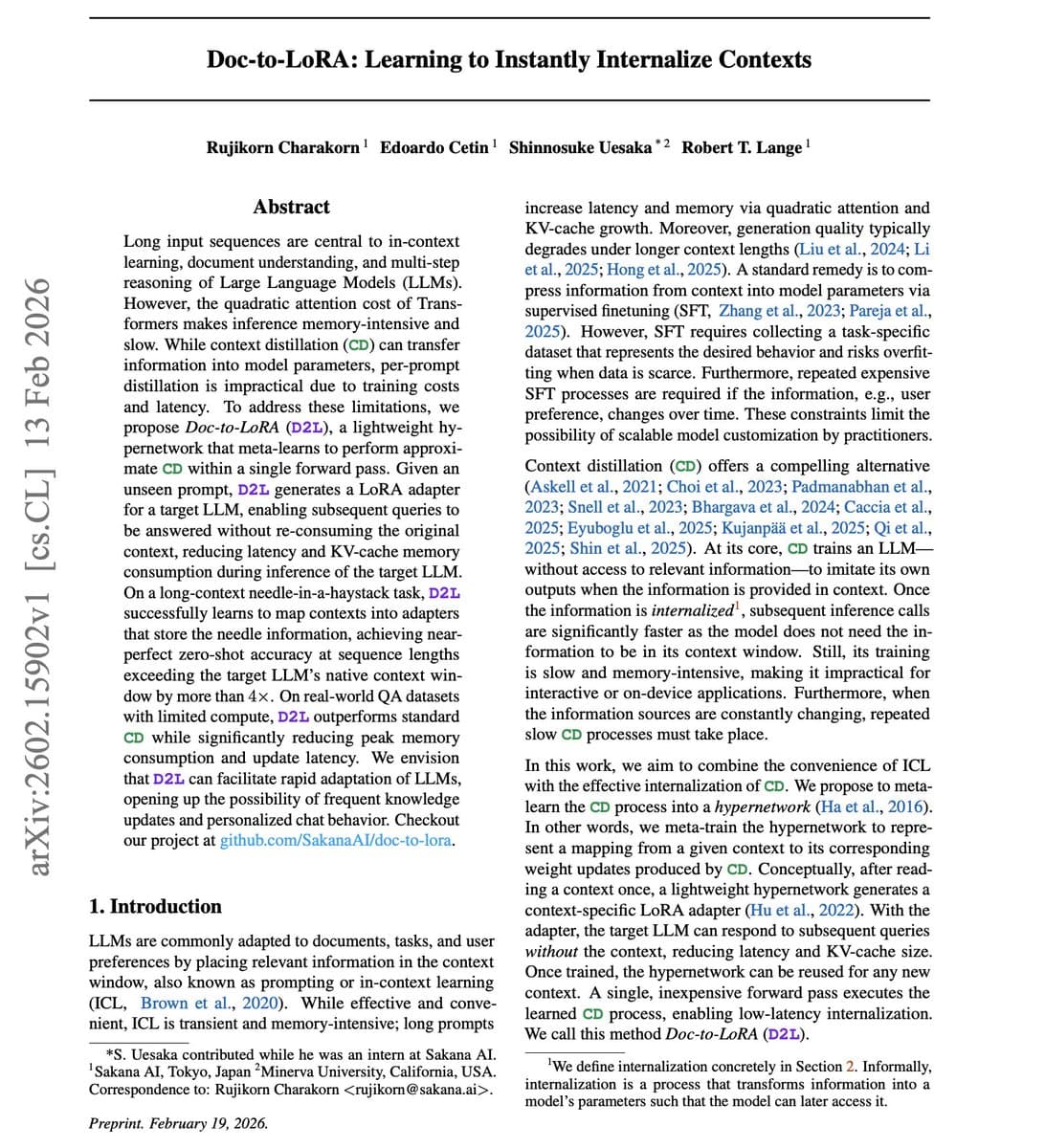
This week, Sakana AI has introduced a potentially transformative solution: Doc-to-LoRA, a lightweight hypernetwork that meta-learns to compress long documents into efficient Low-Rank Adaptation (LoRA) modules. This innovation represents a significant step forward in making long-context AI processing more accessible and sustainable.
The Long-Context Problem: Why It Matters
Modern transformer-based AI models, including the most advanced large language models (LLMs), face a fundamental scaling challenge when processing lengthy inputs. The attention mechanism that gives these models their remarkable capabilities comes with a computational cost that grows quadratically with input length. This means that doubling the length of a document increases computational requirements by approximately four times.
In practical terms, this quadratic scaling creates three major problems:
- Financial costs: Processing long documents becomes prohibitively expensive, especially at scale
- Latency issues: Longer processing times make real-time applications impractical
- Memory constraints: Hardware limitations restrict the maximum document length that can be processed
These limitations have forced developers to implement workarounds like document chunking, which often loses important contextual relationships between distant parts of a text.
How Doc-to-LoRA Works: A Technical Overview
Doc-to-LoRA addresses these challenges through an elegant architectural innovation. The system employs a hypernetwork—a neural network that generates the weights for another network—to meta-learn how to compress entire documents into compact LoRA adapters.
Here's the technical process:
- Document Encoding: The hypernetwork takes a long document as input and processes it through specialized encoding layers
- Adapter Generation: The system generates lightweight LoRA adapters that capture the essential information from the document
- Efficient Integration: These adapters can then be applied to a base model, effectively "teaching" it about the specific document without requiring expensive processing of the full text
What makes this approach particularly innovative is its meta-learning component. The system doesn't just compress documents; it learns how to compress documents effectively across different domains and document types. This means the approach becomes more efficient over time and can adapt to various use cases.
The LoRA Advantage: Why This Approach Matters
Low-Rank Adaptation (LoRA) has emerged as one of the most important techniques in efficient AI model adaptation. By freezing the original model weights and adding small, trainable rank decomposition matrices, LoRA enables significant model customization with minimal computational overhead.
Doc-to-LoRA extends this concept by:
- Automating adapter creation: Instead of manually training LoRA adapters, the hypernetwork generates them automatically from documents
- Optimizing for compression: The system is specifically designed to maximize information retention while minimizing adapter size
- Enabling rapid switching: Multiple document-specific adapters can be loaded and unloaded quickly, allowing for flexible document processing workflows
Practical Applications and Implications
The implications of this technology extend across numerous domains:
Legal and Research Applications
Legal professionals and researchers who regularly work with lengthy documents could see dramatic improvements in efficiency. Doc-to-LoRA could enable:
- Instant summarization of hundred-page legal briefs
- Efficient comparison of multiple research papers
- Rapid extraction of key information from technical documentation
Enterprise Knowledge Management
Companies maintaining extensive documentation could use this technology to create efficient, queryable knowledge bases without the computational overhead of traditional approaches.
Conversational AI Enhancement
Chatbots and virtual assistants could maintain longer conversation histories without the performance degradation that typically accompanies extended context windows.
Environmental Impact
By significantly reducing the computational requirements for long-context processing, Doc-to-LoRA could contribute to more sustainable AI practices, reducing the energy consumption associated with processing lengthy documents.
Challenges and Future Directions
While promising, Doc-to-LoRA faces several challenges that will need to be addressed:
- Information loss: Any compression technique risks losing nuanced information from the original document
- Generalization: The system must prove effective across diverse document types and domains
- Integration complexity: Seamlessly integrating with existing AI workflows will be crucial for adoption
Future research directions might include:
- Hybrid approaches combining Doc-to-LoRA with other efficiency techniques
- Domain-specific optimization for particular industries
- Real-time adaptation capabilities for streaming documents
The Broader Context: Efficiency as Innovation
Sakana AI's work on Doc-to-LoRA represents a growing recognition within the AI community that efficiency innovations are as important as capability improvements. As models grow larger and more capable, finding ways to make them more accessible and sustainable becomes increasingly critical.
This research aligns with broader trends in efficient AI, including:
- Model compression techniques
- Sparse attention mechanisms
- Hardware-aware optimization
- Energy-efficient training and inference
Conclusion
Doc-to-LoRA represents a significant step forward in addressing one of the most persistent challenges in modern AI: the efficient processing of long-context documents. By combining hypernetworks with LoRA adaptation in a meta-learning framework, Sakana AI has developed an approach that could dramatically reduce the computational costs associated with lengthy text processing.
As the AI field continues to evolve, innovations like Doc-to-LoRA remind us that progress isn't just about building more capable models—it's also about making existing capabilities more accessible, efficient, and sustainable. This research opens new possibilities for applications that require processing lengthy documents while pointing toward a future where AI can handle extensive context without prohibitive computational costs.
Source: Based on research from Sakana AI as reported by @omarsar0