Key Takeaways
- SemiAnalysis states NVIDIA's direct customer feedback is leading the industry toward disaggregated inference architectures.
- In this model, specialized LPUs can outperform GPUs for specific pipeline tasks.
What Happened
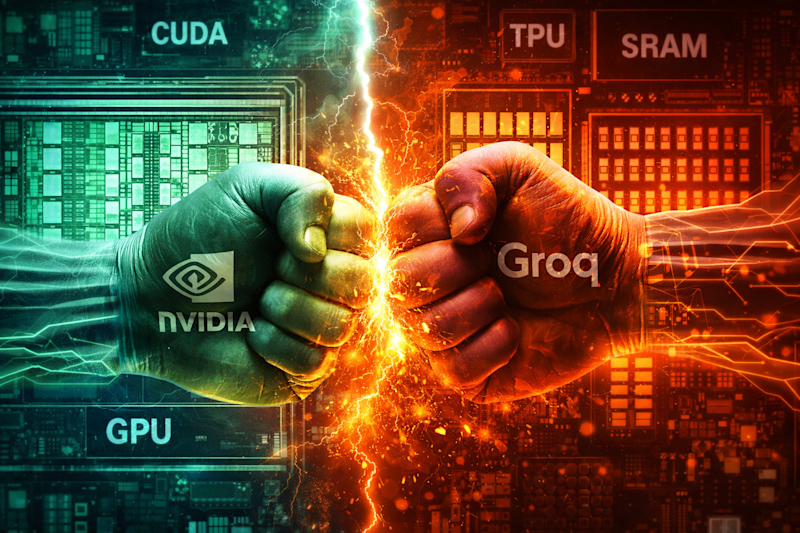
In a brief post on X, Dylan Patel of the semiconductor and AI research firm SemiAnalysis made a pointed claim about the future of AI inference hardware. He argued that NVIDIA's unparalleled access to direct customer requirements is driving a fundamental architectural shift: the move toward disaggregated inference. The core assertion is that in this emerging paradigm, specialized Language Processing Units (LPUs), like those developed by Groq, can surpass the performance of general-purpose Graphics Processing Units (GPUs) for certain stages of the AI inference pipeline.
The post links to a longer, paywalled analysis on the SemiAnalysis website, suggesting the tweet is a summary of a more detailed report on the topic.
Context: The Disaggregated Inference Debate
The concept of "disaggregated" or "heterogeneous" inference challenges the dominant model of running entire large language model (LLM) workloads on monolithic GPU clusters. Instead, it proposes splitting the inference pipeline across different types of specialized hardware. The theory is that different computational tasks—such as prompt preprocessing, token generation, and speculative decoding—have distinct optimal hardware profiles.
Proponents argue that while GPUs are incredibly versatile and powerful for the dense matrix multiplications at the heart of neural networks, they may not be the most efficient or lowest-latency option for every sub-task. This is where specialized inference engines like Groq's LPU, which uses a deterministic, single-core architecture focused on sequential token generation, claim an advantage for specific workloads.
NVIDIA's role, as highlighted by SemiAnalysis, is central. As the supplier of the vast majority of AI training and inference chips, NVIDIA has a unique, ground-level view of the performance bottlenecks, cost concerns, and architectural wishes of its massive cloud and enterprise customer base. The analyst's implication is that this intelligence is convincing NVIDIA itself that a one-size-fits-all GPU approach is not the endpoint for inference optimization.
gentic.news Analysis

This brief commentary from SemiAnalysis taps directly into the most consequential competitive undercurrent in AI hardware. While NVIDIA's H100 and B200 GPUs are undisputed kings of AI training, the inference market—projected to be vastly larger in volume—is where the architecture wars are heating up. Patel's claim that "NVIDIA knows more" is a strategic observation: it suggests the market leader's own data validates the need for alternatives, creating a paradoxical opening for competitors.
This aligns with a trend we've been tracking: the rise of inference-optimized silicon. In February 2026, we covered AMD's launch of the Inferna MI350X, which directly targeted NVIDIA's inference dominance with claimed 2x performance-per-watt gains on LLM serving. Similarly, Groq's LPU has consistently demonstrated record-breaking latency on public benchmarks like the Chatbot Arena, though often at the cost of throughput. The SemiAnalysis point reframes this not as a niche challenge, but as an inevitable fragmentation driven by end-user demand that NVIDIA itself can see.
However, NVIDIA is not a passive observer. This customer insight is precisely what fuels its own architectural evolution. The company's Grace Hopper Superchip and the integration of TensorRT-LLM and NIM microservices are early steps toward a more disaggregated software-defined pipeline within its own ecosystem. The real battle may not be GPU vs. LPU, but whether the disaggregation happens across vendor silos or is efficiently managed within NVIDIA's full-stack platform. If SemiAnalysis's report details specific customer asks pushing NVIDIA toward open heterogeneity, it would signal a significant shift in market dynamics.
Frequently Asked Questions
What is disaggregated inference?
Disaggregated inference is an architectural approach where the process of running a trained AI model (inference) is split across different types of specialized hardware, rather than running entirely on a cluster of identical GPUs. The goal is to assign each sub-task (e.g., context processing, token generation) to the chip best suited for it, optimizing for overall cost, latency, or energy efficiency.
What is an LPU and how is it different from a GPU?
An LPU, or Language Processing Unit, is a type of processor specifically designed for running large language model inference. Groq's LPU, for example, uses a unique single-core, deterministic architecture focused on minimizing latency for sequential token generation. A GPU (Graphics Processing Unit) is a massively parallel processor designed for flexible, high-throughput computation. GPUs are excellent for the varied math of AI training and inference but may introduce overheads that specialized LPUs avoid for specific tasks.
Is NVIDIA working on LPU-like technology?
NVIDIA has not announced a chip called an LPU. However, it is continuously evolving its GPU architecture and full software stack to optimize inference. Features like dedicated Transformer Engines in its latest GPUs, the Grace CPU for memory-intensive tasks, and its TensorRT-LLM software are all efforts to efficiently handle the entire inference pipeline. The company's strategy appears to be enhancing its integrated platform rather than creating a separate, specialized inference chip like Groq's LPU.
Does this mean GPUs are becoming obsolete for AI?
No. GPUs remain the essential workhorse for AI training and will continue to power a vast portion of inference workloads due to their versatility, mature software ecosystem, and scale. The argument from SemiAnalysis and others is that for large-scale, cost-sensitive, or latency-critical inference services, supplementing GPUs with other specialized processors in a disaggregated setup may become the optimal architecture.