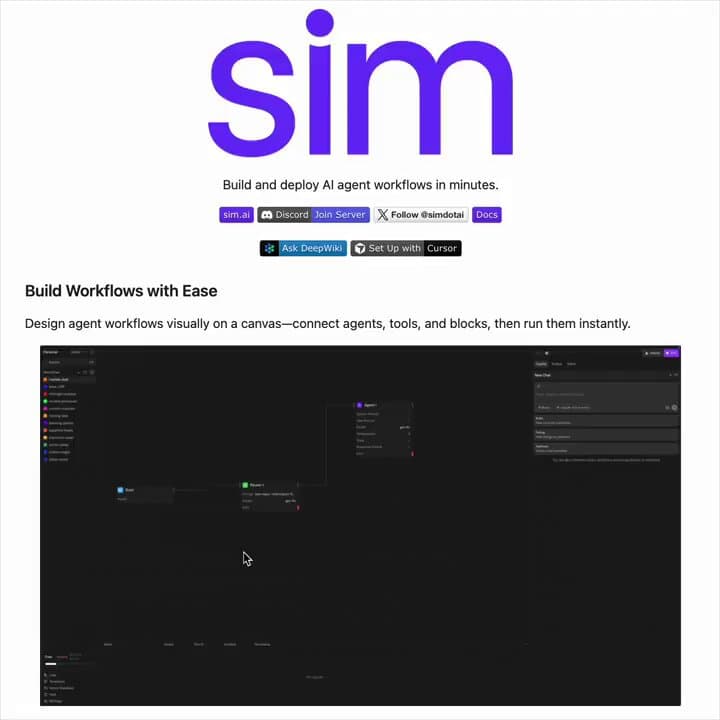
In the rapidly evolving landscape of artificial intelligence, a new contender has emerged that could democratize how developers build and deploy AI agent workflows. Sim, a 100% open-source platform featuring an intuitive drag-and-drop interface, has entered the market as a direct alternative to established workflow automation tools like n8n. Released under the permissive Apache 2.0 license, this development represents a significant shift toward accessible, customizable AI workflow creation.
What Is Sim and How Does It Work?
Sim presents itself as a visual workflow builder specifically designed for AI agent development. The platform's core innovation lies in its drag-and-drop interface that allows users to construct complex AI workflows without extensive coding knowledge. This approach mirrors the visual programming paradigm that has revolutionized other development domains, now applied specifically to AI systems.
Unlike proprietary alternatives, Sim's complete open-source nature means developers can inspect, modify, and distribute the software according to their needs. The Apache 2.0 license provides commercial flexibility while ensuring the code remains freely available—a crucial distinction in an industry increasingly concerned about vendor lock-in and transparency.
The Competitive Landscape: Sim vs. n8n
Sim positions itself as a direct alternative to n8n, a popular workflow automation platform that has gained traction in recent years. While n8n offers both cloud and self-hosted options with some open-source elements, Sim distinguishes itself through its complete open-source commitment and AI-specific focus.
The key differentiators include:
- Licensing philosophy: Sim's pure Apache 2.0 license versus n8n's more complex licensing structure
- AI-centric design: Built specifically for AI workflows rather than general automation
- Community-driven development: As a fully open-source project, Sim invites community contributions and modifications
- Transparency: Complete code accessibility for security auditing and customization
Technical Architecture and Capabilities
Based on the available information, Sim appears to offer a modular architecture where different AI components can be connected visually. The drag-and-drop interface likely supports:
- AI model integration: Connecting various machine learning models and APIs
- Data processing nodes: Transforming and preparing data for AI consumption
- Decision logic: Creating conditional workflows based on AI outputs
- External service connections: Integrating with databases, APIs, and other services
This visual approach reduces the technical barrier to creating sophisticated AI systems that would typically require extensive programming expertise. Developers can prototype, test, and deploy AI workflows more rapidly than with traditional coding approaches.
Implications for AI Development and Deployment
The emergence of Sim represents several important trends in the AI industry:
Democratization of AI Development
By providing a visual interface for building AI workflows, Sim lowers the entry barrier for developers and organizations wanting to implement AI solutions. This aligns with the broader movement toward making advanced technologies more accessible beyond specialized AI research teams.
Open-Source Momentum in AI
Sim joins a growing ecosystem of open-source AI tools challenging proprietary alternatives. This trend reflects increasing demand for transparency, customization, and community-driven innovation in AI infrastructure.
Workflow-First AI Design
The platform emphasizes that effective AI implementation often depends less on individual model performance and more on how multiple components work together in orchestrated workflows. This workflow-centric perspective represents a maturation in how we approach AI system design.
Customization and Control
For organizations with specific requirements or compliance needs, Sim's open-source nature allows for complete customization. This is particularly valuable in regulated industries or for applications requiring specialized security measures.
Potential Applications and Use Cases
Sim's workflow approach could benefit numerous applications:
- Customer service automation: Building multi-step AI agents that handle complex customer inquiries
- Content generation pipelines: Creating structured workflows for generating, editing, and publishing content
- Data analysis automation: Connecting data sources, processing steps, and visualization outputs
- Business process automation: Implementing AI-enhanced workflows for operational efficiency
- Research assistance: Creating reproducible AI workflows for scientific or academic research
Challenges and Considerations
While promising, Sim faces several challenges:
- Ecosystem maturity: As a new entrant, it lacks the extensive integrations and community resources of established platforms
- Documentation and support: Open-source projects often struggle with comprehensive documentation and user support
- Performance optimization: Visual workflow builders can sometimes introduce overhead compared to hand-coded solutions
- Adoption momentum: Convincing organizations to switch from established platforms requires demonstrating clear advantages
The Future of Visual AI Development
Sim represents a broader movement toward visual development tools in AI, similar to how tools like Unity revolutionized game development or Figma transformed interface design. As AI systems become more complex and interconnected, visual workflow builders may become essential tools for managing this complexity.
The platform's success will likely depend on several factors:
- Community growth: Whether developers contribute integrations, improvements, and documentation
- Enterprise adoption: If organizations find value in the open-source, customizable approach
- Feature development: How quickly the platform evolves to match and exceed proprietary alternatives
- Ecosystem partnerships: Integration with popular AI models, services, and platforms
Getting Started with Sim
For developers interested in exploring Sim, the project provides getting started resources through its official channels. The open-source nature means users can immediately begin experimenting with the platform without licensing restrictions or cost barriers—a significant advantage for individual developers, startups, and educational institutions.
As the AI landscape continues to evolve, tools like Sim that prioritize accessibility, transparency, and customization may play an increasingly important role in determining how broadly AI technologies are adopted and who gets to participate in their development.
Source: Based on information from Akshay Pachaar's announcement and Sim's project resources.