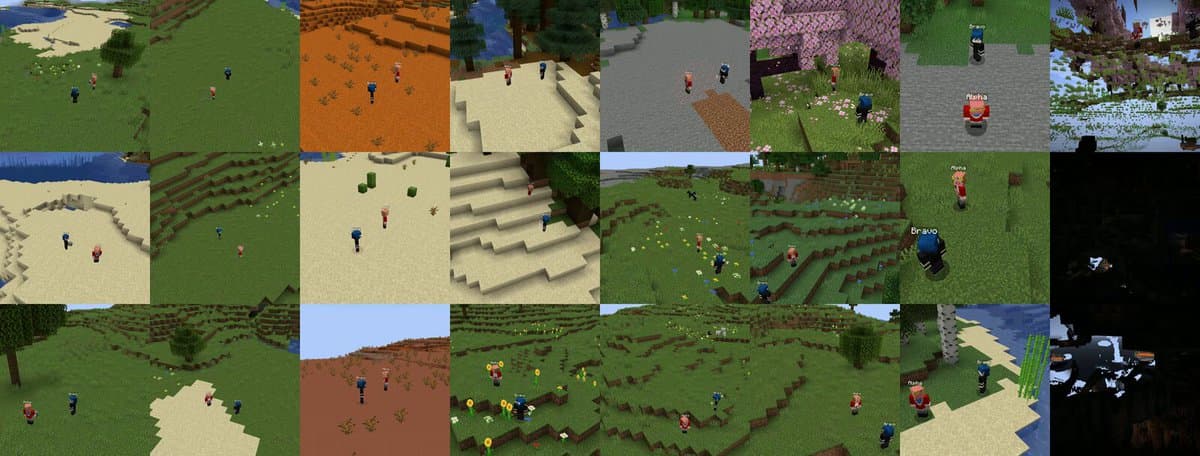
Researchers have achieved a significant milestone in artificial intelligence with the development of Solaris, the first multiplayer video world model designed specifically for Minecraft. This innovative system generates consistent multi-view observations across multiple players simultaneously, representing a major leap forward in creating interactive, shared virtual environments that maintain coherence from different perspectives.
What Makes Solaris Different
Traditional world models in AI typically focus on single-agent environments, where the AI system only needs to maintain consistency from one viewpoint. Solaris breaks new ground by handling multiple players at once, ensuring that what one player sees aligns logically with what other players experience in the same virtual space. This multiplayer consistency has been a longstanding challenge in AI research, as maintaining synchronized observations across different viewpoints requires sophisticated coordination and memory management.
The model was trained on an impressive 12.6 million frames of Minecraft gameplay using a staged pipeline approach. This extensive training dataset allows Solaris to understand the complex dynamics of Minecraft's block-based world, including terrain generation, resource gathering, crafting mechanics, and environmental interactions that vary depending on player actions.
Technical Innovations Behind the Breakthrough
Solaris employs several key technical innovations that enable its multiplayer capabilities. The system uses a novel approach called Checkpointed Self Forcing, a memory-efficient training method that helps maintain consistency across different player viewpoints while managing computational resources effectively. This technique allows the model to "remember" and coordinate what different players are experiencing without overwhelming system memory.
The staged pipeline approach divides the training process into distinct phases, each focusing on different aspects of the multiplayer experience. This methodical training strategy helps the model gradually build up its understanding of how player actions affect the shared environment and how those effects should appear from multiple perspectives simultaneously.
Why Minecraft as a Test Environment?
Minecraft serves as an ideal testing ground for multiplayer world models due to its open-ended nature, complex physics, and established multiplayer infrastructure. The game's block-based construction system creates predictable yet varied environments, while its survival and creative modes offer diverse gameplay scenarios that test different aspects of world modeling.
The game's popularity also means there's abundant training data available, and its relatively simple visual style (compared to photorealistic games) reduces some computational complexity while still presenting meaningful challenges for consistency maintenance. Minecraft's success as a platform for AI research has been demonstrated previously with projects like MineDojo and MineRL, but Solaris represents the first attempt at true multiplayer world modeling within this environment.
Implications for AI and Virtual Worlds
The development of Solaris has far-reaching implications beyond just gaming. This technology could fundamentally change how we build and interact with virtual environments across multiple domains:
Game Development: Solaris-like systems could enable more sophisticated non-player characters (NPCs) that understand multiplayer contexts, create more responsive game worlds, and potentially automate aspects of game testing and quality assurance.
Virtual Collaboration: As remote work and virtual meetings become more common, consistent multi-user virtual environments could enhance collaborative experiences in virtual offices, educational settings, and social platforms.
Robotics and Autonomous Systems: The principles behind Solaris could help robots and autonomous vehicles maintain consistent understandings of shared physical spaces, improving coordination in multi-agent systems.
AI Training Environments: More sophisticated world models could create better training grounds for other AI systems, allowing them to learn in rich, interactive environments that more closely resemble real-world complexity.
Challenges and Future Directions
While Solaris represents a significant achievement, several challenges remain. The current model focuses on observation consistency rather than full gameplay interaction, and scaling to more complex games with photorealistic graphics would require substantial additional development. There are also questions about how such systems would handle unpredictable player behavior or edge cases in the environment.
Future research will likely focus on expanding Solaris's capabilities to include more players, more complex game mechanics, and eventually different game environments entirely. Researchers may also explore how these world models can be used for predictive purposes—anticipating what players might do next based on their current actions and the shared environment state.
The Broader AI Research Context
Solaris emerges during a period of rapid advancement in world models and game-playing AI. Recent years have seen systems like DeepMind's AlphaStar for StarCraft II, OpenAI's Dota 2 bots, and various chess and Go programs demonstrate remarkable capabilities in complex game environments. However, most of these systems have focused on competitive scenarios rather than cooperative multiplayer experiences.
The development of Solaris suggests a shift toward more collaborative AI systems that can understand and participate in shared virtual spaces. This aligns with broader trends in AI research toward systems that can work alongside humans rather than simply competing against them.
As AI continues to advance, technologies like Solaris may help bridge the gap between single-agent intelligence and truly social, multi-agent systems that can navigate complex shared environments with human-like understanding of perspective and coordination.
Source: HuggingPapers announcement of Solaris, the first multiplayer video world model for Minecraft