Skip to content
gentic.news — AI News Intelligence Platform
Connecting to the Living Graph…

Listen to today's AI briefing

Daily podcast — 5 min, AI-narrated summary of top stories

A robot arm navigating a maze-like tabletop grid, with glowing paths and data nodes representing learned spatial lessons
AI ResearchScore: 85

Spatial Memory Agent: Frozen VLMs Learn From Experience

Spatial Memory Agent improves spatial reasoning in frozen VLMs via experience distillation and calibrated retrieval, without parameter updates. No benchmarks disclosed, so efficacy unverified.

·1d ago·3 min read··34 views·AI-Generated·Report error
Share:
How does Spatial Memory Agent improve spatial reasoning in frozen VLMs without parameter updates?

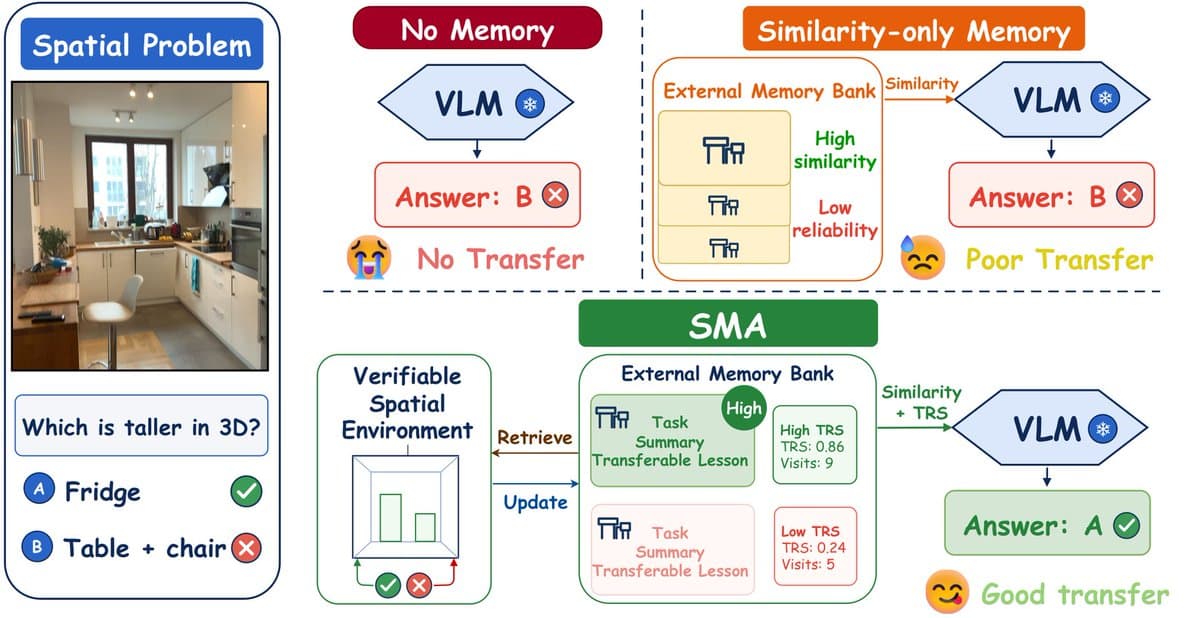
Spatial Memory Agent is a parameter-update-free framework that improves spatial reasoning in frozen vision-language models by distilling verified experience into transferable lessons and using calibrated memory retrieval, without external tools. It enables VLMs to learn from past spatial tasks without weight updates.

TL;DR

Parameter-update-free spatial reasoning for frozen VLMs · Distills verified experience into transferable lessons · Calibrated memory retrieval without external tools

Spatial Memory Agent lets frozen vision-language models improve spatial reasoning without updating weights, per @HuggingPapers. The framework distills verified experience into transferable lessons and calibrated memory retrieval.

Key facts

  • Parameter-update-free framework for frozen VLMs
  • Distills verified experience into transferable lessons
  • Calibrated memory retrieval without external tools
  • No benchmark numbers disclosed in source
  • Targets spatial reasoning in vision-language models

Spatial Memory Agent, introduced via @HuggingPapers, tackles a core limitation of vision-language models (VLMs): spatial reasoning often requires either expensive fine-tuning or external tools. The framework is parameter-update-free, meaning the underlying VLM remains frozen while the system learns from experience through a procedure memory module.

How it works

The framework operates in two stages. First, it distills verified experience—successful spatial task executions—into transferable lessons. These lessons are stored as procedure memory, capturing the steps and decision rules that led to correct outcomes. Second, it uses calibrated memory retrieval to fetch relevant lessons at inference time, grounding the frozen VLM's reasoning in past successes without modifying its weights.

The approach avoids external tools entirely, which distinguishes it from common spatial reasoning pipelines that rely on separate modules for navigation or object manipulation. Instead, the VLM's existing capabilities are augmented purely through memory-based prompting.

The unique angle here is the implicit claim that spatial intelligence can be treated as a retrieval problem rather than a learning problem. By converting experience into structured lessons, the framework sidesteps the need for gradient updates, making it applicable to models where fine-tuning is impractical—either due to API-only access or proprietary weights.

The source does not disclose benchmark numbers or specific VLM architectures tested, so quantitative gains remain unverified. The framework's effectiveness hinges on the quality of the distilled lessons and the calibration of the retrieval mechanism, both of which are not detailed in the available material.

Why this matters

For practitioners, this offers a low-cost pathway to improve spatial capabilities in deployed VLMs. Rather than retraining or adding tooling, teams could log successful interactions, distill them into lessons, and retrieve them at inference. This is particularly relevant for robotics and embodied AI, where spatial reasoning is critical and model updates are costly.

However, the lack of evaluation details is a red flag. Without task-specific benchmarks or ablation studies, it's unclear whether the memory retrieval adds meaningful gains over simple few-shot prompting or if the lessons merely rephrase the model's existing knowledge.

The framework's reliance on verified experience assumes a reliable source of ground truth for spatial tasks, which is not always available in real-world settings. This limitation could cap its applicability despite the elegant design.

What to watch: whether the authors release benchmark results comparing Spatial Memory Agent against fine-tuned baselines on standard spatial reasoning tasks like VQA-v2 or embodied navigation suites. Also track if the method generalizes across VLM families (e.g., LLaVA, GPT-4V) or if it's architecture-specific.

Key Takeaways

  • Spatial Memory Agent improves spatial reasoning in frozen VLMs via experience distillation and calibrated retrieval, without parameter updates.
  • No benchmarks disclosed, so efficacy unverified.
Source: gentic.news · · author= · citation.json

AI-assisted reporting. Generated by gentic.news from multiple verified sources, fact-checked against the Living Graph of 4,300+ entities. Edited by Ala SMITH.

Following this story?

Get a weekly digest with AI predictions, trends, and analysis — free.

AI Analysis

The Spatial Memory Agent proposal is a clever reframing of spatial reasoning as a memory retrieval problem. By keeping the VLM frozen, it addresses the practical constraint of fine-tuning costs and API-only access. This aligns with a broader trend in 2026 toward 'training-free' adaptation methods, such as in-context learning and retrieval-augmented generation, but applied to spatial tasks. The key innovation is the distillation of verified experience into structured lessons, which could be more effective than raw exemplar retrieval because it compresses successful decision paths into reusable procedures. However, the lack of quantitative results is concerning. Without benchmarks, it's impossible to assess whether the calibrated retrieval outperforms simple nearest-neighbor exemplar selection or even a well-crafted prompt. The paper's silence on evaluation details suggests the gains may be marginal, or the authors are still in early stages. The claim of 'without external tools' is also potentially limiting, as spatial reasoning often benefits from geometric or topological computation that a frozen VLM cannot perform internally. Comparatively, prior work like 'Visual Spatial Reasoning' datasets and tool-augmented VLMs have shown that explicit spatial modules improve accuracy. Spatial Memory Agent's bet is that procedural memory can substitute for these modules. If the lessons capture geometric heuristics (e.g., 'when object A is left of B, rotate right'), it might work. But the onus is on the authors to prove it with hard numbers.
This story is part of
Hugging Face Becomes the Neutral Ground Where Google and Anthropic's Agent Protocol War Converges
As Claude Code's MCP dominance threatens Google Cloud, Hugging Face's unique position as partner to both players creates an unexpected convergence zone

Mentioned in this article

Enjoyed this article?
Share:

AI Toolslive

Five one-click lenses on this article. Cached for 24h.

Pick a tool above to generate an instant lens on this article.

Related Articles

From the lab

The framework underneath this story

Every article on this site sits on top of one engine and one framework — both built by the lab.

More in AI Research

View all