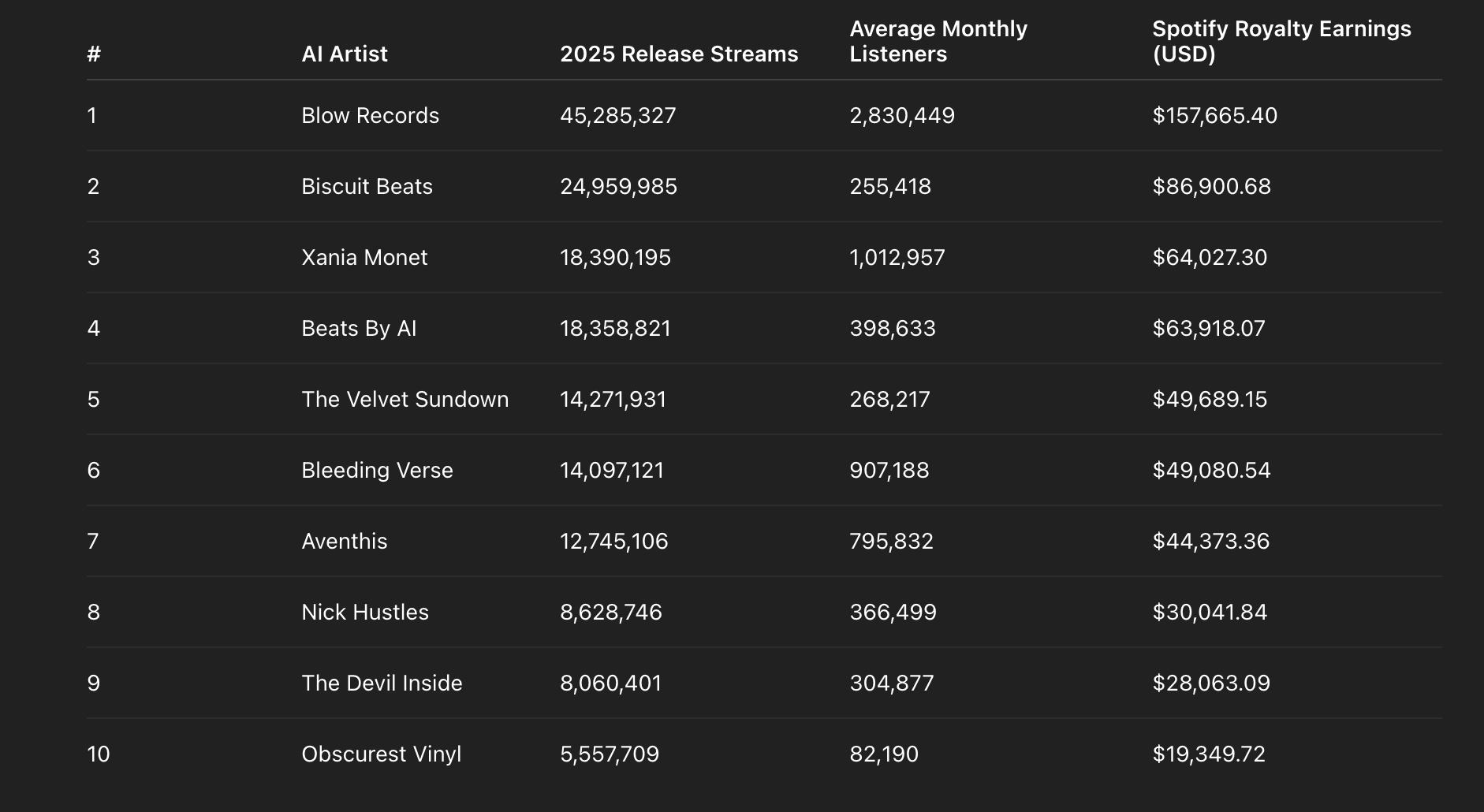
A report highlighted by AI commentator Rohan Paul claims that the rapid growth of AI-generated music on Spotify is having a direct and significant financial impact, redirecting millions of dollars in royalty payments away from human musicians and toward the creators of AI content.
The source points to an underlying article detailing this shift, suggesting the platform's algorithmic promotion and user consumption of AI tracks is now substantial enough to alter the distribution of the streaming revenue pool.
What the Report Claims
The core claim is straightforward: money that previously flowed to human artists as royalties for streams of their music is now being earned by those who produce and upload AI-generated tracks to the platform. The scale is described as "millions of dollars," indicating this is not a niche experiment but a material economic shift within Spotify's ecosystem.
This redirection occurs because Spotify's royalty model distributes its total royalty pool based on a track's share of total streams. As AI-generated songs accumulate plays—whether through organic discovery, playlist inclusion, or algorithmic recommendation—they claim a larger portion of the fixed pie, reducing the share available for human-created music.
Context: Spotify's AI Music Landscape
This development follows Spotify's aggressive moves into AI audio over the past two years. In 2024, the company launched its AI Playlist feature, allowing users to generate playlists via text prompts. More significantly, it has been testing tools that allow users to create full music tracks using AI from within the app, blurring the line between consumption and creation.
The platform has also been home to viral AI music acts and "soundalike" tracks for years, often existing in a legal gray area. The reported financial shift suggests these tracks are moving from being curiosities to becoming mainstream listening options that compete directly with human artists for listener attention and revenue.
The Mechanics of the Shift
The redirection of royalties operates through Spotify's standard pro-rata payment system. Key factors likely accelerating this shift include:
- Lower Production Cost & Volume: AI enables the rapid creation of vast music catalogs at near-zero marginal cost after initial model training, flooding the platform with new content.
- Algorithmic Optimization: AI music can be engineered (e.g., via prompt tuning and audio analysis) to match the sonic characteristics that Spotify's recommendation algorithms favor, potentially giving it a discovery advantage.
- Functional Music Demand: A significant portion of streaming is for background listening (focus, sleep, exercise). AI is particularly adept at generating endless, mood-matched instrumental content for these use cases, directly competing with human-made ambient and lo-fi genres.
Immediate Reactions and Implications
For the music industry, this report quantifies a long-feared scenario. Artist advocacy groups have repeatedly warned that generative AI could devalue human artistry and disrupt royalty streams. This claim provides a concrete, financial dimension to that concern, suggesting the disruption is already underway on one of the world's largest music platforms.
The report will likely intensify debates around:
- Platform Policy: Should Spotify implement separate royalty pools or tagging systems for AI-generated content?
- Artist Compensation: How should streaming deals be renegotiated to protect human artists in an era of synthetic competition?
- Listener Transparency: Should platforms be required to clearly label AI-generated music?
gentic.news Analysis
This report, if verified, marks a critical inflection point in the generative AI revolution: the moment its economic impact on a creative profession moves from theoretical warning to reported financial reality. It directly connects the technical capability of AI music models (like Google's Lyria, Meta's AudioCraft, and startups like Suno and Udio) to a tangible market outcome—the redistribution of royalty payments.
This aligns with broader trends we've covered where AI begins to capture economic value within existing digital marketplaces. We've seen similar dynamics in stock photography (with AI art on platforms like Shutterstock), voice acting (with synthetic voice libraries), and commercial writing. The music industry, with its well-established, data-rich streaming economy, was always a prime candidate for this type of displacement.
The key question this raises is about platform incentives. Spotify's goal is to maximize user engagement and subscription retention. If AI-generated, mood-specific playlists keep users listening longer at a lower licensing cost, the platform's economic interests may inadvertently align with AI creators over traditional rights holders. This creates a fundamental tension that the next round of licensing negotiations between Spotify and major record labels will have to address.
Furthermore, this development contradicts some early, optimistic narratives that AI would merely be a tool for human artists. While that use case exists, this report suggests a parallel, competitive ecosystem is emerging where AI is not the brush but the painter, competing directly for the same revenue stream.
Frequently Asked Questions
How does Spotify pay royalties for AI-generated music?
Spotify uses a pro-rata model. All subscription and ad revenue goes into a pool, which is distributed to rights holders based on their share of total streams. If an AI-generated track gets 0.1% of all Spotify streams, its uploader/rights holder gets 0.1% of the royalty pool. There is currently no separate pool or different rate for AI-generated content.
Is AI-generated music legal on Spotify?
The legality is complex and depends on the training data and output. Spotify's terms require uploaders to own the rights to their content. AI music that directly infringes on an artist's copyright (e.g., a deepfake vocal clone used without permission) can be taken down. However, AI music in a general style or genre, or using properly licensed voice models, exists in a permissible gray area, which is how millions of such tracks are currently on the platform.
What can human musicians do about this?
Artists and labels are pushing for several changes: (1) Transparency, demanding clear labeling of AI-generated content; (2) Policy, advocating for separate royalty pools or a lower payout rate for AI streams; and (3) Legal, strengthening copyright law to protect artist identity and style from unauthorized AI mimicry. The outcome will largely depend on collective bargaining power during platform licensing deals.
Does this mean AI will replace human musicians?
Not entirely, but it reshapes the industry. AI is likely to dominate certain functional, background music segments (e.g., generic workout or sleep playlists) due to cost and scale. This will pressure human artists in those genres. However, music with strong human narrative, cultural connection, live performance, and fan communities will remain resilient. The industry will bifurcate, with AI handling high-volume, utilitarian audio and humans focusing on scarce, authentic artistry.