A new reinforcement learning (RL) algorithm called Sequence-Level Proximal Policy Optimization (SPPO) promises to dramatically accelerate the fine-tuning of language models on complex reasoning tasks. By reformulating multi-step reasoning as a sequence-level contextual bandit problem, SPPO enables stable, single-sample updates, achieving a 5.9× speedup over the popular Group Relative Policy Optimization (GRPO) method while matching its performance on key mathematical reasoning benchmarks.
The work, detailed in a paper shared on X, addresses a critical bottleneck in aligning LLMs with human feedback: the high computational cost and instability of traditional RL fine-tuning, especially for long-horizon tasks like solving math problems.
Key Takeaways
- Researchers introduced SPPO, a sequence-level PPO algorithm that reformulates reasoning as a contextual bandit.
- It achieves a 5.9x speedup over GRPO while matching performance on AIME, AMC, and MATH benchmarks at 1.5B and 7B scales.
What the Researchers Built: A Faster RL Fine-Tuning Engine

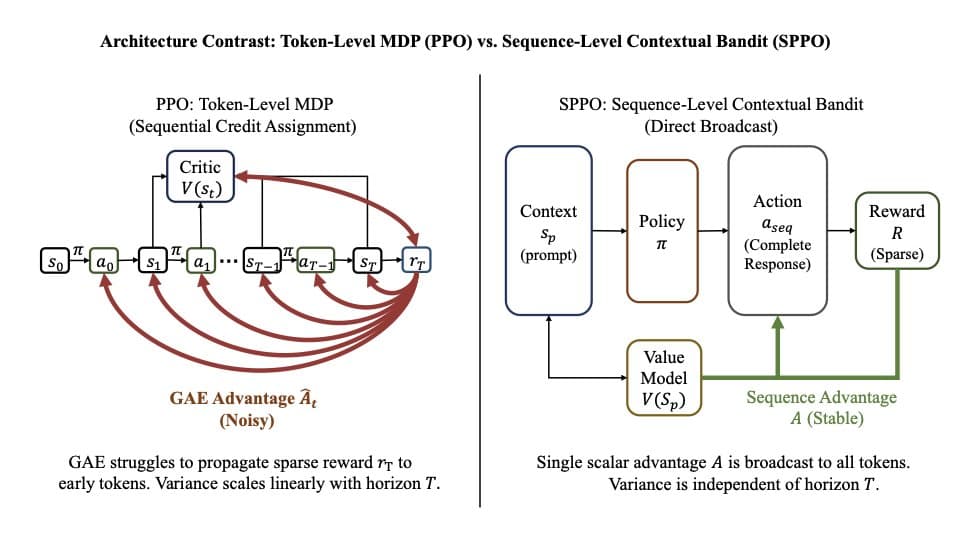
The core innovation of SPPO is a shift in perspective. Instead of treating each token generation as a separate step in a complex RL environment (a token-level Markov Decision Process), SPPO treats the generation of an entire reasoning chain—a complete answer to a math problem—as a single action in a sequence-level contextual bandit. This fundamental reformulation simplifies the credit assignment problem and allows the algorithm to learn from a single complete sequence, rather than requiring rollouts and value estimation across dozens of intermediate tokens.
This approach directly targets the inefficiency of methods like PPO and GRPO, which can require multiple model passes and extensive sampling for a single update, making RL training prohibitively expensive for many research groups and companies.
Key Results: Matching Performance, Slashing Time
The team evaluated SPPO against GRPO, a recent and efficient RLHF method, on standard mathematical reasoning benchmarks:
- AIME 2024 & 2025 (American Invitational Mathematics Examination)
- AMC 2023 (American Mathematics Competitions)
- MATH-500
Tests were conducted at two model scales: 1.5 billion and 7 billion parameters. The results show a clean trade-off reset:
AIME24/25, AMC23, MATH500 1.5B Baseline Matched Performance Parity AIME24/25, AMC23, MATH500 7B Baseline Matched Performance Parity Training Efficiency 1.5B & 7B 1x (Baseline) 5.9x faster 5.9× SpeedupThe headline result: SPPO achieved equivalent final performance on all benchmarks while requiring 5.9 times less training time than GRPO. This is not a minor optimization; it represents a potential reduction in training costs and carbon footprint by nearly 85% for the RL phase of model alignment.
How It Works: From Token-Level MDP to Sequence-Level Bandit
Traditional RLHF fine-tuning with PPO frames text generation as a sequential decision-making process. The "state" is the current context and generated tokens, an "action" is choosing the next token, and a "reward" is typically given only at the very end of a sequence (e.g., for a correct final answer). This creates a sparse and delayed reward problem, making training unstable and sample-inefficient.
SPPO's key technical maneuver is to collapse this long horizon. It treats the entire sequence (e.g., a full step-by-step solution) as a single, compound action. The algorithm:
- Samples a complete sequence from the model given a prompt (problem).
- Evaluates the sequence with a reward model (or outcome), assigning a single score for the entire output.
- Performs a policy update using this sequence-level reward, optimizing the likelihood of generating high-reward sequences in the future.
This method leverages the REINFORCE gradient estimator but incorporates crucial stability techniques from PPO, such as clipping and a baseline (value function), applied at the sequence level. The "contextual bandit" framing is apt: the problem (prompt) is the context, the chosen action is the full output sequence, and the reward is immediately observed.
Why It Matters: Cheaper, More Accessible RL Alignment

The high computational barrier to RLHF has created a divide. Large well-funded labs can run massive PPO jobs, while smaller entities often settle for simpler, less effective techniques like Direct Preference Optimization (DPO). SPPO, by drastically reducing the cost of sequence-level policy optimization, could democratize access to high-quality RL fine-tuning.
For practitioners, this means the potential to:
- Iterate faster on reward modeling and alignment techniques.
- Fine-tune larger models with RL where it was previously too costly.
- Explore RL on more tasks beyond chat, like code generation, long-form writing, and strategic planning, where long-horizon reasoning is essential.
The work also provides a compelling alternative to the trend of reward-free methods like DPO and ORPO. It suggests that with the right algorithmic reformulation, traditional reward-based RL can be made highly efficient and remain competitive.
gentic.news Analysis
SPPO arrives at a pivotal moment in the RLHF landscape. The field has been bifurcating between heavyweight PPO-based pipelines run by giants like OpenAI and Anthropic, and the lightweight, reward-free DPO paradigm that dominates open-source efforts. SPPO, developed by researchers from Peking University and Microsoft Research Asia, offers a third path: retaining the theoretical grounding and flexibility of reward-based RL while attacking its core computational inefficiency.
This development directly connects to our previous coverage of GRPO, which itself was a simplification of PPO designed for efficiency. SPPO can be seen as the next logical step in this lineage—aggressively optimizing for speed without sacrificing outcome. It also aligns with the broader industry trend, noted in our analysis of Mistral AI's and Google's recent releases, of prioritizing inference and training efficiency alongside raw capability.
Practically, SPPO's sequence-level bandit formulation may have limits. It inherently assumes the reward for a sequence is holistic and not easily decomposed, which works well for final-answer correctness but may be less ideal for tasks requiring fine-grained, step-by-step feedback. The next test will be its application to more subjective domains like helpfulness and harmlessness, where reward models are noisier. If SPPO proves robust there, it could become a standard tool, shifting the calculus for when to apply RLHF in the model development stack.
Frequently Asked Questions
What is the difference between SPPO and DPO?
SPPO and DPO (Direct Preference Optimization) are both methods for aligning language models with human preferences, but they take fundamentally different approaches. DPO bypasses the need for a separate reward model by directly using pairs of preferred and dispreferred outputs to tweak the model. SPPO, in contrast, still uses a reward model but reformulates the RL problem to make training much faster. SPPO retains the flexibility of using any reward signal (including synthetic ones), while DPO is tied to pairwise comparison data.
How does a 5.9x speedup in training translate to cost savings?
A 5.9x reduction in training time translates almost directly to a proportional reduction in the cost of cloud GPU compute. If a GRPO fine-tuning run costs $10,000 in compute, an equivalent SPPO run would cost roughly $1,700. This also means experiments can be completed in a fraction of the time, accelerating research and development cycles significantly.
Can SPPO be used for tasks other than math reasoning?
The paper demonstrates SPPO on mathematical reasoning, a classic long-horizon task. The method's principles are general, however. It should be applicable to any task where a complete output (a code file, a story, a strategic plan) can be assigned a holistic reward. Its performance on more nuanced tasks like open-ended dialogue or creative writing, where rewards are fuzzier, remains an open and interesting research question.
Is SPPO an open-source method?
While the research paper is publicly available, the implementation status is not specified in the source tweet. Typically, research of this nature from academic and industry labs like Microsoft Research is accompanied by code releases on platforms like GitHub. Practitioners should watch for an official code repository to experiment with the method themselves.