What Happened
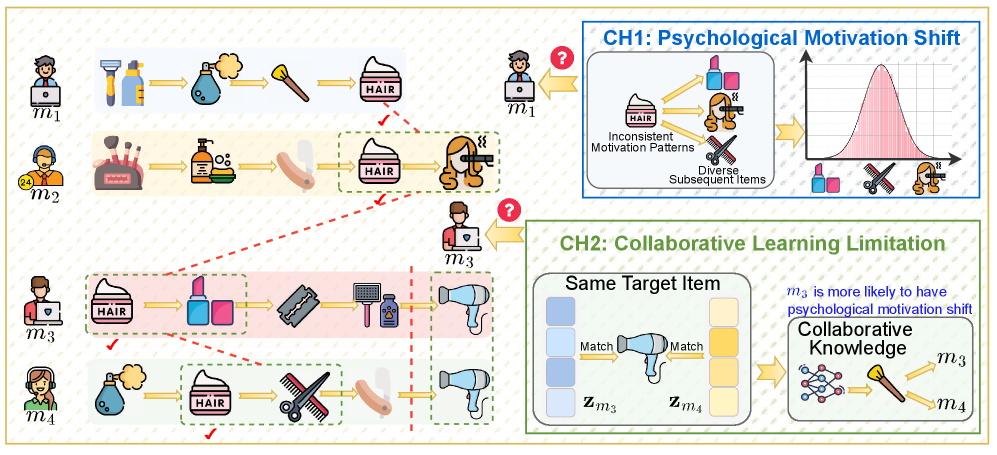
A research team has introduced SRSUPM (Sequential Recommender System Based on User Psychological Motivation), a novel framework designed to address a fundamental limitation in current recommendation systems. Published on arXiv in February 2026, the paper argues that most sequential recommenders fail to explicitly model the psychological motivation shifts that drive user behavior over time.
Traditional sequential recommenders typically compress a user's recent interaction history into a single embedding vector, which is then optimized to predict the next item. While effective in many scenarios, this approach treats user intent as relatively static, potentially missing nuanced changes in what motivates a user from one session to the next.
Technical Details
The SRSUPM framework introduces several key components to model psychological motivation shifts more effectively:
Psychological Motivation Shift Assessment (PMSA): This module quantitatively measures the degree of psychological motivation shift between user interactions. Instead of assuming uniform intent, it identifies when and how significantly a user's underlying motivations have changed.
Shift Information Construction: Guided by the PMSA, this component models dynamically evolving multi-level shift states. It creates representations that capture not just what a user did, but the context of change surrounding those actions.
Psychological Motivation Shift-driven Information Decomposition: This technique decomposes and regularizes user representations across different shift levels. By separating information according to motivation stability versus change, the system can maintain consistent aspects of user preference while adapting to evolving interests.
Psychological Motivation Shift Information Matching: This component strengthens collaborative patterns that are sensitive to psychological motivation shifts. It helps the system learn more discriminative user representations by identifying users with similar motivation evolution patterns, even if their surface-level behaviors differ.
The researchers validated their approach through extensive experiments on three public benchmarks, demonstrating that SRSUPM consistently outperforms representative baseline methods across diverse sequential recommendation tasks.
Retail & Luxury Implications
While the paper presents a general framework applicable to any sequential recommendation scenario, the implications for retail and luxury are particularly significant:
Understanding the Luxury Customer Journey: High-value purchases in luxury retail are rarely impulsive; they often represent the culmination of evolving motivations. A customer might begin researching handbags for practical reasons (need for a work bag), then shift toward status considerations, and finally focus on craftsmanship and heritage. SRSUPM's ability to detect these motivation shifts could help luxury brands understand the psychological journey leading to purchase decisions.
Personalization Beyond Surface Behavior: Current recommendation systems in luxury e-commerce often rely on similarity metrics ("customers who viewed this also viewed") or basic sequential patterns. SRSUPM offers the potential to understand why a customer's browsing pattern changed—did they shift from exploring classic styles to avant-garde pieces because of changing self-perception, social influences, or seasonal trends? This deeper understanding could enable more sophisticated personalization that anticipates rather than reacts to customer needs.
Managing Multi-Category Relationships: Luxury customers often engage with multiple categories (ready-to-wear, accessories, beauty, home). A motivation shift from "building a professional wardrobe" to "curating a personal aesthetic" might manifest across categories. SRSUPM's framework could help identify these cross-category motivation patterns, enabling more coherent omnichannel recommendations.
Seasonal and Trend Adaptation: The fashion industry operates on seasonal cycles where customer motivations naturally shift (from winter practicality to spring renewal to summer social display). Explicit modeling of motivation shifts could help systems better anticipate and respond to these cyclical changes in user psychology.
Challenges for Implementation: The practical application of SRSUPM in luxury retail would require significant adaptation. The framework assumes access to detailed sequential interaction data, which luxury brands may have in digital channels but less so in physical retail. Additionally, the "psychological motivation" construct, while theoretically valuable, would need operational definition specific to luxury contexts—what specific motivations drive luxury purchases, and how do they shift?